

Table of Contents
- 1. Anchor a Room with a Single Statement Piece
- 2. How to Curate a Gallery Wall with Cultural Art
- 3. Layer Textures: Woven, Mudcloth, and Canvas
- 4. Best Practices for Displaying Canvas Art
- 5. Use Neutral Backgrounds to Make Art Pop
- 6. Rental-Friendly Hanging Solutions That Preserve Heritage Art
- 7. Is Heritage Decor Worth the Price?
- Frequently Asked Questions
Last Updated: September 12, 2026
1. Anchor a Room with a Single Statement Piece
The most effective way to style black heritage wall art is to let one commanding piece of black heritage wall art carry the entire wall. Designers consistently recommend this approach over filling space with multiple smaller pieces.

A single large work, like the Harriet Tubman Relief Art ($240.00), creates a focal point that draws the eye immediately. This 39" x 29" framed piece by artist D.D. Ike uses relief sculpting to give the Underground Railroad narrative real physical depth.

Why One Large Work Beats a Cluttered Wall
Over-decorating with too many pieces diminishes the impact of heritage art. Noirci Studio's guidance on heritage art display recommends limiting displays to one to three pieces per wall for a modern aesthetic. The restraint lets each work breathe.
2. How to Curate a Gallery Wall with Cultural Art
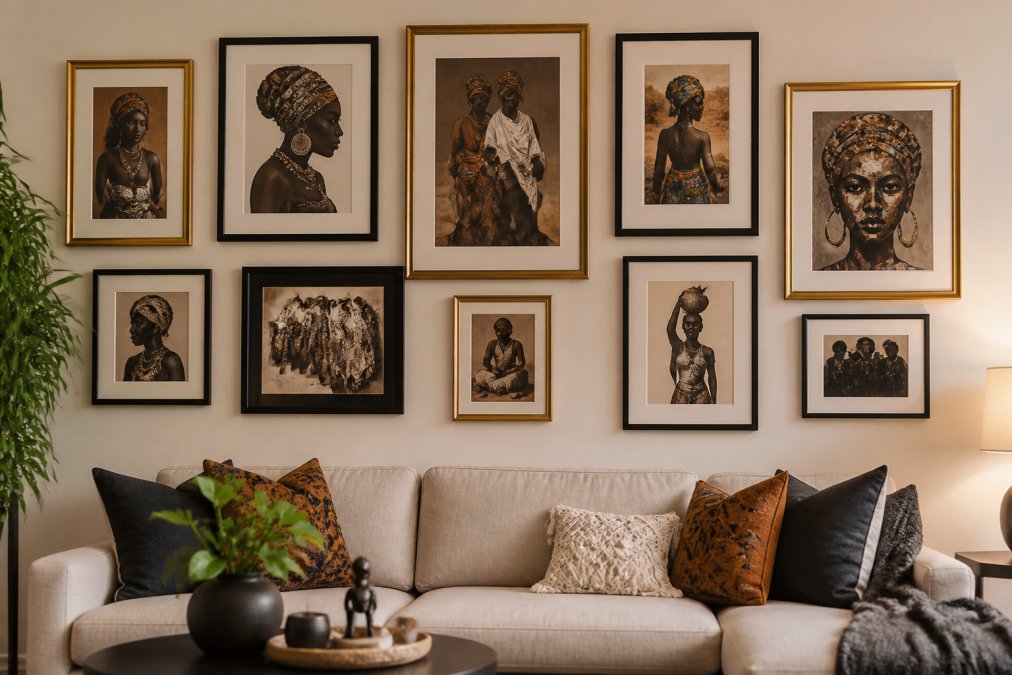
A gallery wall lets you tell a layered story through multiple works, but with heritage art the arrangement has to solve a problem most generic gallery-wall guides ignore: you are often mixing framed paper prints, stretched canvas, and textile pieces that each have different weight, fragility, and light sensitivity. Plan the layout around those material differences, not just around frame sizes.
Planning Your Layout Before You Hang
Measure your wall space, then map the arrangement on paper or with painter's tape. Keep consistent spacing between frames, typically 2 to 3 inches. Anchor the grouping at eye level, roughly 57 inches from the floor to the center of the arrangement.
For heritage pieces, add two planning steps before you commit:
- Group by material, not just by size. Keep delicate works on paper and unframed textiles away from high-traffic corners and doorways where they can snag or brush against clothing.
- Assign the heaviest piece to a stud. A 39" x 29" framed relief work like the Harriet Tubman piece carries real weight; a lightweight 11" x 14" canvas does not. Mark stud locations with a stud finder before you tape the layout, because the stud positions may force you to shift the whole arrangement a few inches.
Mixing Frames, Sizes, and Textures
Vary frame finishes (matte black, warm gold, natural wood) and mix orientations. A large horizontal canvas paired with smaller vertical portraits creates visual balance. The goal is rhythm, not symmetry.
When heritage textiles are part of the grouping, treat them as the anchor rather than an afterthought. A mudcloth panel or woven piece usually reads larger than its dimensions because of pattern density, so give it more breathing room than you would give a same-size print. A common pattern is to place the textile at one end of the arrangement and let framed works step down in size away from it.
Protecting Heritage Materials Inside the Arrangement
This is where heritage gallery walls diverge from standard decor advice. Works on paper and textiles age differently, and the two biggest enemies are ultraviolet light and fluctuating humidity.
- UV-filtering glazing: For signed prints, photographs, and works on paper, ask for UV-filtering glass or acrylic when framing. It will not stop all fading, but it slows the process significantly compared with standard glass.
- Keep textiles off exterior walls: Exterior walls run cooler and damper in winter and warmer in summer. A mudcloth or woven piece hung directly on an exterior wall in a humid climate is more prone to mildew and fiber breakdown than the same piece on an interior wall.
- Avoid direct sun and heat sources: Do not place the arrangement where morning or afternoon sun hits it directly, and keep it away from fireplaces, radiators, and forced-air vents.
- Rotate the grouping: If one piece is especially light-sensitive, rotate it out of the direct-light position every few months and swap in a less fragile work.
Spacing and Alignment Cheat Sheet
- Between frames: 2 to 3 inches for a tight, modern look; 3 to 4 inches if any piece is a textile or has a deep frame.
- Above furniture: Leave 6 to 10 inches between the bottom of the lowest frame and the top of a sofa or console.
- Center height: 57 inches from the floor to the center of the arrangement is the standard gallery benchmark; adjust up if your ceilings are tall and the wall feels bottom-heavy.
3. Layer Textures: Woven, Mudcloth, and Canvas
Texture separates a styled wall from a flat one. Eleano's Gallery guide to Black wall artwork notes that pieces with softer textures, such as charcoal drawings, textile works, or paintings with subtle surface variations, enhance home environments more than uniform finishes.
Pair a smooth canvas print with a woven basket or mudcloth textile hung nearby. The contrast between matte canvas and dimensional fiber adds depth that photographs alone cannot achieve.
4. Best Practices for Displaying Canvas Art
Canvas prints need different handling than framed paper art. The Coat of Many Colors Canvas ($35.00) by Thomas Blackshear shows how an 11" x 14" canvas can hold a wall without a frame. But the real difference between a canvas that looks sharp in ten years and one that looks tired in three is how you hang it, light it, and care for it, and how you frame it if you decide to.

Lighting and Placement That Protects Your Piece
Keep canvas art out of direct sunlight, which fades pigment over time. LED track lighting angled at 30 degrees from the wall highlights texture without glare. Avoid hanging canvas above heat sources like fireplaces or radiators.
A few placement rules that matter more for canvas than for framed prints:
- Stay off exterior walls in humid climates. Canvas is stretched over a wooden frame, and that frame absorbs and releases moisture. On a damp exterior wall, the stretcher bars can warp and pull the canvas out of square.
- Leave an air gap behind the canvas. Rubber bumpers on the bottom corners hold the canvas slightly off the wall, which lets air circulate and prevents a moisture trap.
- Keep canvas out of kitchens and bathrooms. Grease aerosol and steam both settle into the weave and are difficult to remove without damaging the surface.
Cleaning Canvas Without Damaging It
Dust canvas with a soft, dry brush every few months. Never use liquid cleaners, which can seep into the weave. A few additional rules:
- Brush in one direction, not circles. Circular brushing can push dust deeper into the texture.
- Vacuum only with a brush attachment on the lowest setting, held an inch or two off the surface, never let the nozzle touch the canvas.
- Blot, do not rub, if something spills. A clean, dry microfiber cloth pressed gently is safer than any wipe.
- Skip commercial canvas cleaners unless the manufacturer of the specific print recommends one. Many contain solvents that dull the finish.
Budget-Friendly Framing for Heritage Pieces
Framing is where heritage art gets expensive fast, and it is the single biggest reason people leave a meaningful piece rolled up in a tube. You do not have to choose between a custom frame and no frame.
- Ready-made frames with a custom mat: Buy a standard-size frame (11" x 14", 16" x 20", 18" x 24") and have a mat cut to fit your actual artwork. The mat does the custom work; the frame stays cheap.
- Floating a canvas in a frame: A canvas can be set into a ready-made frame with a small gap around the edges, which reads as intentional and avoids the cost of stretching and matting.
- Standardize your sizes: If you plan to build a collection, buy art in two or three standard sizes so you can reuse frames and swap pieces seasonally.
- Check for acid-free materials: Whatever route you take, make sure the mat and backing are acid-free. Standard cardboard backing will yellow a print over time.
Preserving Textiles and Works on Paper Nearby
If your canvas hangs alongside mudcloth, woven pieces, or signed prints, the care routine changes:
- Textiles: Keep them out of direct sun and rotate them periodically so no single fold or edge takes all the light. Store them rolled, not folded, when they come down.
- Works on paper: UV-filtering glazing and acid-free matting are the two upgrades that matter most. Both are inexpensive relative to the cost of replacing a signed print.
- Humidity: Aim to keep the room in a moderate range. Basements and unconditioned rooms are the worst environments for any heritage material.
5. Use Neutral Backgrounds to Make Art Pop
Bold heritage art performs best against quiet walls. Warm white, soft greige, or deep charcoal backgrounds let color and cultural motifs carry the visual weight.
This aligns with a broader shift in 2026 wall art trends. Urban Road's 2026 wall art trend analysis notes a move away from stark black-and-white contrasts toward warmer, more layered minimal styling.
If you rent and cannot paint, a large neutral fabric tapestry behind your art creates the same effect.
6. Rental-Friendly Hanging Solutions That Preserve Heritage Art
Renters face a real constraint: no nail holes, no damage, no permanent changes. Several options solve this without compromising the art.
- Command strips rated for the weight: Best for canvas under 5 pounds and lightweight decals
- Picture ledge shelves: No drilling required when installed with adhesive strips; holds multiple small pieces
- Freestanding easels: Ideal for a statement piece on a console table or floor
- Tension rods in alcoves: Works for lightweight textiles and unframed canvas
Wall decals offer the simplest rental solution. The Still I Rise Wall Art Decal ($20.00) uses matte vinyl with one-sided adhesive that will not damage walls and is reusable. Measure and clean the wall space before installation, then peel slowly when removing.
7. Is Heritage Decor Worth the Price?
Heritage decor is worth the price when the piece carries genuine cultural narrative, quality materials, and staying power. It is not worth it when you are paying a premium for generic imagery with cultural marketing layered on top.
What You're Actually Paying For
A $240 framed relief art piece and a $20 vinyl decal serve different purposes. The relief art is a permanent anchor piece with artist attribution (D.D. Ike) and dimensional construction. The decal is an affordable entry point that lets you test a style before committing to larger investments.
| Option | Price | Best For | Longevity |
|---|---|---|---|
| Harriet Tubman Relief Art | $240.00 | Statement walls, collectors | Decades with care |
| Coat of Many Colors Canvas | $35.00 | Gallery walls, gifting | 10+ years |
| Wall Art Decals | $20.00 | Renters, quick refresh | 3-5 years reusable |
For organizations, the math changes entirely. African American Expressions' fundraising program lets schools and churches earn 40% on every sale, turning decor purchases into community funding.
Frequently Asked Questions
How do you arrange heritage wall art in a modern living room?
Start with one large anchor piece, like the Harriet Tubman Relief Art at 39 by 29 inches, then build outward with smaller works. Keep 2 to 3 inches between frames for visual balance. Hang the center of your arrangement at eye level, roughly 57 to 60 inches from the floor. Use a neutral wall color so the art becomes the focal point, and limit each wall to one to three pieces to avoid a cluttered look.
What is the best way to display Black heritage canvas art?
Canvas prints work best in spaces with indirect natural light. Direct sunlight fades pigments over time, so position canvas art away from south-facing windows or use UV-filtering curtains. For best practices when displaying canvas art, keep pieces at eye level and avoid hanging above heat sources like fireplaces or radiators. A small canvas like the Coat of Many Colors (11 by 14 inches) works well in a hallway grouping or above a desk.
Is heritage decor worth the price for home styling?
Heritage decor carries cultural meaning that mass-produced prints cannot replicate. A framed relief piece at $240 or a canvas print at $35 each serves as both art and storytelling. When you factor in longevity, a well-made piece stays on your wall for decades, unlike trend-driven decor that cycles out in a season. The value comes from daily connection to your heritage and the conversations the art sparks with guests.
Can Black heritage art work in a minimalist interior?
Yes. Minimalist interiors benefit from one strong cultural piece rather than several small ones. Choose a single large work with clean lines or a bold silhouette, and let the surrounding wall stay bare. Neutral backgrounds in white, cream, or warm gray make the art the focal point. The 2026 trend toward warmer, layered minimalism means textured pieces like charcoal drawings or textile works fit naturally into pared-back spaces.
How do I choose the right size for Black heritage wall art?
Measure your wall first. For a single statement piece, the art should cover roughly two-thirds to three-quarters of the furniture width below it. A sofa that is 84 inches wide pairs well with art 56 to 63 inches wide. For gallery walls, mix one large anchor piece with three to five smaller works. Wall decals starting at $20 offer a flexible option for renters or anyone testing a layout before committing to framed pieces.
Styling black heritage wall art well comes down to restraint, texture, and intention. African American Expressions has spent 34 years curating culturally inspired art, canvas prints, and decals that carry real narrative, and the brand's fundraising program helps schools and churches earn 40% on every sale while doing it. Start with one statement piece, layer in texture, and let the work speak. Browse the collection at African American Expressions and find the piece that belongs on your wall.