

Table of Contents
- How to Verify Online Store Security Before You Buy
- Identifying High-Quality Cultural Home Decor
- Best Black-Owned Home Decor Brands and What Sets Them Apart
- Return and Shipping Policies for Small Makers
- Cultural Appropriation vs. Appreciation in Black Heritage Decor
- Why Black Heritage Decor Is Worth the Investment
- Frequently Asked Questions
Last Updated: September 21, 2026
How to Verify Online Store Security Before You Buy
Buying black heritage decor online is safe when you verify the seller before you pay. Research from the Better Business Bureau's Online Shopping Fraud Study Update shows that online shopping fraud remains a persistent problem, and scammers often hide behind polished storefronts. At African American Expressions, we have sold culturally inspired gifts for 34 years, so we have watched this issue from the inside.

Step 1: Check Domain Age, Contact Info, and Policy Pages
Start with three quick checks before you enter any payment details:
- Domain age. New domains are riskier. Use a free WHOIS lookup to see when the site launched. A store that claims "34 years in business" but registered its domain eight months ago is a contradiction worth investigating.
- Contact info. A real business lists a phone number, email, and mailing address. No contact page is a red flag. Call the number. If it rings to a generic voicemail with no business name, treat that as a signal, not a dealbreaker.
- Policy pages. Look for clear shipping, return, and privacy policies. Scam sites skip these because they do not want to honor them.
Step 2: Read the Checkout for Security and Payment Protection Signals
A safe checkout shows clear signals. Look for these:
- A padlock icon and "https://" in the address bar. This means the connection is encrypted, so your card number is not transmitted in plain text. It does not mean the merchant is honest, scammers can buy SSL certificates too.
- Payment options with built-in protection, like major credit cards or PayPal. Credit cards offer chargeback rights under the Fair Credit Billing Act, which generally lets you dispute charges for goods that never arrive or arrive materially different from the description. PayPal offers its own buyer protection program with similar dispute rights.
- No requests for wire transfers, gift cards, or cryptocurrency. These payment methods have no chargeback mechanism, which is exactly why scammers push them.
Step 3: Spot the Dropshipping and Fake-Store Patterns
Many unsafe shops are not outright scams, they are dropshippers reselling mass-produced items with heritage-themed marketing. The pattern looks like this:
- Product photos that appear on multiple unrelated sites (run a reverse image search on the main product photo).
- Shipping estimates of three to six weeks with no tracking, because the item ships from overseas.
- A catalog that mixes black heritage decor with unrelated categories like phone cases, pet supplies, or kitchen gadgets.
- No named artist, no studio location, and no explanation of the cultural symbols used in the design.
- Prices that are dramatically lower than what comparable handmade or small-batch pieces sell for.
Step 4: Verify Before You Commit Real Money
Before a first purchase from an unfamiliar shop, run one small test order if the catalog allows it, a single card, print, or small accessory. This limits your exposure while you confirm shipping speed, packaging quality, and whether the item matches the listing. Save the order confirmation email and take a screenshot of the product page; both help if you need to file a chargeback later.
Identifying High-Quality Cultural Home Decor
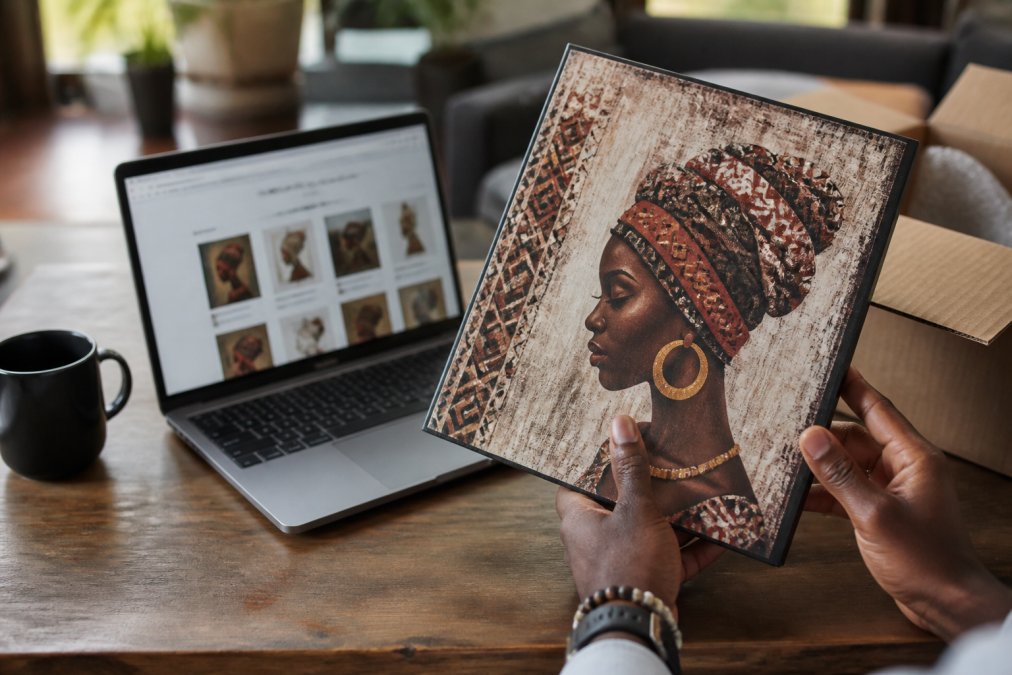
Quality black heritage decor comes down to materials, print method, and the maker's story. Baymard Institute's 2026 UX research on furniture and home decor shopping found that shoppers treat decor as a high-consideration purchase, meaning they want proof of quality before they commit.
Authentic Craftsmanship vs. Mass-Produced Copies
Authentic craftsmanship shows in small details. Ask these questions:
- Does the listing name the artist or maker?
- Is the print method described, such as giclée or archival ink?
- Are materials listed, like canvas weight or paper type?
- Does the brand explain the cultural story behind the design?
Mass-produced copies skip all four. They sell a generic look with no provenance.
Best Black-Owned Home Decor Brands and What Sets Them Apart
The best Black-owned home decor brands combine quality products with a clear cultural mission. African American Expressions stands out because we have spent 34 years building a catalog of calendars, canvas art, stationery, and accessories that celebrate Black heritage.
| Product | Price | Best For | Format |
|---|---|---|---|
| Black Heritage Trivia Game Cards | $24.00 | Family game nights, classrooms | 131 cards, 114 questions |
| Black Heritage Word Search Book | $17.99 | Screen-free learning, all ages | 100 puzzles plus trivia |
| 2027 Black History Calendar | $16.00 | Wall decor, gifting | 12" x 12", 12 full-page months |
Return and Shipping Policies for Small Makers
Small makers often handle returns and shipping differently than big-box stores, and those differences are the number one reason shoppers hesitate to buy heritage decor from an independent shop. The fix is not to avoid small makers, it is to read their policies the way a buyer, not a browser, would. Use the checklist below before you check out.
The Return Policy Checklist
Before you buy, confirm each of these in writing on the shop's site:
- Return window. Most small shops allow 14 to 30 days from delivery, not from order date. Note which one the policy uses, the difference matters if shipping takes a week.
- Who pays return shipping. Many small makers ask the buyer to cover return postage, which can run $8 to $15 for a framed print. Factor that into the total cost.
- Condition requirements. Original packaging, tags, or unopened status are common requirements. A canvas print returned without its protective wrap may be refused.
- Final-sale categories. Custom, personalized, and made-to-order items are frequently non-returnable. If you are ordering a personalized piece, assume it is final sale unless the policy says otherwise.
- Refund vs. store credit. Some small shops offer store credit only. That is not necessarily a red flag, but you should know before you buy.
- Refund processing time. Two to four weeks after the return is received is common for small operations. Big retailers often refund faster.
The Shipping Policy Checklist
Shipping is where small makers most often differ from large retailers. Check these before you order:
- Processing time vs. shipping time. These are separate. A shop may need three to five business days to make or pack your item before the carrier even picks it up.
- Carrier and tracking. Reputable shops provide a tracking number. If tracking is not mentioned, ask before you buy.
- Domestic vs. international fulfillment. If the shop ships from overseas, expect longer transit and possible customs delays. Heritage decor sold by a U.S.-based maker usually arrives faster and is easier to return.
- Insurance on higher-value items. For framed art or large statement pieces, ask whether the shipment is insured against damage. If it is not, you may be absorbing the risk.
- Holiday and Black History Month lead times. Small makers can be overwhelmed in January and early February. If you need a piece for Black History Month, order by early January at the latest. For holiday gifting, add two weeks to the stated processing time as a buffer.
What Good Policies Look Like in Practice
A trustworthy small shop will state its return window, return shipping responsibility, and final-sale categories on a single, linked page, not buried in a FAQ. It will give you a real processing time, not "ships fast." And it will answer a pre-sale question within one to two business days.
Cultural Appropriation vs. Appreciation in Black Heritage Decor
Cultural appropriation is using another culture's symbols without credit, context, or benefit to that community. Appreciation means honoring the culture, naming its source, and supporting its creators.
Why Black Heritage Decor Is Worth the Investment
Black heritage decor is worth the price because it carries meaning that mass-market pieces cannot match. The personalized home decor market alone is valued at $177.31 billion in 2026, according to Future Market Insights' personalized home decor report, which shows how many buyers now want items with a personal story.
Frequently Asked Questions
How can I verify if a Black heritage decor website is legitimate?
Check the domain age using a WHOIS lookup tool; established sites have years of history. Look for a physical mailing address and working phone number on the contact page. Read the return policy and privacy terms; legitimate retailers provide clear, detailed policies. Search for customer reviews on independent platforms like the Better Business Bureau. The BBB's 2024 online shopping fraud study recommends verifying store legitimacy through domain age, contact data, and policy transparency before purchasing.
What security measures should I look for when buying Black heritage decor online?
Confirm the checkout page uses HTTPS (look for the padlock icon and 'https://' in the URL). Use a credit card or PayPal rather than debit cards or wire transfers, since credit cards offer fraud protection under the Fair Credit Billing Act. Avoid stores that only accept money orders or cryptocurrency. Check for a visible return policy and a customer service email. Baymard Institute's 2026 UX research on furniture and home decor shopping notes that clear return policies are a key trust signal for high-consideration purchases.
How do I know if heritage decor is ethically sourced?
Look for supply chain transparency on the product page. Ethical sellers name the artists or makers, describe materials, and explain where the item was produced. Buying directly from Black artists or from established, trusted Black-owned retailers helps ensure authenticity and positive impact. If a listing uses vague language like 'African-inspired' without naming a creator or region, ask the seller directly before buying.
Are there risks to buying cultural art and decor from third-party marketplaces?
Yes. Third-party marketplaces can host counterfeit or mass-produced items that mimic authentic artisan-made goods. The Better Business Bureau's 2024 study on online shopping fraud found that counterfeit products remain a persistent risk, especially when sellers lack verifiable business information. To reduce risk, buy from the artist's own site or a vetted retailer with a public return policy. Check customer reviews and social proof, and avoid listings with stock photos that appear across multiple unrelated stores.
How can I support Black-owned businesses while shopping safely online?
Start with curated lists from publications like Architectural Digest and HGTV, which update their Black-owned home decor brand directories regularly. Verify each brand's legitimacy using the checklist above: domain age, contact info, secure checkout, and clear return policy. Buy directly from the brand's own website when possible, which gives the maker a larger share of the sale. The personalized home decor market reached $177.31 billion in 2026 (Future Market Insights), so your purchase supports a growing sector of independent creators.
Shopping online for black heritage decor carries real risk, but the right checks remove most of it. African American Expressions has spent 34 years earning trust with high-quality, culturally inspired products, and our fundraising program lets schools and churches earn 40% on every sale. Browse our calendars, canvas art, and accessories, or become part of our AAE family and start fundraising today.