

Table of Contents
- Quick Comparison: Top 10 Culturally Inspired Throw Pillows
- 1. Praises Go Up Pillow Cover: Celebrating Faith Through Art
- 2. Strong Girl Pillow Cover: Fashion-Forward Black Art
- 3. With God Roses Pillow Cover: Inspirational Floral Design
- 4. Trust in the Lord Pillow Cover: Scripture-Inspired Comfort
- 5. Sister Friends Pillow Cover: Celebrating Black Sisterhood
- 6. She Who Kneels Pillow Cover: Powerful Statement of Faith
- 7. Small Princess Pillow: Whimsical Accent for Kids
- 8. Small Queen Pillow: A Matching Accent
- 9. Large Princess Pillow: Bigger Statement, Same Charm
- 10. Large Queen Pillow: Room to Grow
- How to Style Culturally Inspired Throw Pillows
- Choosing the Right Pillow Size and Insert
- Mixing Patterns, Textures, and Cultural Motifs
- Is Heritage Decor Worth the Price?
- Care and Maintenance for Delicate Textiles
- Frequently Asked Questions
Last Updated: September 10, 2026
Quick Comparison: Top 10 Culturally Inspired Throw Pillows
The best culturally inspired throw pillows for living rooms blend textile craftsmanship with a story you want on your sofa. This guide from African American Expressions covers ten picks that celebrate Black heritage through art, scripture, and bold design.
Designers note that homeowners are paring down pillow counts in 2026, favoring fewer, more meaningful pieces over crowded sofas, according to The Spruce's 2026 throw pillow trend report. That shift favors exactly what we're recommending here: pieces with cultural provenance, not filler.
Below, we'll show you how to style these throw pillows, which sizes work best, and what most guides miss about mixing patterns and textures. All ten picks come from a 34-year-old Black-owned brand that has supplied culturally inspired home decor since 1991.
| Pillow | Price | Size | Best For |
|---|---|---|---|
| Praises Go Up Cover | $25.00 | 17.5" x 17.5" | Faith-centered living rooms |
| Strong Girl Cover | $25.00 | 17.5" x 17.5" | Modern, fashion-forward decor |
| With God Roses Cover | $25.00 | 17.5" x 17.5" | Floral and inspirational styling |
| Trust in the Lord Cover | $25.00 | 17.5" x 17.5" | Scripture reminders |
| Sister Friends Cover | $25.00 | 17.5" x 17.5" | Celebrating friendship |
| She Who Kneels Cover | $25.00 | 17.5" x 17.5" | Bold statement pieces |
| Small Princess Pillow | $15.00 | 12" x 8" | Kids' rooms and nurseries |
| Small Queen Pillow | $15.00 | 12" x 8" | Kids' rooms and nurseries |
| Large Princess Pillow | $30.00 | 16" x 16" | Kids' rooms and nurseries |
| Large Queen Pillow | $30.00 | 16" x 16" | Kids' rooms and nurseries |
1. Praises Go Up Pillow Cover: Celebrating Faith Through Art
Carl Crawford's artwork anchors this cover, depicting three women with eyes lifted toward heaven. It's the most overtly worship-focused piece in the lineup, making it a natural living room anchor.

At $25.00 for a 17.5" x 17.5" cover, it pairs well with a solid insert and a neutral sofa. The text reads "When th", a natural fit for families who want their decor to say something.
Give it the center position in a three-pillow arrangement.
2. Strong Girl Pillow Cover: Fashion-Forward Black Art
Nicholle Kobi's fashion-forward illustration gives this cover a modern, editorial feel that separates it from traditional faith-based designs, suiting contemporary living rooms with neutral palettes.
The 17.5" x 17.5" cover sells for $25.00. Pair it with a textured throw in a complementary tone, and let the illustration carry the visual interest.
3. With God Roses Pillow Cover: Inspirational Floral Design
Sandy Clough's pink rose artwork softens the scripture reference, Matthew 19:26, into something decorative first and devotional second, making it easy to style in a mixed-pattern arrangement.
Priced at $25.00 for 17.5" x 17.5", it works alongside embroidered or tufted accent pillows without competing for attention.
4. Trust in the Lord Pillow Cover: Scripture-Inspired Comfort
This cover leads with Proverbs 3:9, positioning it as a daily reminder rather than pure decoration. The message suits entryways, reading nooks, and any corner where someone sits and thinks.
It's $25.00 for a 17.5" x 17.5" cover. This style works best as one of two scripture pieces in a room, so the theme reads intentional rather than accidental.
5. Sister Friends Pillow Cover: Celebrating Black Sisterhood
Friendship is the subject here, and Nicholle Kobi's art gives it a chic, contemporary treatment. It's a natural gift for a close friend, a sorority sister, or anyone whose living room doubles as a gathering space.
The cover runs $25.00 at 17.5" x 17.5". Style it solo on an accent chair for maximum effect.
6. She Who Kneels Pillow Cover: Powerful Statement of Faith
The text says it plainly: "She Who Kneels Before God Can Stand ". The artwork shows a woman humbled in prayer, making this the boldest statement piece in the collection.
At $25.00 for 17.5" x 17.5", it earns the center position on a sofa. A piece with this much text needs visual breathing room; keep surrounding pillows solid or subtly patterned.
7. Small Princess Pillow: Whimsical Accent for Kids
This 12" x 8" pillow carries the word "Princess" and suits a child's room, a nursery glider, or a reading corner. At $15.00, it's an easy add-on.
8. Small Queen Pillow: A Matching Accent
Same 12" x 8" footprint, same $15.00 price, with "Queen" in place of "Princess." Buy both and let siblings each claim one.
9. Large Princess Pillow: Bigger Statement, Same Charm
At 16" x 16" and $30.00, this version scales up the message for a bed or lounge chair. Pair it with a firm insert that holds its shape through daily use.
10. Large Queen Pillow: Room to Grow
The 16" x 16" Queen pillow, also $30.00, rounds out the set. Together, the four kids' pillows let you build a coordinated scheme without repeating a single design.
How to Style Culturally Inspired Throw Pillows
Styling culturally inspired throw pillows comes down to three decisions: how many to use, how to mix patterns, and how to coordinate color. Designers in 2026 favor fewer pillows overall, making each choice more visible.
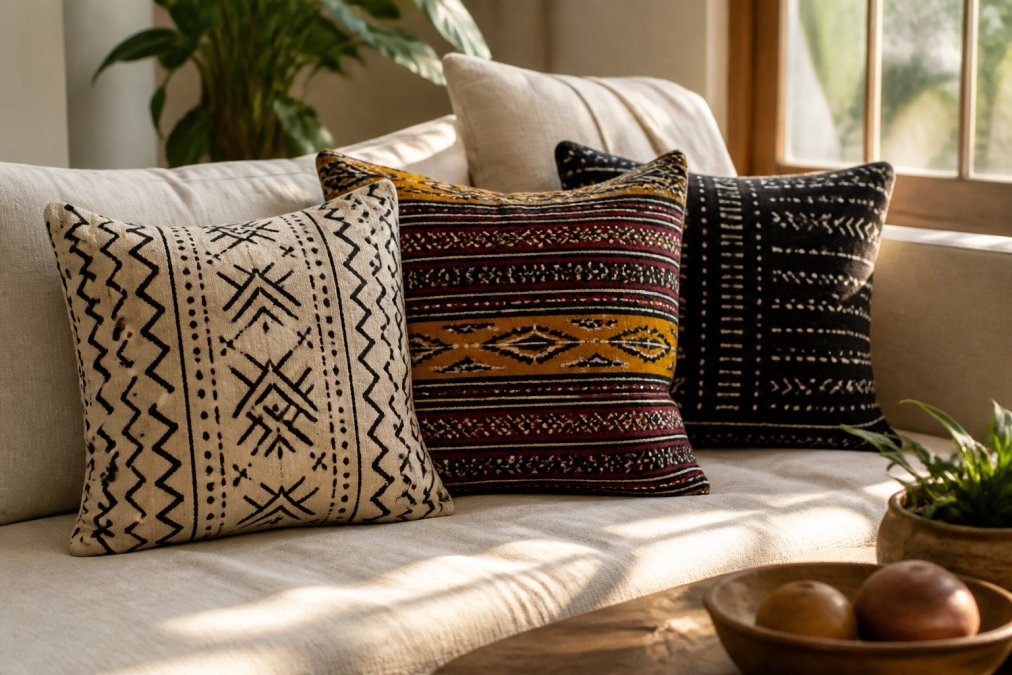
Start with an odd number: three or five pillows read as intentional, while even numbers look staged. Vary size, one large square, two medium, one small lumbar, and mix texture, pairing a smooth printed cover with a handwoven or tufted accent for depth.
For color, pull two tones from the artwork itself and repeat them elsewhere in the room through a throw blanket or rug. That single move does more for cohesion than any matching set.
Become a part of our AAE family and start fundraising today! →
Choosing the Right Pillow Size and Insert
Most living room covers are built around an 18" or 20" insert, and the covers here run 17.5" x 17.5", so a slightly larger insert fills the corners properly. Undersized inserts create the droopy look that makes even good textiles seem cheap.
Insert density matters as much as size. A firm, high-density fill holds a karate-chop shape; a soft fill slumps. For delicate or heavily printed covers, a down-alternative insert balances shape and softness without poking through.
Mixing Patterns, Textures, and Cultural Motifs
Most guides stop at "vary scale, not just design." That rule is incomplete: culturally inspired pillows are harder to mix than plain geometrics because each motif carries its own visual weight, symmetry, and history. Knowing a pattern's tradition tells you how it will behave next to another.
Here is how the major textile families read on a sofa:
- Mudcloth (bogolanfini). A Malian cotton textile traditionally painted with fermented mud, producing high-contrast, hand-drawn geometry, dashes, zigzags, irregular grids. The lines are deliberately imperfect, so it reads as organic. Pair it with a solid or fine stripe; don't stack it against another high-contrast geometric.
- Kente. Ghanaian strip-woven cloth built from narrow bands sewn together, so the pattern repeats in vertical columns. That vertical rhythm partners naturally with a horizontal lumbar or round pillow, which breaks the grid.
- Kilim. A flat-woven (no pile) rug tradition from Anatolia and the broader region, characterized by stepped geometric medallions and saturated color blocks. Kilim motifs are bold and angular, so they hold their own next to a small-scale print but fight a second large medallion.
- Ikat. A resist-dye technique in which threads are bound and dyed before weaving, producing the characteristic feathered, blurred edges. That softness is the point: ikat is the rare bold pattern that behaves like a neutral, so it layers easily under or over almost anything.
- Kuba cloth. Woven by Kuba artisans in Central Africa from raffia palm, often with appliqué and embroidery, giving it a nubby, sculptural surface. Treat it as a texture first and a pattern second.
The two-print rule. Two patterned pillows per sofa is the practical ceiling for most rooms. A third works only when one is a texture rather than a print, a boucle, chunky knit, or tufted piece. Texture adds the tactile layer that makes a room feel collected rather than purchased, with almost no risk of clashing.
Anchor with one neutral. The fastest way to make culturally inspired decor look curated instead of random is to anchor it with one neutral textile, a solid linen, a cream boucle, a natural cotton canvas, and let the patterned pieces carry the color. Two neutrals plus two motifs is a reliable four-pillow formula.
Pull color from the motif, not the room. Instead of matching a pillow to your rug, pull one secondary color out of the pillow's own pattern and repeat it once elsewhere, a throw blanket, a lampshade, a ceramic vase. One repeat reads as intentional; three reads as a theme.
Name the tradition before you buy the pillow. A shopper who knows the difference between mudcloth and kilim will style both correctly on the first try, and will avoid the most common mistake, which is treating every bold pattern as interchangeable.
When in doubt, put the two loudest patterns on opposite ends of the sofa and keep the center pillow solid. The eye needs a resting point, and the center cushion is where it lands.
Is Heritage Decor Worth the Price?
Heritage decor is worth the price when three things are true: the piece carries a documented cultural source, the construction holds up over years of use, and the cost per year beats the generic alternative. Run all three tests before you buy.
The cost-per-use test. A $25.00 printed cover used daily for five years works out to roughly $5.00 per year. A $12.00 mass-market pillow that pills or fades in eighteen months costs about $8.00 per year, and you replace it twice in the same window. The cheaper pillow is the more expensive habit. The math flips only if the piece sits in a guest room and gets seen twice a year.
What you are actually paying for. With culturally inspired textiles, part of the price is design and part is provenance. A cover that credits a named artist, technique, or tradition pays for a story a stock-photo pillow cannot supply, and that story survives trend cycles: mudcloth, kente, and kilim have been in continuous production for generations, while any season's "boho" print dates within two years.
The authenticity checklist. Not every product marketed as culturally inspired reflects genuine heritage. Before you buy, look for:
- A named artist or maker. A credited designer is accountable for the work; an anonymous stock image is not.
- A named technique. "Handwoven," "block-printed," "flat-woven," or "hand-dyed" tells you how the piece was made. "Ethnic print" tells you nothing.
- A specific tradition. Mudcloth, kente, kilim, ikat, and kuba cloth are identifiable. "Tribal" and "global" are marketing words, not origins.
- A documented brand history. A company that has sold this category for decades has a track record you can verify. A dropshipper with recycled product photos does not.
- A price that makes sense. Genuine handwork costs more to produce. A "handwoven" pillow priced below mass-market synthetic equivalents is usually neither.
The honest caveat. Heritage decor is not automatically better decor. A culturally inspired pillow in a room that ignores it looks like a souvenir. The value shows up only when the piece is styled with intent, anchored by a neutral, given room to breathe, and placed where people actually sit.
The most common mistake is buying heritage decor as a trend rather than a commitment. If you would not still want the piece in five years, the cost-per-year math does not work in your favor no matter how low the sticker price is.
Care and Maintenance for Delicate Textiles
Printed and embroidered covers need gentler handling than solid cotton. Spot-clean first, wash cold on a delicate cycle only when necessary, and air-dry flat to protect the print and stitching. Skip the dryer; heat fades color and shrinks natural fibers.
For handwoven or tufted accent pillows, vacuum on the lowest setting with a brush attachment rather than washing. Rotate pillows every few weeks so sunlight fades them evenly, and store seasonal covers in a breathable cotton bag, not plastic.
Frequently Asked Questions
What are the pillow trends for 2026?
The 2026 home decor market is seeing a shift toward artisan-made items, with a focus on printed Indian textiles and global patterns to create textured, layered living spaces. Platforms like Society6 are increasingly used to source unique, culturally inspired prints that move away from mass-produced aesthetics. Designers note a trend of paring down the total number of throw pillows used in living room styling.
What is the 2-2-1 throw pillow rule?
The 2-2-1 rule is a styling guideline for arranging throw pillows on a sofa: start with two larger pillows (e.g., 20-inch) on each end, then layer two medium pillows (e.g., 18-inch) in front, and finish with one accent pillow (e.g., 12-inch) in the center. This creates a balanced, visually appealing arrangement that works for most sofa sizes.
How do I choose culturally inspired decor that is authentic?
Look for pieces that tell a story of cultural provenance. Authentic decor often comes from independent artists or specialized artisan collections rather than big-box inventory. Seek out details like handwoven techniques, traditional motifs, and collaborations with artists from the culture represented. African American Expressions offers a collection of pillow covers featuring artwork by Black artists, ensuring authenticity and cultural relevance.
What are the best materials for high-quality decorative throw pillows?
High-quality throw pillows often use natural fibers like cotton, linen, or wool for covers, which offer durability and a premium feel. For inserts, down or down-alternative fills provide loft and comfort. Consider the intended use: indoor pillows can be more delicate, while outdoor ones need weather-resistant fabrics. African American Expressions' pillow covers are made from quality materials that hold up well with proper care.
How do I care for artisanal or embroidered throw pillows?
Always check the care label first. For delicate textiles, spot clean with a mild detergent and cold water, or hand wash gently. Avoid harsh chemicals and direct sunlight when drying. For embroidered or embellished pillows, turn the cover inside out before washing to protect the details. Store in a cool, dry place when not in use to prevent fading and damage.