

Table of Contents
- Why Student-Led Black History Month Assemblies Matter in 2026
- 1. Living Wax Museum: Historical Figures Come to Life
- 2. Student-Led Black History Month Celebration Ideas: Performance Showcases
- 3. Interactive Trivia and Game Show Assemblies
- 4. Digital Gallery and Mural Projects
- 5. Guest Speakers and Community Storytelling
- 6. Black History Month School Assembly Scripts: A Planning Framework
- 7. Black History Month Educational Resources for Teachers
- Frequently Asked Questions
Last Updated: September 14, 2026
Why Student-Led Black History Month Assemblies Matter in 2026
The strongest of our 8 creative Black History Month 2026 assembly ideas put students on stage, not just in the audience. When young people research, write, and perform their own tributes, the history sticks in a way a passive slideshow never achieves.
The National Association of Elementary School Principals notes a clear move toward student-led celebrations, including murals, digital galleries, and fashion showcases (naesp.org). The 8 creative Black History Month 2026 assembly ideas in this guide from African American Expressions are built around that principle: give students ownership, and the commemoration becomes something a school community remembers.
Below are eight ready-to-run formats, plus the planning framework, differentiation, and reflection activities most guides leave out.
1. Living Wax Museum: Historical Figures Come to Life
The living wax museum is the highest-impact format on this list. Students research a historical figure, dress in period attire, and stand frozen until a visitor presses a "button" that brings them to life with a first-person monologue.
Costumes can stay simple: a borrowed suit jacket, a handmade placard, a single prop. What matters is the research behind the words. Give each student two to three weeks to write a 60-second script from primary sources, then rehearse in pairs.
What most guides miss is the traffic problem. A single-file museum line stalls fast. Arrange figures in clusters of four, with small groups rotating between clusters on a timed schedule.
2. Student-Led Black History Month Celebration Ideas: Performance Showcases
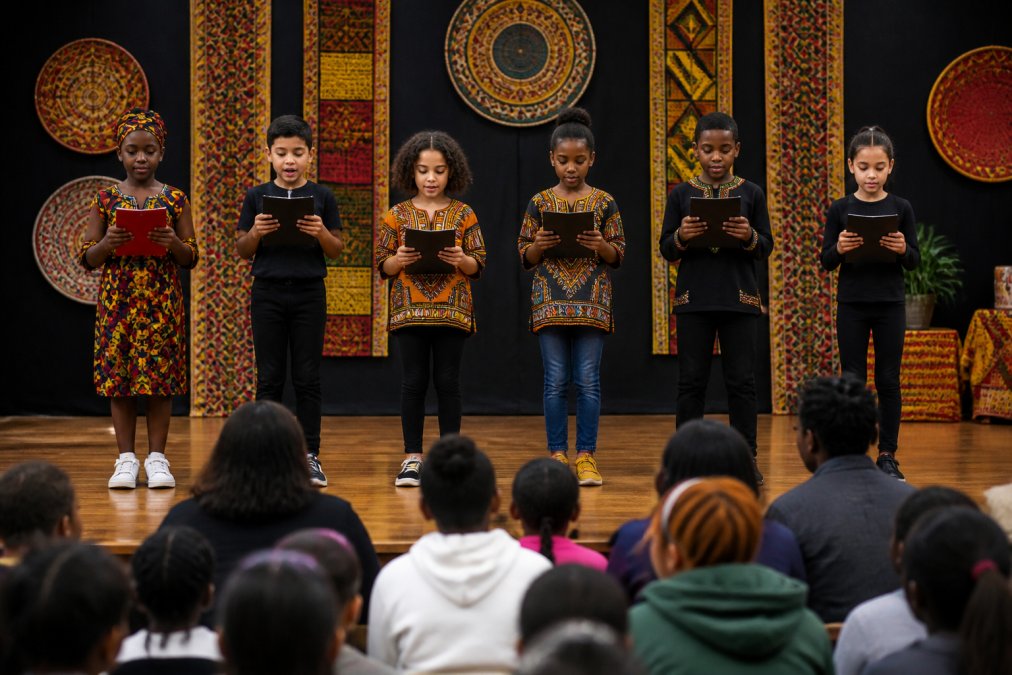
Performance is where student-led Black History Month celebration ideas hit hardest. Spoken word, dance, and music turn historical content into embodied memory, and audiences respond to peers in a way they rarely do to a guest lecturer.
Spoken Word and Poetry Slams
Poetry slams work at every grade level with the right scaffolding. Younger students can perform short choral poems, while older students write original pieces about civil rights, heritage, or personal heroes. Provide mentor texts from Black poets, then let students draft, workshop, and revise. The revision is the lesson.
Dance and Movement Tributes
Dance tributes pair beautifully with historical research. A group might interpret the Great Migration through contemporary movement, or build a step routine around a timeline of milestones. Keep rehearsal blocks short and frequent rather than one long session; retention improves and fatigue drops.
3. Interactive Trivia and Game Show Assemblies
Trivia turns the whole gym into participants. Run a game show with teams, buzzers, and a scoreboard, and engagement climbs. The format scales from one grade level to a full-school event, and every student in the room has a reason to pay attention.
Build the Run of Show First
Structure matters more than questions. Divide the room into four or five teams, appoint a student host and scorekeeper, and run three rounds of increasing difficulty. A workable 45-minute block:
- Setup and rules (5 minutes): Host explains scoring, buzzer etiquette, and the no-shouting rule.
- Round 1 (10 minutes): Team multiple choice, all teams answer on whiteboards, 30 seconds per question.
- Round 2 (10 minutes): Buzzer round, first buzz answers, 20 seconds per question.
- Round 3 (10 minutes): Audio and image round, 45 seconds per question.
- Tiebreaker and close (5 minutes): Sudden-death question, then a short reflection prompt.
Mix formats across rounds: multiple choice, "name that figure," and audio clips from Black musicians or speeches. Keep every answer moment brief; a stalled game show loses the room faster than a boring lecture.
How to Run a Black History Bee
A Black History Bee follows the spelling bee model with history questions instead of words. Students prepare with study guides, then face elimination rounds on stage. One district's 2026 Black History Bee paired the competition with art and writing contests, giving students multiple ways to demonstrate what they learned (American History and Civics-National Activities Grants (84.422B)).
The Black Heritage Trivia Game Cards format, 114 questions across 131 cards, mirrors how a classroom bee works: quick rounds, clear answers, and enough variety to keep every grade level engaged.
| Round | Format | Question Type | Time Per Question |
|---|---|---|---|
| Round 1 | Team multiple choice | Key figures and dates | 30 seconds |
| Round 2 | Buzzer round | Milestones and firsts | 20 seconds |
| Round 3 | Audio and image | Music, art, speeches | 45 seconds |
Equipment, Scoring, and Tiebreakers
You do not need a television studio. A basic setup works: one wireless microphone per host and scorekeeper, a laptop running slides, a projector or gym screen, and physical buzzers or a free buzzer app on student tablets. Test the buzzers in a full rehearsal; a dead buzzer mid-round kills momentum.
Score on a whiteboard or projected spreadsheet. Award 10 points in Round 1, 20 in Round 2, and 30 in Round 3, with a 5-point deduction for buzzing in and answering incorrectly, that penalty keeps the buzzer round honest.
For tiebreakers, prepare three sudden-death questions in advance and keep them sealed. Do not let the host improvise; improvised questions are where disputes start.
Sourcing Questions Without Reinventing the Wheel
Pull questions from primary sources students already study: the Emancipation Proclamation, the 13th, 14th, and 15th Amendments, Brown v. Board of Education, the Montgomery bus boycott, and the March on Washington. For the audio round, use short public-domain or classroom-cleared clips, and credit the source on the slide.
4. Digital Gallery and Mural Projects
A digital gallery lets every student contribute without competing for stage time. Students create slides, short videos, or recorded interviews, and the school displays them on hallway screens or a shared link families can browse at home.
Murals take the same idea physical. Assign each class a panel of a larger collaborative mural, then assemble the pieces on a gym wall. The Experiential Learning Depot documents how interactive museum displays and community storytelling events have become assembly centerpieces, and a mural opening ceremony fits that model exactly.
Skipping the accessibility review is the most common mistake here. Add captions to every video, alt text to every image, and a printed program for visitors who cannot read projected text from the back of the room. Without these, a portion of your audience is excluded from an assembly about inclusion.
5. Guest Speakers and Community Storytelling
Invite community elders, local artists, and church leaders to share personal stories rather than lectures. Narratives about school integration, family migration, or building a business connect students to history as lived experience.
Become a part of our AAE family and start fundraising today! →
Prepare speakers with a simple brief: 10 minutes, one story, one takeaway, then questions. Assign two students to introduce each guest with a short researched biography, itself a research assignment that signals respect to the speaker.
For a lasting artifact, record the stories with permission and add them to the school's digital gallery. Oral histories collected this way become a genuine educational resource for future classes.
6. Black History Month School Assembly Scripts: A Planning Framework
A workable Black History Month school assembly script follows a three-part arc: opening context, student performances, and a closing reflection. Write the transitions first; they carry the emotional thread between segments.
Use this sequence as your template:
- Welcome (2 minutes): Student emcees frame the theme and its relevance.
- Historical context (3 minutes): A brief narrated timeline, delivered by students.
- Performances (20-25 minutes): Poetry, dance, or wax museum rotations.
- Guest story (10 minutes): A community speaker, if available.
- Reflection and close (5 minutes): A moment of silence or a shared reading.
A Six-Week Planning Timeline
Most assembly guides hand you ideas and stop. What determines whether the event runs is the calendar. Work backward from your assembly date:
- Six weeks out: Confirm the date with administration, reserve the gym or auditorium, and identify the theme.
- Five weeks out: Recruit student performers and emcees; open sign-ups for research and script-writing roles.
- Four weeks out: Distribute scripts, assign research topics, and confirm any guest speakers in writing.
- Three weeks out: Begin rehearsals; submit AV and facilities requests; order any printed programs or materials.
- Two weeks out: Full run-through of transitions; confirm accessibility accommodations; finalize the run of show.
- One week out: Dress rehearsal on stage with microphones and slides; print cue cards and programs.
- Day of: Arrive 60 minutes early for setup; build a 10-minute buffer into the run of show.
Budget and Materials
Most school assemblies run on a modest budget, but the line items surprise first-time organizers: printed programs and cue cards, simple costume or prop rentals, guest speaker honoraria or thank-you gifts, and AV rentals beyond what the school owns. Ask your parent-teacher organization or student council to cover a portion, and check whether your district has a cultural programming fund.
If budget is tight, lean on what you already have: student-made props, a school-owned projector, and drama department volunteers for staging. The assembly's impact comes from student ownership, not production value.
Age-Appropriate Differentiation
Elementary students respond to movement, repetition, and simple scripts. Keep segments under five minutes, use choral speaking so no single student carries a long passage, and build in a movement break. Middle schoolers want debate, competition, and creative control; give them the trivia round, mural design, and emcee roles. High schoolers can handle primary-source analysis, nuanced discussion of social justice, and independent project management. Younger students perform; older students direct, research, and mentor.
A practical pattern is pairing an older student with a younger one as a research buddy: the older student helps draft the script, the younger performs it. Both learn more than they would alone, and the assembly gains a visible mentoring layer families notice.
Logistics Checklist for Assembly Day
- Confirm stage, sound, and lighting needs with facilities one week ahead
- Print scripts and cue cards; do not rely on screens alone
- Assign a student stage manager and two runners
- Test microphones and any audio clips during a full rehearsal
- Prepare accessible seating and a printed program
- Schedule a photographer and confirm media permissions
- Build a 10-minute buffer into the run of show
Accessibility and Inclusivity
An assembly about inclusion should be inclusive by design. Reserve front-row seating for students with mobility or sensory needs, provide a printed program for anyone who cannot read projected text from the back, and caption any video or audio segment. Book a sign language interpreter early and share the script in advance. For students overwhelmed by crowds, offer a quiet viewing room with a live stream.
7. Black History Month Educational Resources for Teachers
Strong assemblies start with strong classroom preparation. Build a resource library students can draw from during research: primary-source documents, poetry collections, documentary clips, and activity books that keep learning going after the assembly ends.

The Black Heritage Word Search Book combines word searches, trivia, and coloring pages in one volume, which makes it useful across multiple grade levels and as a quiet activity for early finishers. Pair it with Black Heritage Trivia Game Cards for classroom practice ahead of a bee.
For a lasting classroom artifact, students can record their research and reflections in a Black History Wired Journal, which features artwork by Thomas Blackshear depicting Barack Obama, Frederick Douglass, Mary McLeod Bethune, and Sojourner Truth.
Post-Assembly Reflection Activities
Reflection is the step most schools skip, and it's where learning consolidates. Try a short written response: "What is one thing you learned that surprised you?" Then run a structured small-group discussion. Older students can write a letter to a historical figure or propose a spring follow-up project.
Display the responses on a hallway board for the rest of the month. It extends the assembly's reach to families and visitors, and shows students their thinking was the point.
Planning a memorable assembly takes more than a script; it takes materials students are proud to hold and share. African American Expressions has spent 34 years creating culturally inspired gifts, stationery, and home decor that celebrate Black heritage, and our fundraising program lets schools and churches earn 40% on every sale to fund programs like these. Explore our Black history journals, trivia cards, and activity books, then start a fundraiser with African American Expressions and turn this year's assembly into next year's tradition.
Frequently Asked Questions
What is the theme for Black History Month in 2026?
The 2026 theme has not been officially announced by the Association for the Study of African American Life and History (ASALH) at the time of this writing. However, schools often develop their own themes based on student interests and curriculum goals. Recent years have seen themes like 'African Americans and the Arts' and 'Black Resistance.' When planning your assembly, consider a theme that highlights local Black leaders, artistic contributions, or civil rights milestones relevant to your student body.
How can schools make Black History Month assemblies more student-led?
Shift planning responsibility to students by forming a student committee that selects themes, writes scripts, and leads rehearsals with teacher guidance. Assign roles like research leads, stage managers, and performers. Use student-led formats such as living wax museums, where students embody historical figures, or peer-hosted trivia competitions. This approach builds ownership and ensures the assembly reflects student voices, increasing engagement and cultural relevance.
What are some creative project ideas for Black History Month?
Consider a digital gallery where students create multimedia presentations on historical figures, or a collaborative mural project that visually tells stories of Black excellence. Other options include a Black History Bee with trivia contests, a living wax museum with student performances, or a community storytelling event featuring local elders. Pair these with hands-on activities like the Black Heritage Word Search Book or Black Heritage Trivia Game Cards for interactive learning.
What resources are available for planning a Black History Month school event?
Teachers can use lesson plans from organizations like Teaching Tolerance, the National Archives, and ASALH. For assembly-specific materials, consider scripts from educational publishers and interactive tools like the Black Heritage Trivia Game Cards or Black Heritage Word Search Book. African American Expressions also offers culturally inspired journals and art that can serve as prizes or decor. Always preview materials to ensure they align with your school's curriculum and age group.
How do I choose age-appropriate Black History Month assembly ideas?
For younger students (K-2), focus on sensory activities like songs, simple crafts, and picture-book readings about figures like Harriet Tubman or Frederick Douglass. Grades 3-5 can handle short skits, trivia games, and art projects. Middle and high school students benefit from student-led research presentations, debates, and spoken word performances. Always preview content for complexity and emotional weight, and provide context to help students process historical injustices.