

Table of Contents
- Top Fundraising Products for Schools: A Quick Comparison
- High Profit School Fundraising Ideas That Actually Deliver
- How to Choose the Right Fundraising Products for Schools
- School Fundraising Best Practices for Organizers
- Fundraising Letter Templates for Schools: What to Include
- Sustainability, Eco-Friendly Products, and Post-Fundraiser Impact Reporting
- Conclusion
Last Updated: August 10, 2026
School fundraising is increasingly competitive and essential. Parent-teacher associations and administrators face pressure to close budget gaps, fund extracurriculars, and build community pride while managing volunteer fatigue and limited planning time. African American Expressions has spent more than 34 years helping schools, churches, and community organizations run fundraisers that generate meaningful revenue. This guide covers the best fundraising products for schools in 2026, ranked by profit potential, ease of execution, and community impact, while addressing logistics, financial compliance, sustainability, and impact reporting that most guides ignore.
The most important insight: the best fundraising products are ones your community actually wants to buy, not just the easiest ones to sell.
Top Fundraising Products for Schools: A Quick Comparison
| Fundraiser Type | Profit Margin | Upfront Cost | Volunteer Effort | Best For |
|---|---|---|---|---|
| Culturally Inspired Gifts and Calendars | Up to 40% | None | Low | Community-focused schools |
| Cookie Dough and Gourmet Food | Up to 55% | None | Medium | Broad community appeal |
| Custom Apparel and Spirit Wear | Varies | None | Medium | School spirit campaigns |
| Online Pledge / Crowdfunding | Up to 95% | None | Low-Medium | Tech-savvy parent networks |
| Chocolate and Candy Sales | 40-50% | None | Low | Quick, high-volume sales |
| Popcorn Sales | Up to 50% | None | Low | Low-lift, online-friendly |
Most programs require no upfront cost, removing a major barrier to entry. Profit margins vary by community fit.
High Profit School Fundraising Ideas That Actually Deliver
The highest-performing fundraisers sell products people would buy anyway, or products that carry genuine meaning. High profit margins alone do not guarantee success. A product that resonates emotionally with your community will outsell a higher-margin generic item almost every time.
African American Expressions built its fundraising program on this insight. Schools selling culturally inspired gifts, calendars, and home decor see strong participation because the products carry meaning beyond the transaction. Supporters acquire something they value, not just donate.
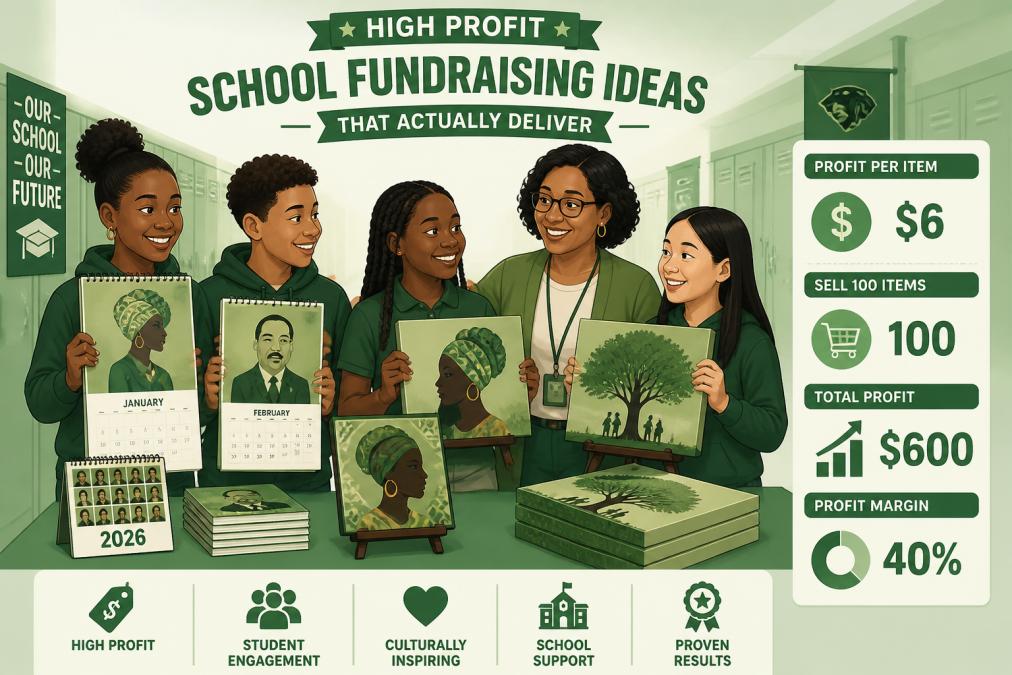
Culturally Inspired Gifts and Calendars
Culturally inspired gifts and calendars are among the most effective fundraising products for schools with a community identity to celebrate. Products reflecting Black heritage, history, and artistry sell with conviction because buyers feel pride in the purchase.
African American Expressions' fundraising program offers schools 40% on every sale. The catalog includes calendars, canvas art, accessories, and stationery celebrating Black culture, making them ideal for Black History Month campaigns, end-of-year drives, and community events. With 34 years of experience and millions of dollars generated for organizations since 1991, the program has a proven track record.
What works: Supporters are offered meaningful gifts they genuinely want, not items they do not need.
What to watch: Calendar sales peak between October and January. Plan your campaign timeline accordingly.
Pros:
- 40% commission on every sale
- Products carry cultural significance, driving genuine demand
- No upfront cost or inventory management required
Cons:
- Strongest appeal within communities that identify with the cultural mission
- Seasonal products like calendars have a natural sales window
Cookie Dough and Gourmet Food Sales
Cookie dough fundraisers remain a staple because cookies have universal appeal. Established vendors offer profit margins of 40% to 55%, with no upfront cost and pre-portioned products that simplify fulfillment.
Frozen options require freezer space before distribution. Shelf-stable formats sidestep this entirely and are worth requesting from your vendor.
Pros: High margins, broad appeal, minimal setup Cons: Frozen products require cold storage; order collection needs coordination
Custom Apparel and Spirit Wear
Custom apparel fundraisers raise funds while building school spirit. Schools design t-shirts, hoodies, and hats with their logos, then sell through online storefronts that handle order management and shipping.
Platforms like Bonfire's school fundraising program allow campaigns with no upfront costs or inventory risk. Profit per item varies based on product cost and selling price. The bigger challenge is promotion: campaigns live or die by active social media sharing.
Pros: Builds community identity, no inventory risk, year-round potential Cons: Requires active promotion; margins vary by product
Online Pledge-Based and Crowdfunding Campaigns
Pledge-based fundraisers, including walk-a-thons and read-a-thons, have evolved with online platforms. Tools like 99Pledges platform for schools allow each participant to create their own donation page and share via text and social media. Boosterthon (MyBooster) handles event planning while schools retain an average of 95% of funds raised.
Peer-to-peer fundraising works because it distributes marketing across hundreds of families instead of relying on a handful of volunteers. This dramatically increases conversion rates.
Pros: Very high net proceeds, strong community engagement, low overhead Cons: Success depends on student participation and digital outreach; some platforms charge transaction fees
How to Choose the Right Fundraising Products for Schools
The right fundraising products depend on three factors: your audience's purchasing habits, your volunteers' capacity, and your fundraising goals. A high-margin product your community has no interest in will underperform a lower-margin product they genuinely want.
Map your community before committing to a format. Survey parents to understand their preferences. A school with strong cultural identity will respond differently to a calendar campaign than one where food-based fundraisers have historically dominated.
Elementary vs. High School Fundraising Considerations
Elementary school fundraising relies heavily on parent networks. Parents drive outreach, manage fulfillment, and coordinate logistics. Product-based fundraisers with simple catalogs and low price points work well because purchasing decisions are made by adults with clear motivation to support the school.
High school fundraising can lean on student-led initiatives. Older students can run peer-to-peer fundraising pages, manage social media, and take ownership of logistics. This opens doors to ambitious crowdfunding campaigns and custom apparel drives where student identity is part of the product.
A common mistake is applying the same strategy across grade levels. What motivates a fifth-grade parent differs from what motivates a high school senior.
Seasonal Campaigns and Community Engagement
Seasonal timing shapes demand significantly. Black History Month in February is ideal for culturally inspired gifts and calendars. Back-to-school season in August and September suits spirit wear. The holiday season from October through December is strongest for food-based and gift-based fundraisers.
Community engagement amplifies every campaign. When a fundraiser connects to something the community already cares about, a cultural celebration, sports season, or school milestone, participation rates climb.
Become a part of our AAE family and start fundraising today! →
School Fundraising Best Practices for Organizers
Running a fundraiser well is an operational challenge as much as a sales challenge. Many campaigns fall short not because the product was wrong, but because execution broke down.
Volunteer Coordination and Logistics
Before launch, assign specific roles: order management, parent communications, tracking goals and net proceeds, and managing inventory or fulfillment. Create a clear distribution plan before orders are placed. Know where products will be stored, who will sort them, and how families will pick them up or receive delivery.
For online campaigns, ensure every participant has their personal fundraising page set up before launch and confirm the donor database is capturing information correctly.
According to the Association of Fundraising Professionals' resource library, donor retention is significantly higher when organizations communicate clearly about how funds were used. Families who see the results of their effort are more likely to participate again.
Financial Compliance and Reporting
Schools operating under a parent-teacher association or booster club structure may be subject to IRS requirements depending on tax status. Many PTAs are registered 501(c)(3) organizations, meaning donations may be tax-deductible, but the organization must maintain proper records and file appropriate returns. Check with your school board and consult your district's guidance.
For all fundraisers, maintain clear records of gross revenue, overhead costs, vendor payments, and net proceeds. This protects the organization and builds credibility with the school board and community.
Fundraising Letter Templates for Schools: What to Include
A well-written fundraising letter that speaks to community values and explains how funds will be used converts at meaningfully higher rates than generic flyers.

Every effective fundraising letter should include:
- A specific goal: "We are raising $8,000 to fund new science lab equipment" outperforms vague appeals.
- A clear deadline: Urgency drives action.
- The community connection: Explain why this fundraiser matters to this specific school.
- The product or campaign mechanics: Tell supporters exactly what they are buying and how to participate.
- The impact statement: Describe what success makes possible.
- A direct call to action: One clear next step.
Template framework:
Dear [School Name] Community,
Our [grade/team/club] is raising funds to [specific goal]. Every purchase supports [specific outcome], and we need your help to reach our goal of [dollar amount] by [deadline].
This year, we are partnering with [program name] to offer [product description]. [One sentence on why this product is worth buying.] Your purchase directly funds [specific use of proceeds].
To participate, [clear one-step action]. Orders close on [date].
Thank you for your continued support of our students and our community.
[Signature]
Adapt this framework for email, printed flyers, and social media. The core elements remain the same.
Sustainability, Eco-Friendly Products, and Post-Fundraiser Impact Reporting
Post-fundraiser impact reporting, communicating to supporters exactly how funds were used, builds lasting donor relationships. A simple one-page summary showing total funds raised, allocation, and outcomes does more for long-term engagement than any incentive program.
Sustainability is an emerging consideration, particularly among parent communities prioritizing eco-conscious purchasing. Ask vendors about packaging materials, sourcing practices, and responsible production. Some communities will respond positively to fundraisers aligned with their values; others will prioritize product quality and margin.
For schools seeking culturally meaningful products with lasting value, gifts, art, and calendars offer advantages over consumable food items. A calendar or canvas piece remains in a home for months or years, serving as an ongoing reminder of the community and cause.
According to the National PTA's guidance on school fundraising best practices, transparent communication about fundraising outcomes is one of the strongest predictors of community participation in future campaigns.
| Fundraiser Element | Best Practice | Impact |
|---|---|---|
| Goal setting | Specific dollar amount with named use | Higher donor motivation |
| Volunteer roles | Assigned before launch | Fewer logistics failures |
| Financial records | Gross revenue, costs, net proceeds tracked separately | Compliance and credibility |
| Post-campaign report | Sent within two weeks of campaign close | Stronger donor retention |
| Seasonal timing | Aligned with cultural calendar or school events | Higher participation rates |
Choosing the right fundraising products for schools is a strategic decision, not just a shopping exercise. Schools that raise the most match product to community, plan logistics before launch, and close the loop with honest impact reporting.
African American Expressions brings 34 years of experience to this work, along with a fundraising program that lets schools earn 40% on every sale of culturally inspired gifts, calendars, and home decor that supporters genuinely want. Become a part of our AAE family and start fundraising today.
Frequently Asked Questions
What is the most profitable fundraiser for schools?
Product-based fundraisers with margins at or above 40% consistently rank among the most profitable options. Culturally inspired gifts and calendars, gourmet food sales, and custom apparel all fall into this range. The key variable is demand: products that supporters genuinely want to own sell faster and in higher volume, which raises net proceeds without adding overhead costs. Pairing a high-margin product with peer-to-peer promotion on social media typically produces the strongest results.
What are the best low-effort fundraising products for schools?
Online-first programs require the least volunteer coordination because order fulfillment and payment collection happen automatically. Popcorn fundraisers with direct shipping, pledge-based platforms like 99Pledges or Schoolfundr, and catalog sales programs that handle distribution all reduce the workload on parent-teacher association volunteers. Culturally inspired catalog programs, such as those offered by African American Expressions, also pre-organize inventory management so organizers focus on promotion rather than logistics.
How do you choose the right fundraising product for your school demographic?
Start with your audience. Elementary schools tend to do well with food-based products and fun-run events because younger students respond to incentive programs and prizes. High schools see stronger conversion rates with apparel, digital campaigns, and products tied to identity or community pride. Schools with a strong connection to Black heritage often find that culturally relevant gifts generate higher participation rates because supporters feel a personal connection to what they are buying.
What is the 80/20 rule for school fundraising?
The 80/20 rule in school fundraising means roughly 20% of your participants or donors will generate about 80% of your total funds raised. This makes donor retention and top-seller recognition critical. Rather than spreading your marketing materials thin across every student, identify your most engaged families early, equip them with strong fundraising letter templates, and focus your volunteer coordination on supporting that core group. Tracking a donor database helps you recognize and re-engage these high-value supporters each season.
Are donations to school fundraisers tax-deductible?
Tax deductibility depends on how your school or organization is structured. Public schools are government entities, so donations made directly to them may qualify as tax-deductible under IRS guidelines. Donations to school booster clubs or parent organizations are only tax-deductible if the group holds 501(c)(3) status. Always consult a tax professional and confirm your organization's status before communicating tax-deductible donation benefits to supporters in your fundraising letters or campaign pages.
This article was written using GrandRanker