

Last Updated: October 31, 2026
Quick Summary
Gel pens for note taking work well because their water-based gel ink flows smoothly and dries quickly, which reduces smudging during fast lectures. A 0.5 mm tip is the most common classroom compromise, fitting about 10-12 words per line on a standard college-ruled page.
- Test drying speed on the actual notebook paper you use, not a single quick scribble.
- A 0.5 mm tip is the most common classroom compromise for note-taking.
- Three to five ink colors are usually enough to organize a page without clutter.
- Check your school's exam rules, since some settings restrict certain pen types or colors.
- Replace refills before they run dry in the middle of a lecture.
Table of Contents
- Why Gel Pens Work Well for Class Notes
- Fast-Drying Gel Pens: How to Avoid Smudges
- Choosing the Right Pen Tip Size for Note-Taking
- Pentel EnerGel vs. Zebra Sarasa for Lecture Notes
- Best Colored Gel Pens for Organizing Notes
- Downsides of Gel Pens and Exam Rules
- Choosing Your Note-Taking Pen Before the Next Lecture
- Frequently Asked Questions
Why Gel Pens Work Well for Class Notes
Gel pens suit fast lecture note-taking, and gel pens for note taking are popular because their water-based gel ink flows smoothly and dries quickly enough to reduce smudges. This question comes up often from students and educators, so here is a practical buying guide. Gel pens are a common choice for class notes, and the reasons come down to how they write.
Gel ink pens are generally known to dry quickly, which lowers the risk of smudging during class. That matters when you write fast, rest your palm on the page, or flip back through pages before the ink sets. Smooth ink flow also helps you keep pace with a lecturer without pressing hard on the paper.
Gel pens are not the only option. Rollerball, ballpoint and felt-tip pens each have their own trade-offs in flow, drying and line feel. The right choice depends on how you take notes, the paper you use and how long your sessions run.
Fast-Drying Gel Pens: How to Avoid Smudges
Fast-drying gel ink is the feature to check first if smudging is a problem. Test a line on the paper you actually use before a big lecture.
Many note-takers find that a few habits help more than the pen alone:
- Write with a light touch so the ink does not pool on the page.
- Let each line dry for a moment before you rest your hand across it.
- Use a notebook with paper that does not absorb ink too heavily.
- Keep a spare notebook page or a sheet of scrap paper under your writing hand.
A common mistake is judging drying speed on a single quick scribble. Write a full sentence, drag a finger across it after a few seconds, and see what happens. That simple test shows more than any marketing claim.
Choosing the Right Pen Tip Size for Note-Taking
Tip size changes how much text fits on a line, how legible your handwriting stays at speed, and how the ink behaves on thin notebook paper. Most gel pens sold for note-taking fall between 0.38 mm and 0.7 mm, and the difference between those numbers is larger in practice than it looks on the package.
Here is how the common sizes play out in a lecture setting:
- 0.38-0.4 mm (extra-fine): Best for crowded notes, small margins, planners, and technical diagrams. Lines stay crisp, but the tip can feel scratchy if the ink flow is inconsistent, and some writers find they press harder to get a visible line, which speeds up hand fatigue over a 75-minute lecture.
- 0.5 mm (fine): The most common classroom compromise. It fits roughly 10-12 words per line on a standard college-ruled page, keeps subscripts and formulas readable, and still lays down enough ink to scan quickly during review.
- 0.7 mm (medium): Bolder and easier to read from across a desk, which helps for headings and diagrams. On thin loose-leaf paper, though, a 0.7 mm gel line is more likely to show through to the back of the page.
- 1.0 mm and wider: Rarely the right call for dense lecture notes. Wide tips bleed through cheap notebook paper and make tight handwriting hard to decipher later.
Tip size and ink flow work together. A fine tip paired with poor flow feels scratchy and skips on fast strokes; a wider tip with smooth flow can feather on absorbent paper. The practical test is to write a full sentence at your normal lecture speed on the actual notebook you bring to class, then check three things: whether the line stays unbroken, whether the back of the page shows ink, and whether your letters stay open enough to read a week later.
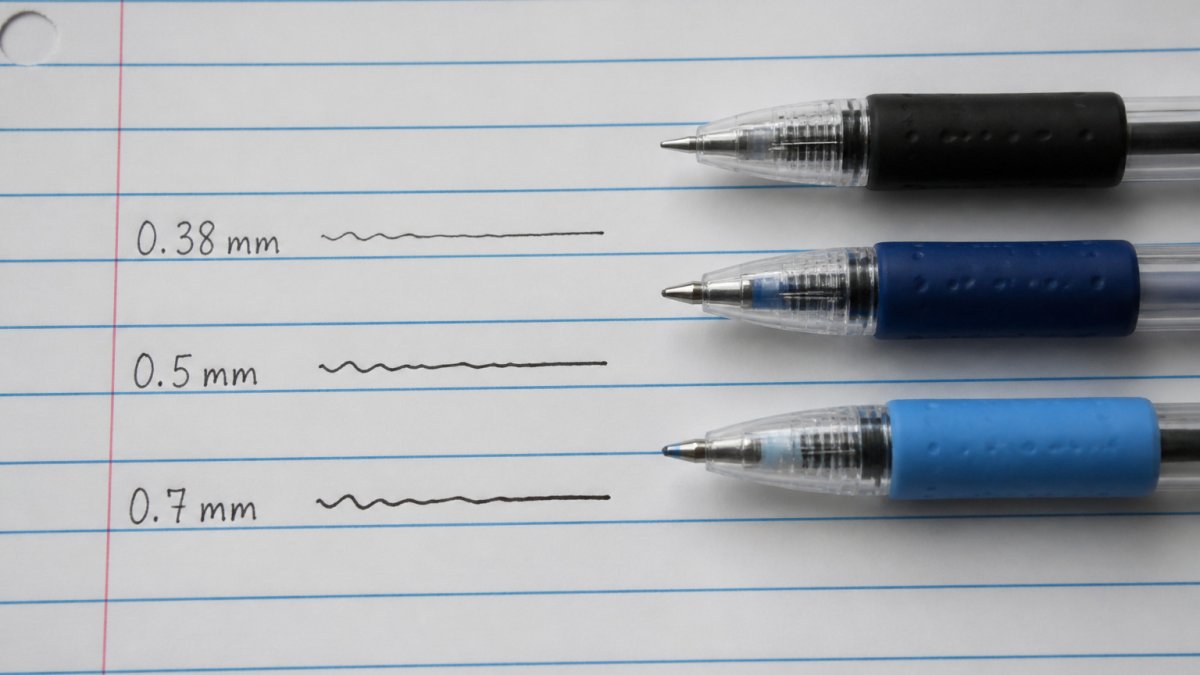
The article compares common gel pen tip sizes and how each one plays out in a lecture setting.
| Tip size | Best for | Key difference |
|---|---|---|
| 0.38-0.4 mm (extra-fine) | Crowded notes, small margins, planners | Crisp lines but can feel scratchy |
| 0.5 mm (fine) | Most classroom note-taking | Fits about 10-12 words per line |
| 0.7 mm (medium) | Headings and diagrams | Easier to read but may show through thin paper |
| 1.0 mm and wider | Rarely recommended for dense notes | Bleeds through paper and hard to decipher |
Pentel EnerGel vs. Zebra Sarasa for Lecture Notes
Pentel EnerGel and Zebra Sarasa are two gel pen lines students often compare. Neither is universally better, the right pick depends on how fast you write, whether you are left-handed, and what paper your notebook uses. Selecting the proper ink flow becomes even more critical when annotating books, as the wrong choice can lead to unsightly bleed-through that obscures the text on the reverse side of the page.
Ink and drying. If smudging is your main pain point, test both pens on the paper you actually use, since drying speed can vary between smooth and absorbent notebook stock.
Become a part of our AAE family and start fundraising today! →
Pentel EnerGel product and refill information
Zebra Sarasa product and refill information
Best Colored Gel Pens for Organizing Notes
Colored gel pens can help you sort notes by topic, and gel pens for note taking in several colors make it easy to mark key terms or separate definitions from examples. Many students use one color for headings, another for formulas and a third for questions to revisit.
Keep the palette simple. Three to five colors are usually enough to organize a page without making it hard to read. Pick colors with strong contrast against the paper, and test each one for smudging, since some lighter shades dry differently from darker ones.
Colored ink also works well for study review. Use the same color system across all of your classes so you can find information quickly before an exam.
Downsides of Gel Pens and Exam Rules
Gel pens are not perfect for every student. Some note-takers find the ink too wet, especially on thin paper, and a few dislike the feel of gel compared with ballpoint. Some note-takers find gel pens less comfortable than other styles, so the right pen depends on personal preference.
Check your school's rules before exams. Some testing settings require a specific pen type, and some do not allow certain colors or erasable ink. Ask your instructor or review the exam policy if you are unsure, and bring a backup pen that meets the requirements.
Choosing Your Note-Taking Pen Before the Next Lecture
Start with the features that matter most to your notes: quick drying, a tip size that fits your handwriting, smooth flow and affordable refills. Then test two or three pens on the paper you use in class.
Our advice is simple. Pick one pen for everyday lectures, keep a second color pen for organizing, and replace refills before they run dry in the middle of a lecture. Small choices like these make class notes easier to read and easier to use later.
For current options and availability, visit African American Expressions and browse the stationery collection.
Frequently Asked Questions
Which pen is better for note-taking: Pentel EnerGel or Zebra Sarasa?
Both are popular gel pens for class notes, and the better choice depends on your handwriting pressure, paper, and preferred line width. Compare them by testing each on the notebook paper you actually use, checking how quickly the ink dries and whether it smears when you rest your palm on the page. Buy a single pen of each type at a retail store to test before committing to a multipack, since prices and availability vary by location and retailer.
Do gel pens dry quickly enough for fast note-taking?
Many gel inks dry within seconds on standard notebook paper, which reduces smudging when you write quickly and move your hand across the page. Drying speed still varies by ink formula, paper coating, and how hard you press. Test a line, drag a fingertip across it after a few seconds, and see whether it smears before you rely on a pen for timed lectures.
Which pen tip size is best for class notes?
A fine or extra-fine tip, often around 0.5 mm, fits more text on each line and works well for dense lecture notes. Medium tips are easier to read from a distance and suit students who press lightly or write large. Choose one size for body text and keep a second color or size for headings and key terms.
Are gel pens allowed in exams?
Rules differ by school, testing body, and exam type, so check the official instructions for your specific test before the exam day. Many schools permit gel pens, but some require ballpoint or specific ink colors. Ask your instructor or proctor directly if the policy is unclear.
