

Table of Contents
- Defining Cultural Calendars vs Standard Office Planners
- Quick Comparison: Features and Functionality
- Productivity and Cognitive Load: Paper vs Digital
- Black Heritage Stationery Brands and Cultural Identity
- Why Choose Culturally Inclusive Office Supplies
- African American Expressions Fundraising Program for Organizations
- Choosing the Right Tool for Your Workflow
- Frequently Asked Questions
Last Updated: September 19, 2026
Defining Cultural Calendars vs Standard Office Planners
When comparing cultural calendars vs standard office planners, what separates them? The answer goes deeper than aesthetics. A cultural calendar is a planning tool that integrates significant dates, observances, and holidays meaningful to a specific community, celebrating heritage, religious traditions, and historical milestones alongside everyday scheduling. A standard office planner, by contrast, treats the calendar as a neutral grid for appointments and deadlines, typically featuring generic holidays and Western business conventions.
The distinction matters because the planner you choose shapes how you think about time itself. Research from Baylor University's Keller Center for Research found that individuals using paper calendars make higher-quality plans and achieve better completion rates compared to those relying solely on digital versions. When that paper calendar reflects your cultural identity, the stakes shift further, planning becomes an act of affirmation, not just task management.
African American Expressions offers culturally inspired planning tools that bridge this gap. Products like the 2027 Black History Weekly Planner ($18) and 2027 Walking by Faith Calendar ($16) embed cultural significance into your daily workflow, turning routine scheduling into a practice that honors heritage.


Quick Comparison: Features and Functionality
Standard office planners excel at tracking appointments with minimal friction: clean layouts, ample writing space, and corporate calendar compatibility. But they're deliberately blank, no context, no celebration, no acknowledgment that your life contains moments beyond meetings.
Cultural calendars layer meaning onto scheduling by marking religious observances, historical anniversaries, cultural celebrations, and community milestones. The 2027 Black History Calendar from African American Expressions ($16) features 12 full-page months celebrating visionaries like Frederick Douglass and W.E.B. Du Bois, turning each month into a teaching moment.
Here's the practical breakdown:
| Feature | Standard Office Planner | Cultural Calendar |
|---|---|---|
| Monthly overview | Yes | Yes |
| Weekly spreads | Yes | Often minimal |
| Daily appointment space | Extensive | Limited |
| Cultural/religious dates marked | No | Yes |
| Educational content | None | Integrated |
| Heritage imagery | Generic or absent | Culturally specific |
| Best for scheduling | Optimal | Adequate |
| Best for cultural connection | Poor | Excellent |
The trade-off is real: cultural calendars sacrifice appointment real estate for meaning. If you're managing hourly meetings, a standard planner handles that load better. But if you're balancing professional time with cultural participation, church events, and family observances, a cultural calendar keeps those commitments visible and honored.
Productivity and Cognitive Load: Paper vs Digital
The research on paper versus digital planning is well-established: Columbia Business School research documented that individuals using paper calendars achieve higher plan fulfillment than those relying on mobile or digital alternatives. The mechanism involves motor memory, the act of writing engages the motor cortex and creates stronger neural encoding than passive screen interaction. But this research typically compares neutral paper planners to digital tools. Cultural calendars introduce an additional cognitive layer that standard research doesn't capture.
Cultural calendars create three distinct cognitive benefits:
1. Semantic Priming and Motivation Exposure to heritage imagery and historical narratives primes your brain to recognize and prioritize related tasks. A cultural calendar showing Black History Month context and visionary profiles activates motivation networks, making you more likely to block time for community service, cultural learning, and family gatherings because those commitments are cognitively present.
2. Emotional Encoding and Long-Term Retention Emotionally significant information is retained longer than neutral data. A church member marking a service date in a Walking by Faith Calendar, surrounded by scripture and spiritual imagery, is more likely to remember and honor that commitment than one entering it into a generic digital calendar. Emotional salience acts as a retention multiplier.
3. Cognitive Load Trade-off and Intentionality Cultural calendars sacrifice appointment real estate for meaning, forcing intentionality: you must choose what matters most. This selectivity reduces decision fatigue and planning paralysis. Paradoxically, less space creates clearer priorities.
Use a cultural calendar for medium-to-long-term planning and time blocking around significant dates. Pair it with a digital tool for real-time notifications and syncing. The 2027-2028 Black History Checkbook Planner ($6) serves this purpose: pocket-sized, portable, culturally grounded, yet minimal enough to complement digital systems.

Teams using shared cultural calendars alongside digital scheduling systems show better cross-cultural communication.
Black Heritage Stationery Brands and Cultural Identity
The stationery market is projected to grow from USD 1.25 billion in 2026 to USD 1.73 billion by 2035, according to Business Research Insights. Within that expansion, Black heritage brands occupy a distinct niche: they're not just selling organizational tools but affirming identity and supporting community economic strength.
Why Choose Culturally Inclusive Office Supplies
Culturally inclusive office supplies create accountability through visibility. When your calendar celebrates Black history, you're more likely to block time for community engagement, cultural learning, or spiritual practice.
African American Expressions Fundraising Program for Organizations
The African American Expressions fundraising program offers a straightforward model: earn 40% on every sale while distributing products your community values.
Choosing the Right Tool for Your Workflow
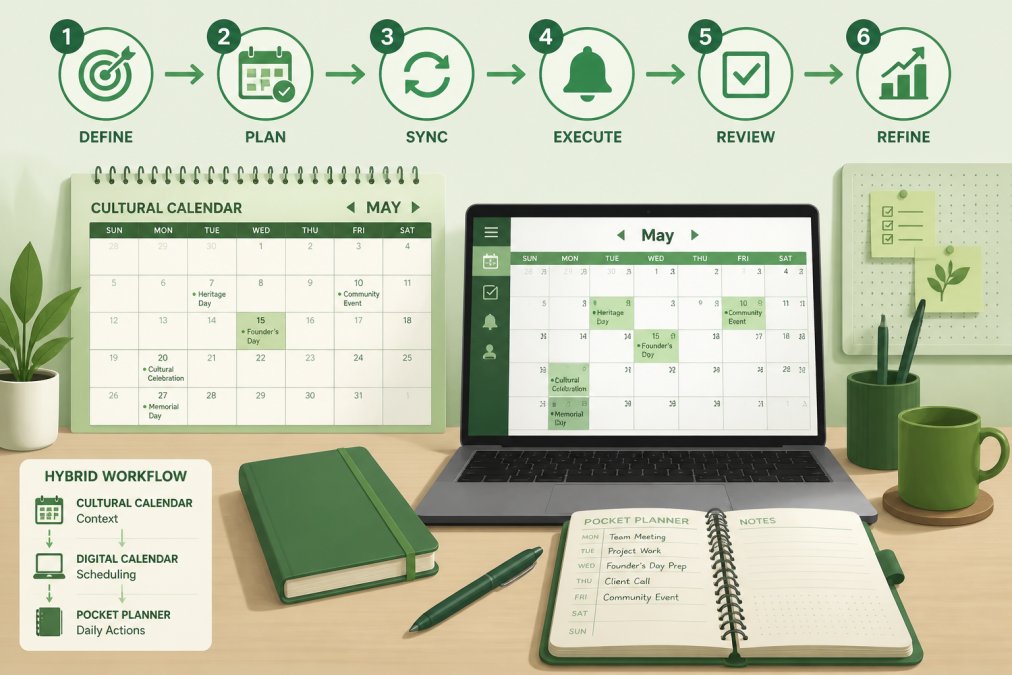
The decision between cultural calendars and standard office planners depends on your actual workflow, not your intentions. But the real competitive advantage comes from integrating both systems strategically. Here's how to diagnose your needs and build a hybrid setup that works.
Step 1: Audit Your Current Time Allocation
Track how you spend scheduled time and categorize commitments:
2027 Black History Calendar - Coming →
- Appointment-heavy (client meetings, recurring professional commitments)
- Project-based (multi-week deliverables, strategic planning)
- Cultural/spiritual (religious services, community events, family observances)
- Administrative (email, expense tracking)
Step 2: Match Tools to Time Categories
Step 3: Build Your Integration Protocol
-
Quarterly Planning (60 minutes, 4x per year): Block time for cultural observances, religious holidays, and family milestones in your cultural calendar. Use a highlighter to mark these dates as your "cultural anchor."
-
Monthly Sync (30 minutes, monthly): Transfer cultural calendar dates into your digital calendar. Create recurring events for annual observances and set notifications 2 weeks before major events.
-
Weekly Planning (20 minutes, weekly): Schedule appointments and project work. When you encounter a date marked as a cultural observance, decide if you need to block preparation time or communicate this commitment to colleagues.
-
Daily Capture (5 minutes, daily): Use your pocket planner for quick tasks and notes. Transfer anything requiring scheduling into your standard planner or digital calendar.
Step 4: Manage Overlap and Conflict
- Visibility Rule: Mark cultural observances in your digital calendar so colleagues see them and conflicts are prevented.
- Negotiation Window: When conflicts emerge, "I have a family observance marked for that date" is clearer than "I'm not available."
- Quarterly Adjustment: Review previous conflicts. Did certain observances consistently clash with work? Block time earlier or communicate observances to your team in advance.
Step 5: Organizational Implementation
-
Distribute cultural calendars to all team members as a shared reference.
-
Create a shared digital calendar with major cultural observances and religious holidays marked to prevent scheduling conflicts.
-
Establish a communication protocol: When scheduling meetings, check both calendars. If a conflict exists, offer alternative times.
-
Train managers to recognize cultural observances when reviewing team availability.
Common Implementation Mistakes to Avoid
- Mistake 1: Treating cultural calendars as decorative. They're functional tools. Use them actively in your planning process.
- Mistake 2: Failing to sync cultural dates into digital systems. If a date exists only in a physical calendar, it won't trigger notifications or prevent scheduling conflicts.
- Mistake 3: Over-scheduling around cultural observances. You don't need to block entire days. Mark the observance, decide what time commitment it requires, and schedule accordingly.
- Mistake 4: Assuming everyone knows your cultural observances. Communicate them explicitly, especially in multicultural teams. A shared calendar does this work for you.
Start with a cultural calendar for quarterly and annual planning, then layer in digital tools for daily scheduling. This combination captures the meaning-making benefits of paper while maintaining the convenience of digital synchronization across devices. The key is intentional integration, not parallel systems that never talk to each other.
Frequently Asked Questions
What is the difference between a cultural calendar and a standard office planner?
Cultural calendars celebrate heritage, holidays, and observances specific to a community while serving as scheduling tools. Standard office planners focus purely on task management, appointments, and deadlines without cultural context. Cultural calendars from brands like African American Expressions integrate meaningful imagery and historical figures into the planning experience, making them both functional and inspirational for daily use and organizational goals.
Do cultural calendars offer the same organizational features as standard planners?
Yes. Cultural calendars and standard planners both include time blocking, task management, and appointment tracking. The 2027 Black History Weekly Planner, for example, features monthly tab dividers, budget and note sections, and weekly layouts identical to conventional planners. The primary difference is content: cultural calendars add heritage imagery, historical narratives, and observance dates that enhance engagement without sacrificing functionality.
Why should I choose a culturally inspired calendar for my office?
Paper-based planning tools improve plan quality and task completion rates. Culturally inspired calendars add an emotional and identity component that increases accountability and motivation. They also create an inclusive workspace that reflects community values. For organizations, they signal commitment to cultural representation and support Black-owned businesses while maintaining professional productivity standards.
How do African American Expressions products support community fundraising?
African American Expressions offers a fundraising program where schools, churches, and organizations earn 40% commission on every sale. Products like the 2027 Black History Weekly Planner ($18.00) and 2027 Black History Calendar ($16.00) are high-demand items perfect for fundraising. Over 34 years, the program has generated millions of dollars for organizations. This model allows groups to raise funds while distributing culturally meaningful products that strengthen community pride and engagement.
Are cultural calendars effective for professional time management?
Absolutely. Cultural calendars deliver the same time management, task organization, and deadline tracking as standard planners. Studies show paper planners improve plan fulfillment and task completion. The added cultural dimension simply makes the planning process more meaningful without compromising effectiveness.