

Table of Contents
- What You'll Need Before You Start
- How to Style Cultural Artifacts in a Modern Home
- Blending Cultural Styles in Interior Design
- Is Heritage Decor Worth the Price?
- Ethical Sourcing and Avoiding Cultural Appropriation
- Caring for Heirlooms and Preserving Legacy Pieces
-
Budget-Friendly DIY Heritage Decor Ideas
- 1. Build an Ancestral Photo Wall
- 2. Display Inherited Textiles Instead of Storing Them
- 3. Group Woven Baskets You Already Own
- 4. Frame Archival Images and Documents
- 5. Layer One Meaningful Pillow Cover Over Plain Cushions
- 6. Upcycle a Piece of Furniture With Heritage Detail
- What to Spend On vs. What to DIY
- Common Mistakes to Avoid When Decorating with Cultural Heritage Items
- Frequently Asked Questions
Last Updated: September 16, 2026
What You'll Need Before You Start
Decorating with cultural heritage items works best when you treat it as curation, not shopping. The global home decor market is valued at an estimated $862.18 billion in 2026, per Musa Art Gallery's home decor statistics, and within that market, "Modern Heritage" has emerged as a leading design style, defined by natural materials like solid wood, brick, and stone paired with muted palettes (Good Housekeeping's 2026 design coverage).
Before you buy anything, gather these:
- A clear story for each room. Decide which culture, era, or family line each space will honor.
- Measured wall and surface space. Hand-carved pieces and textiles need room to breathe.
- A budget range per piece, so you can choose quality over quantity.
- Provenance questions for every seller: who made it, where, and how it was acquired.
- A maintenance plan for anything fragile, textile-based, or antique.
How to Style Cultural Artifacts in a Modern Home
Styling cultural artifacts is the practice of placing heritage objects so they function as focal points rather than background clutter. The goal is a curated space where each piece carries visual weight and a story. Co-design research in the heritage sector shows that tangible interactions between people and cultural objects create stronger emotional engagement (Taylor & Francis research on tangible heritage interactions), and the same principle applies at home: pieces you can touch, use, and explain get noticed.
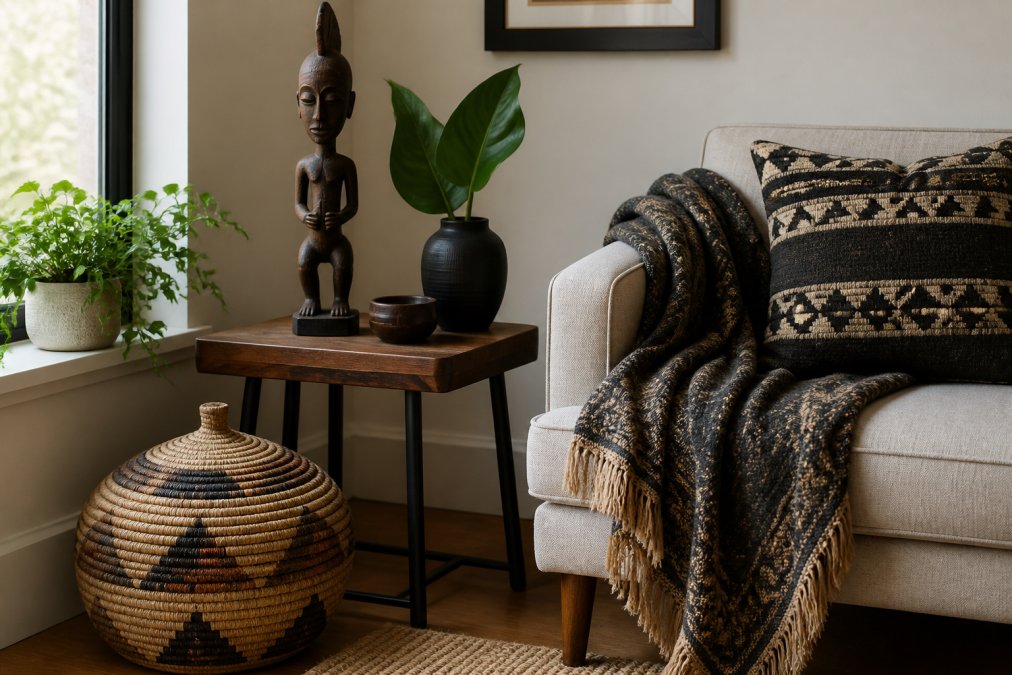
Three placement rules that hold up in practice:
- One anchor per surface. A single hand-carved sculpture on a console beats five small trinkets.
- Vary height deliberately. Pair a tall carved piece with a low woven basket to create a visual triangle.
- Leave negative space. Empty wall around a piece signals intention; clutter signals storage.
Room-by-Room Placement That Actually Works
Each room has a different sightline, traffic pattern, and light source:
- Entryway. One vertical anchor, a carved mask, tall textile, or relief panel, centered at roughly 57 to 60 inches from the floor, standard gallery eye level. Keep the console beneath nearly empty: a single bowl or candle.
- Living room. Treat the mantel or media console top as one composition. Group three objects of graduated height within an 18- to 24-inch span so the eye reads them as a unit.
- Dining room. A textile runner or woven wall hanging behind the table softens hard modern lines and creates a focal wall without competing with the table.
- Bedroom. Keep it low-stimulation: one framed piece above the headboard, one textile at the foot of the bed. Bedrooms reward restraint.
- Hallway or stairwell. Hang three to five related pieces in a single row with 2 to 3 inches between frames so the group reads as a collection.
Lighting Heritage Pieces Correctly
Texture is the point of most heritage objects, and flat overhead light kills it:
- Rake the light. A picture light or a small adjustable lamp aimed across, not straight down at, a carved or woven surface throws shadows that reveal depth.
- Keep UV off textiles. Sunlight fades cotton, wool, and natural dyes fast. Sheer curtains or UV-filtering film on the nearest window is the cheapest protection.
- Use warm bulbs. A 2700K to 3000K bulb flatters wood, brass, and natural fiber; cooler temperatures make them look gray and flat.
- Avoid backlighting framed art. Light behind glass creates glare that hides the piece entirely.
Displaying Sculptures and Hand-Carved Pieces
Sculptures need light and clearance. Position hand-carved wood or stone where natural light rakes across the surface, at eye level or slightly below so viewers read the detail:
- Give a sculpture at least 6 inches of clear space on every side. Crowded objects lose their silhouette.
- Match the base to the piece. A rough-hewn carving on glass looks accidental; on wood or stone it looks deliberate.
- Weigh it down. Museum putty or a felt pad under a top-heavy piece prevents tip-overs.
- Rotate on a schedule. Move sun-exposed pieces to shade every three to four months, preservation as much as styling.
Wall Art and Historical Narratives
Wall art does the heaviest storytelling. A piece like our Harriet Tubman Relief Art, a 39" x 29" framed relief by artist D.D. Ike, anchors a room because its depth and shadowing change through the day. Relief and canvas outperform flat prints.

- Hang it first, then build around it. Choose the anchor before the paint color or sofa.
- Center it on the wall, not the furniture. A piece centered on the sofa but off-center on the wall reads as a mistake.
- Leave 8 to 10 inches between frame bottom and furniture top. Closer feels cramped; farther feels disconnected.
- Write the story down. A card or phone note with the artist, year, and meaning turns a decoration into a conversation.
Blending Cultural Styles in Interior Design
Blending cultural styles is the deliberate combination of motifs, materials, and objects from more than one tradition into a single coherent room. It fails when pieces compete and succeeds when they share a common thread: color palette, material, or scale. Academic reviews of cultural heritage integration in interior design note a persistent gap between interest in the field and documented methods for applying it well (Malque Publishing review of heritage integration in interior design), which is why most blended rooms look accidental rather than designed.
| Unifying Thread | What Stays Consistent | What Varies |
|---|---|---|
| Palette | Muted earth tones | Pattern and origin |
| Material | Natural wood and cotton | Region and era |
| Scale | One large anchor per room | Small supporting accents |
Mixing Traditional Textiles with Contemporary Furniture
Textiles are the easiest entry point because they soften modern furniture without overwhelming it. Our Praises Go Up Pillow Cover, featuring Carl Crawford's artwork, adds narrative and color to a neutral couch without a redesign, while a 100% cotton throw like The Obamas Throw adds warmth and legacy storytelling.


Is Heritage Decor Worth the Price?
Heritage decor is worth the price when a piece carries verifiable craftsmanship, a documented maker, and a story you'll retell, not a premium for a generic motif.
Run every purchase through three questions:
- Is the maker named? Named artists and documented artisans hold value; anonymous imports rarely do.
- Is the material honest? Solid wood, cotton, and stone age well. Printed veneer doesn't.
- Will you display it for five years? If not, it's a seasonal buy, not a heritage piece.
Ethical Sourcing and Avoiding Cultural Appropriation
Ethical sourcing means buying from makers and businesses with a legitimate connection to the culture represented, transparent supply chains, and fair compensation. Cultural appropriation happens when sacred symbols get stripped of context and sold as trend decor. The line isn't who can buy what, it's whether the people behind the culture benefit.
How to source responsibly:
- Ask sellers who made the piece and how they were paid
- Avoid items that reproduce sacred or ceremonial objects for decoration
- Prioritize businesses that reinvest in the communities they represent
- Learn the meaning of a motif before you display it
- Skip "tribal" or "exotic" marketing language entirely
Caring for Heirlooms and Preserving Legacy Pieces
Preservation is a set of habits, not a one-time cleaning. Textiles, wood, and framed art each fail differently, and most damage comes from sunlight, humidity, and handling rather than age.
Quick care reference:
| Material | Main Threat | Routine Care |
|---|---|---|
| Cotton textiles | Sun fading, moths | Cold wash, store folded with acid-free tissue |
| Carved wood | Dryness, cracking | Dust dry, keep out of direct sun |
| Framed art | Humidity, UV | Hang away from windows, check mounting yearly |
| Baskets | Moisture, crushing | Display upright, never stack |
Budget-Friendly DIY Heritage Decor Ideas
Most guides assume you're buying heritage decor. For many households, the most meaningful pieces are already in a drawer, photo album, or relative's closet, the budget-friendly move is to bring them out rather than buy new. Spend on one anchor piece if you can, and DIY the supporting layers. Here's how.
1. Build an Ancestral Photo Wall
The highest-impact, lowest-cost heritage project in most homes.
- Gather the photos first. Scan or reprint anything fragile so originals stay safe. A print shop or drugstore kiosk can produce archival-quality reprints for a few dollars each.
- Match the frames. Buy one style in two or three sizes. Uniform frames make mismatched photos look intentional.
- Lay it out on the floor first. A loose grid with 2 to 3 inches between frames works well.
- Add a caption card. A small card with a name and date turns a photo into a story.
2. Display Inherited Textiles Instead of Storing Them
A quilt, woven cloth, or embroidery in a cedar chest does nothing for your home or its preservation.
- Hang it on a curtain rod with clip rings. No sewing, no damage, and it comes down in seconds.
- Use a textile or padded hanger for anything heavy so weight is distributed.
- Keep it out of direct sun. Fading is the number-one killer of inherited fabric.
- Rotate it. Three to four months on the wall, then rest in a dark, dry closet.
3. Group Woven Baskets You Already Own
Baskets are the cheapest texture in the house, and most people already own several.
- Group by material, not size. Three baskets in the same fiber read as a collection; mixed fibers read as clutter.
- Stack two and stand one. The height variation does the styling work.
- Display upright on an open shelf rather than nested, which crushes rims over time.
4. Frame Archival Images and Documents
Old family documents, land records, church programs, and newspaper clippings are heritage decor waiting to happen.
- Use acid-free mats and UV-filtering glass. Spend a little more here; it keeps the document from yellowing.
- Scan before you frame. Keep a digital copy so the information survives even if the paper doesn't.
- Hang away from windows. Paper and ink are the most light-sensitive materials in the house.
5. Layer One Meaningful Pillow Cover Over Plain Cushions
You don't need new furniture to shift a room's story. One cover with a meaningful print, like our Praises Go Up Pillow Cover featuring Carl Crawford's artwork, changes a neutral sofa without a redesign. Pair it with a solid throw so the print has something quiet to sit against.
6. Upcycle a Piece of Furniture With Heritage Detail
Paint and new hardware can turn a plain dresser into a heritage piece.
- Keep the original wood if it is solid. Paint is reversible; sanding through veneer is not.
- Swap hardware for a traditional motif. The cheapest way to signal an era or region.
- Add a textile runner on top. It protects the surface and adds story.
What to Spend On vs. What to DIY
| Element | DIY It | Buy It |
|---|---|---|
| Frames and mats | Reprints, layout, hanging | Acid-free mats and UV glass |
| Textiles | Hanging hardware, rotation | One quality anchor textile |
| Baskets | Grouping and display | Nothing, use what you own |
| Wall art | Family photos, documents | One narrative anchor piece |
| Furniture | Paint, hardware, styling | Nothing, upcycle what you have |
One $90 canvas, like our Praise Dancer Group Stretched Canvas, can carry an entire wall if surrounding pieces stay quiet. The DIY layer isn't about saving money, it's about making the one piece you buy look like it belongs.
Common Mistakes to Avoid When Decorating with Cultural Heritage Items
The most common mistake is treating heritage decor as a theme instead of a collection. Themed rooms look like sets; collections look like homes.
What to avoid:
- Clustering everything in one room. Spread pieces so the whole home tells the story.
- Mixing too many traditions without a unifying thread. Pick palette or material, not both.
- Buying for quantity. Five forgettable pieces are worth less than one you'll keep for decades.
- Ignoring scale. A small artifact on a large blank wall disappears.
- Skipping the story. If you can't explain a piece to a guest, it isn't doing its job.
Frequently Asked Questions
What are 5 examples of cultural artifacts I can use in my home decor?
Common cultural artifacts used in home decor include hand-carved wooden sculptures, woven baskets, traditional textiles such as mudcloth or kente, ceramic pottery with customary motifs, and framed historical artwork. Each piece carries a narrative and adds visual storytelling to your living space. When selecting cultural heritage items, choose pieces that reflect your cultural identity or ancestral legacy, and display them in curated spaces where they can be appreciated without clutter.
How do I know if heritage decor is worth the price?
Heritage decor is worth the price when it is authentic, well-crafted, and holds personal or cultural significance. Look for artisanal techniques like hand-carving or embroidery, and verify that materials are durable. Pieces from established Black-owned businesses often come with a story and support community economic strength. For example, a $240 Harriet Tubman relief art piece offers historical significance and lasting quality, making it a meaningful investment rather than a disposable trend.
How can I source authentic cultural heritage items ethically?
Source from Black-owned businesses, local artisans, or reputable galleries that credit the makers and share the cultural context of each piece. Ask about the origin of materials and whether the artists receive fair compensation. Avoid mass-produced items that copy customary designs without attribution. Ethical sourcing ensures your decor honors the culture rather than appropriating it, and it supports the communities that keep these traditions alive.
What are the best ways to preserve delicate cultural heritage decor?
Keep textiles out of direct sunlight and rotate them every few months to prevent fading. Dust sculptures with a soft brush, and use acid-free backing for wall art. For heirlooms like woven baskets, maintain indoor humidity around 40-50% to prevent drying and cracking. Store unused pieces in breathable cotton bags, not plastic, and handle with clean hands to avoid transferring oils that can damage surfaces over time.