

Table of Contents
- Why Black History Month Classroom Activities Need a Fresh Approach
- Black History Month Lesson Plans for Elementary Students That Stick
- Interactive Black History Classroom Projects for Deeper Engagement
- Culturally Responsive Teaching Resources for Every Classroom
- How to Keep Black History Going All Year Long
- Common Mistakes That Make Black History Month Activities Feel Hollow
- Conclusion
- Frequently Asked Questions
Last Updated: September 6, 2026
Why Black History Month Classroom Activities Need a Fresh Approach
Meaningful Black History Month classroom activities go beyond surface-level hero worship, focusing instead on primary sources, student inquiry, and the complexity of lived experience. This guide from African American Expressions offers educators a practical path toward richer, more honest instruction.
The shift toward experiential and interactive learning is gaining real momentum in schools. Educators are increasingly turning to platforms that weave songs, videos, and interactive lessons into standard curricula to boost student engagement Flocabulary's approach to multimedia learning. At the same time, schools are adopting museum-style classroom environments where students research and present on Black history figures to their peers, a model endorsed by the National Association of Elementary School Principals. Below, we'll show you exactly how to plan lessons that generate genuine curiosity and critical thinking, not just passive listening.
Black History Month Lesson Plans for Elementary Students That Stick
Strong black history month classroom activities for elementary students make children active participants rather than spectators. Here are two complete lesson frameworks you can adapt for your classroom.
Interactive Read-Alouds with Primary Sources
Pairing a picture book with a primary source makes the past feel real. This framework takes about 45 minutes.
For grades K-2: Ruby Bridges and School Desegregation
-
Hook (5 minutes): Show a photograph of Ruby Bridges walking into William Frantz Elementary School in 1960, surrounded by federal marshals. Ask: "What do you notice? What do you wonder?" Record responses on chart paper.
-
Read-Aloud (15 minutes): Read The Story of Ruby Bridges by Robert Coles. Pause at key moments to ask feeling-based questions: "How do you think Ruby felt on her first day? Why do you think she kept going back?"
-
Primary Source Analysis (10 minutes): Return to the photograph. Ask what details they notice now that they know the story. Introduce "primary source" as a firsthand account from the past.
-
Response Activity (10 minutes): Have students draw a time they showed courage and dictate or write one sentence about it. Display these alongside the photograph to connect history to their own lives.
-
Extension: Use Norman Rockwell's painting The Problem We All Live With (1964) as a secondary source. Compare the painting to the photograph. How are they the same? How are they different? Why might an artist create a painting of a historical event?
For grades 3-5: The Greensboro Sit-Ins
-
Hook (5 minutes): Ask students: "What would you do if you were told you couldn't eat at a lunch counter because of your skin color?" Have them write a quick response in a journal.
-
Build Background (10 minutes): Read a short excerpt from Sit-In: How Four Friends Stood Up by Sitting Down by Andrea Davis Pinkney. Explain that in 1960, four college students in Greensboro, North Carolina, sat at a segregated Woolworth's lunch counter, were refused service, and stayed until the store closed.
-
Primary Source Analysis (15 minutes): Show the actual Woolworth's lunch counter menu from the Smithsonian National Museum of American History's online collections. Discuss: What items were on the menu? How much did a sandwich cost? Why was refusing service based on race unfair? Then show a photograph of the four students at the counter.
-
Discussion (10 minutes): Guide a structured discussion: "What risks did the students take? What strategies did they use to protest peacefully? How did their actions lead to change?" Emphasize that the sit-in movement spread to over 50 cities within weeks (naesp.org).
-
Response Activity (5 minutes): Have students write a journal entry from the perspective of one of the four students, describing their feelings as they sat at the counter.
Music and Movement: Learning Through Spirituals and Protest Songs
Music offers an immediate emotional connection to history that text alone often cannot. This framework helps students analyze music as a historical document.
For grades K-2: "This Little Light of Mine"
-
Listen (5 minutes): Play a recording of "This Little Light of Mine." Have students clap along to the rhythm.
-
Discuss (10 minutes): Ask: "What is the song about? What does 'let it shine' mean?" Explain that it began as a spiritual and became a Civil Rights Movement anthem, sung at marches to express hope and determination.
-
Move (10 minutes): Teach students simple hand motions to accompany the song. Have them stand and sing together, just as protesters did.
-
Connect (10 minutes): Show a photograph of children in the 1963 Children's Crusade in Birmingham, Alabama. Ask: "Why do you think children sang while they marched? How might singing have helped them feel brave?"
For grades 3-5: "We Shall Overcome"
-
Listen (5 minutes): Play the Pete Seeger or Joan Baez recording of "We Shall Overcome." Ask students to listen for the message without seeing the lyrics first.
-
Analyze (15 minutes): Distribute printed lyrics. In pairs, students underline phrases expressing hope, determination, or unity. Discuss: "What does 'I do believe' mean? Why is 'we shall overcome' repeated?"
-
Historical Context (10 minutes): Explain that this song evolved from an old spiritual and became the unofficial anthem of the Civil Rights Movement, sung at the 1963 March on Washington and marches throughout the South. Show a short video clip of it being sung at a historical march.
-
Compare (10 minutes): Play a contemporary protest song or modern cover. Ask: "How is this similar to or different from the original? Why do protest songs remain important today?"
-
Create (5 minutes): Have students write one new verse reflecting a hope for their community or the world.
These frameworks build historical inquiry skills naturally. For younger learners, a letter, a song lyric, or a newspaper clipping can serve as a powerful entry point into a larger story.
Interactive Black History Classroom Projects for Deeper Engagement
Interactive black history classroom projects are most effective when they give students ownership over their own learning. Research projects, debates, and creative presentations beat worksheets because they demand that students synthesize information and form their own conclusions.
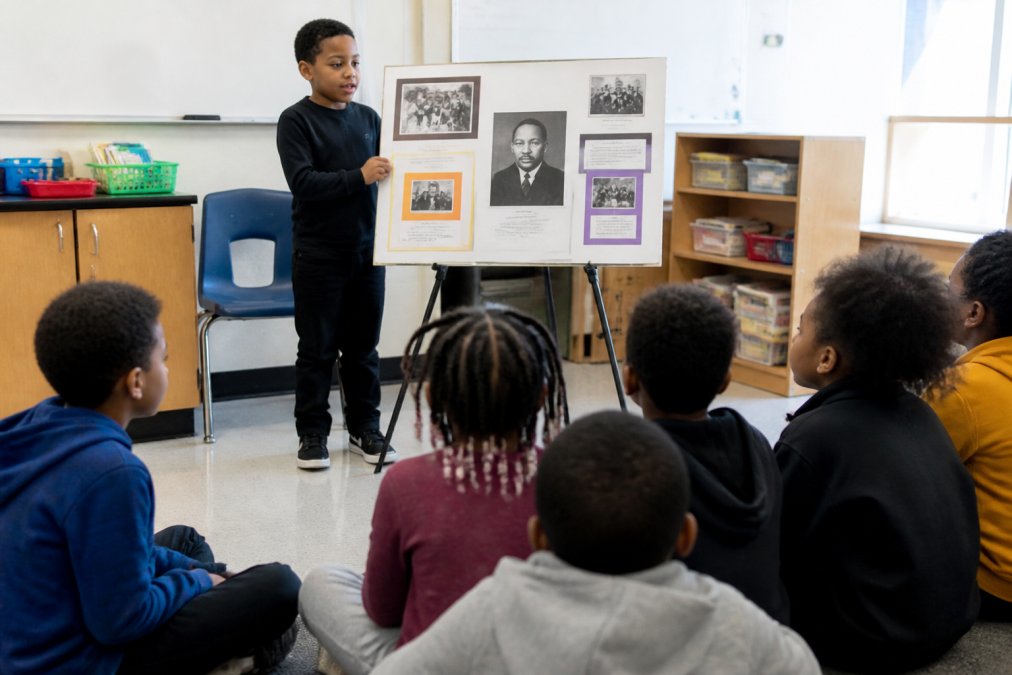
Museum Walk: Student-Led Gallery Exhibits
Transform your classroom into a gallery. This project spans one to two weeks and culminates in a gallery walk.
Implementation Timeline:
-
Day 1-2: Topic Selection and Research. Assign each student or small group a historical figure, event, or cultural movement. Provide a curated list spanning beyond usual figures: artists like Augusta Savage, scientists like Percy Julian, writers like Zora Neale Hurston, and activists like Bayard Rustin. Give students a research organizer with guiding questions: What did this person accomplish? What obstacles did they face? Why is their story important? What primary sources exist?
Become a part of our AAE family and start fundraising today! →
-
Day 3-4: Exhibit Creation. Students create a visual exhibit like a poster or tri-fold board, including at least one image, one quote, and a timeline of key events. Encourage creativity, such as QR codes linking to audio clips or short videos.
-
Day 5: Gallery Walk. Arrange exhibits around the room. Half the class stands by their exhibits while the other half walks through, taking notes. Then switch. This encourages student voice and collaborative learning.
-
Day 6: Reflection and Assessment. Have students write a short reflection: "What did you learn from your own research? What did you learn from classmates' exhibits? What questions do you still have?" Use a simple rubric assessing research quality, exhibit completeness, and presentation clarity.
Differentiation for Neurodivergent Learners:
A unique angle most guides miss is building in accessibility from the start. For neurodivergent students, the traditional museum walk can be overwhelming due to noise and crowding. Consider these adjustments:
- Offer a quiet hour for the gallery walk with fewer students moving through at once.
- Provide noise-canceling headphones for students who need them.
- Allow students to present their exhibit one-on-one to the teacher instead of to the whole class.
- Offer alternative response formats: a student who struggles with writing might record an audio reflection or create a comic strip summary instead.
- Use visual schedules and clear expectations for each phase of the project.
These accommodations benefit all students, creating a calmer, more focused learning environment.
STEM Spotlights: Honoring Black Inventors and Scientists
Black history is often taught through the lens of struggle, but it is equally a story of innovation. Spotlighting Black inventors and scientists shows students that Black excellence spans every field.
Hands-On STEM Activities:
-
Garrett Morgan and the Traffic Light (Grades 2-5): After reading about Morgan's invention, have students design a light sequence for a model intersection using construction paper or LED circuits. Challenge them to think about timing and pedestrian crossings, connecting history to engineering design.
-
Katherine Johnson and Orbital Mechanics (Grades 4-8): Introduce Johnson's calculations for John Glenn's orbit. Have students plot coordinate points to simulate a spacecraft's trajectory. Discuss why precision mattered, a small error could mean missing the landing zone, making abstract math concrete.
-
George Washington Carver and Soil Science (Grades 2-5): Test soil drainage by pouring equal water into cups of sand, clay, and potting soil, measuring how quickly it drains. Discuss why Carver promoted crop rotation with peanuts and sweet potatoes to restore nitrogen, tying history to hands-on science.
-
Charles Drew and Blood Storage (Grades 6-8): Discuss Drew's work developing blood banks during World War II. Have students research blood types and why matching matters. A food coloring and water demonstration can illustrate how different types interact.
Digital Citizenship and Media Literacy Extension:
A content gap across most Black History Month activity guides is teaching students how to critically evaluate online sources about Black history. Add this component to any research project:
-
Source Evaluation Lesson (30 minutes): Teach the CRAAP test (Currency, Relevance, Authority, Accuracy, Purpose). Show two websites about the same figure: one from a reputable source like the Library of Congress or the National Museum of African American History and Culture, and one from an unverified personal blog or social media post.
-
Guided Practice: Have students compare the sources using a simple checklist: "Who wrote this? What evidence do they provide? Are there citations? When was it published? Why might one source be more reliable?"
-
Application: Require at least two sources for museum walk research, with citations. Ask students to note which sources they trusted and why.
-
Discussion: Talk about why media literacy matters for Black history. Misinformation has shaped public understanding of Black history for centuries; verifying sources is a form of historical justice.
This combination of hands-on STEM learning and critical media literacy gives students skills they will use long after February ends.
Culturally Responsive Teaching Resources for Every Classroom
Culturally responsive teaching resources are not an add-on for February; they are a lens for the entire school year. This pedagogy recognizes that culture is central to learning and that connecting curriculum to students' lived experiences improves engagement and outcomes.
For neurodivergent students, provide options like drawing, building, or recording a response instead of only writing. Offering multiple entry points ensures every learner can access the material and demonstrate their understanding.
How to Keep Black History Going All Year Long
The most meaningful instruction treats Black history as American history, not a separate month-long unit. Weaving Black figures and events into lessons throughout the year prevents the "February only" syndrome. supporting education through fashion.
Year-round integration also means being intentional about your classroom resources. Having culturally relevant books, puzzles, and games in a permanent classroom library reinforces that Black culture and history are valued every day.
Common Mistakes That Make Black History Month Activities Feel Hollow
A common mistake is focusing solely on pain and struggle, defining Black history only through slavery and the Civil Rights Movement. This narrative, while essential, is incomplete and can be emotionally draining. Balance stories of oppression with stories of joy, innovation, and cultural richness.
Another misstep is treating all Black people as a monolith. Ensure your lessons cover a range of figures and discuss the diversity of thought within the community. A lesson on the Civil Rights Movement should mention the different strategies of Martin Luther King Jr. and Malcolm X.
The table below summarizes common pitfalls and better alternatives.
| Common Mistake | Why It Falls Flat | More Meaningful Approach |
|---|---|---|
| Only teaching about struggle | Incomplete narrative | Balance with innovation and joy |
| Focusing on the same few figures | Shallow coverage | Include STEM pioneers and artists |
| Passive worksheets | Low engagement | Use primary sources and discussion |
| February-only lessons | Isolated learning | Integrate history all year |
| Stereotypical crafts | Trivializes history | Prioritize critical thinking |
Conclusion
Teaching meaningful black history month classroom activities requires intention, but the payoff is substantial. When students engage with primary sources, lead their own research, and see Black history reflected all year, they develop a richer understanding of the world.
At African American Expressions, we believe in supporting that mission beyond the classroom walls. For over 34 years, we have offered culturally inspired gifts, puzzles, and journals that make history tangible, like our Black Heritage Word Search Book or our Black Heritage Trivia Game Cards. These tools extend the conversation from the classroom to the family dinner table. For schools and churches, our fundraising program helps generate funds while spreading cultural pride.


Get started with African American Expressions and bring these stories to life in your community.
Frequently Asked Questions
What is the 2026 theme for Black History Month?
The Association for the Study of African American Life and History (ASALH) sets the annual theme. While the specific 2026 theme had not been announced at the time of writing, each year's theme focuses on a specific aspect of Black life, history, or culture. Check the ASALH website for the official 2026 announcement. You can design your classroom activities around the theme once it is released, which helps create a cohesive and meaningful Black History Month lesson plan.
How can teachers incorporate Black history into the curriculum year-round?
Weave Black history into your existing curriculum rather than isolating it to February. When teaching science, highlight Black STEM pioneers like Katherine Johnson. In literature, include books by Black authors across genres. Use primary sources like speeches and letters during social studies units. This approach builds cultural awareness and shows students that Black history is American history, not a separate topic reserved for one month.
What are some fun and engaging crafts for Black History Month?
Crafts work best when they connect to a historical figure or cultural tradition. Students can create quilt squares inspired by the Gee's Bend quilting tradition, design freedom quilts that tell a story, or make collages using images of influential Black leaders. For older students, try a collaborative mural project featuring Black artists like Jacob Lawrence or Alma Thomas. These hands-on projects encourage creative expression while building historical knowledge.
How do I make Black history activities accessible for neurodivergent students?
Offer multiple ways to participate. Some students thrive with hands-on projects, while others prefer written reflection or verbal discussion. Provide sensory-friendly options like quiet reading corners with biographies. Use visual schedules for multi-step projects. Allow students to choose how they demonstrate learning, whether through art, writing, or presentation. This differentiated approach ensures every student can engage meaningfully with the material.