

Table of Contents
- Why Cultural Appreciation Matters in Gift-Giving
- Start With the Person, Not the Category
- How to Choose Culturally Appropriate Gifts That Reflect Real Interests
- Black-Owned Gift Brands: Why They Change the Equation
- Black History Month Gift Ideas That Go Beyond February
- A Culturally Conscious Gifting Guide for Every Budget
- Etiquette, Stereotypes, and Performative Gifting: What to Avoid
- Frequently Asked Questions
Last Updated: September 30, 2026
Why Cultural Appreciation Matters in Gift-Giving
Choosing culturally appropriate gifts for Black friends starts with one idea: see the person, not a category. The Black community holds $1.7 trillion in spending power, according to the NAACP's 2026 Buy Black Gift Guide, and how you spend your gift dollars says something about what you value.
At African American Expressions, we have spent 34 years helping people find gifts that celebrate Black heritage with care. This guide shows you how to do the same, whatever your budget.

Cultural appreciation is the practice of honoring a person's heritage through informed, respectful choices rather than treating it as a theme. The difference between appreciation and appropriation comes down to intent, research, and where your money lands.
A Pew Research Center survey from February 2026 found that racial identity shapes how many Black Americans connect with one another. Gifts that affirm that identity land differently than generic ones.
Start With the Person, Not the Category
Ask what your friend actually loves before you think about heritage at all. A jazz fan wants concert tickets or a vinyl record. A home cook wants a good cast-iron skillet. A reader wants a book they will finish.
Black people are not a monolith, and a gift built on assumptions about "what Black people like" usually misses. Your friend's hobbies, faith, and sense of humor matter more than any cultural checklist.
A common mistake is buying the most visibly "Black" item on the shelf instead of the most fitting one.
How to Choose Culturally Appropriate Gifts That Reflect Real Interests
The reliable method is matching the gift to the person's real life, then layering in cultural meaning where it fits. Think of it as two filters: interest first, heritage second.
Match the Gift to Hobbies, Not Skin Color
Build a short list of what your friend does for fun, then look for culturally rooted versions of those items. A puzzle lover might enjoy the Black Heritage Word Search Book, which packs 100 large-print puzzles, trivia, and coloring borders into one $17.99 activity book.
- Readers: books by Black authors they have not read yet
- Hosts: trivia, card games, or a good journal for gathering notes
- Decorators: art and prints inspired by African heritage
- Letter writers: stationery with real substance
When to Ask, and How to Ask Well
Asking is fine, and most friends appreciate it. Keep it light: "I want to get you something you'll actually use. Is there anything you've had your eye on?"
Black-Owned Gift Brands: Why They Change the Equation
Where you buy matters as much as what you buy. The NAACP notes that Black entrepreneurs face disproportionate difficulty securing funding, so choosing Black-owned gift brands is a direct form of community support.
- 34 years in business
- Culturally inspired gifts, stationery, and home decor
- A fundraising program built for schools and churches
- 40% earned on every sale for partner organizations
Black History Month Gift Ideas That Go Beyond February
The strongest Black History Month gift ideas work in June and December too. That is the test: if a gift only makes sense in February, it is a gesture. If it fits year-round, it is a gift.
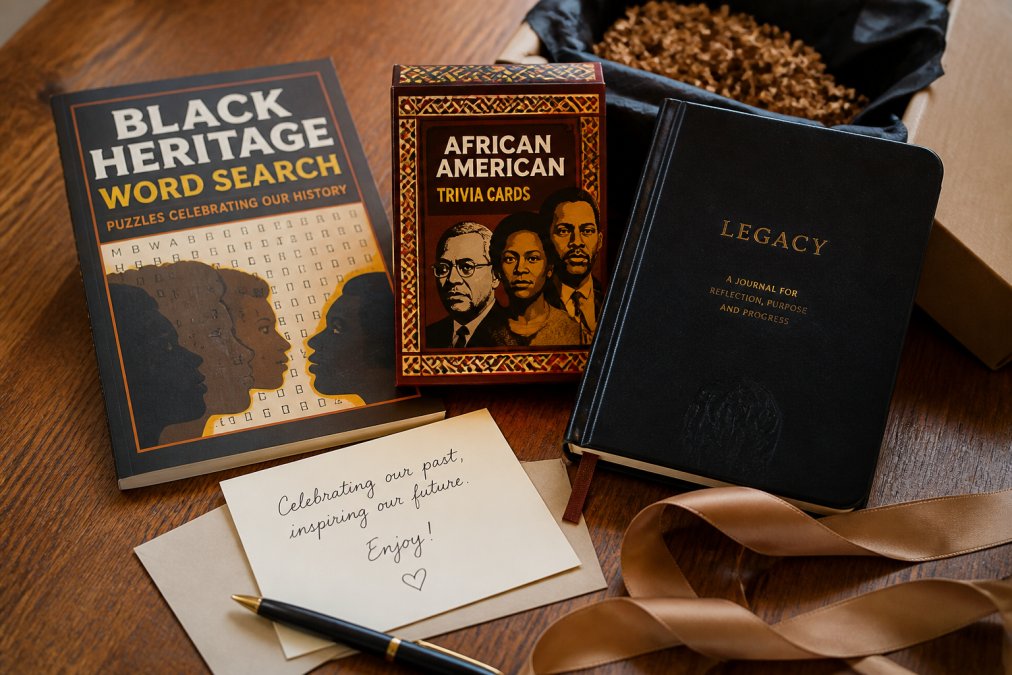
Books, Trivia, and Journals With Real Educational Value
Items with educational value do double duty: they entertain and they teach. The Black Heritage Word Search Book covers civil rights, HBCUs, inventors, and music legends across more than 2,000 words.
Black Heritage Word Search Book →
Art and Home Decor Inspired by African Heritage
Art is the gift that stays on the wall. Canvas prints and framed pieces inspired by African heritage give a homeowner something they see daily.
- Canvas art for new homeowners
- Calendars for kitchens and offices
- Greeting card boxes for people who still write notes
- Journals and stationery for students and teachers
A Culturally Conscious Gifting Guide for Every Budget
Price does not determine thoughtfulness. A $13 journal chosen well beats a $100 gift chosen badly, and the recipient usually knows the difference.
| Budget | Gift Idea | Best For | Why It Works |
|---|---|---|---|
| Under $15 | Black History Journal | Students, teachers, writers | Useful daily, culturally rooted |
| $15-$25 | Black Heritage Word Search Book | Puzzle fans, seniors, families | Screen-free, educational, all ages |
| $20-$25 | Maya Angelou Greeting Card Box | Letter writers, card collectors | 18 cards with envelopes, all occasions |
| $25-$40 | Black Heritage Trivia Game Cards | Game-night hosts, classrooms | 114 questions, plays with a group |
| $40+ | Art print plus a small item | New homeowners, close friends | Lasting decor with a personal touch |
Etiquette, Stereotypes, and Performative Gifting: What to Avoid
Most guides stop at a list of things not to buy. That list is necessary but not sufficient, because the real failure mode in cross-cultural gifting is not the object. It is the motive behind it. A gift can be perfectly appropriate on paper and still land as a performance.
What Performative Gifting Actually Looks Like
Performative gifting is buying something to be seen giving it rather than to be felt receiving it. The tell is almost always the audience. Ask yourself one question before you buy: would I still give this gift if no one else ever knew I gave it?
- The photo-first gift. You are already picturing the post before you picture your friend's face.
- The February-only gift. The item makes sense in February and nowhere else on the calendar.
- The conversation-starter gift. You want your friend to explain the item to you, or to your other friends.
- The absolution gift. The gift is doing work for a guilt you have not otherwise addressed.
The Self-Audit: Four Questions Before You Buy
Run any gift through these before you check out:
- Would I give this to a friend of any background with the same interests? If no, you are gifting a category, not a person.
- Does this require my friend to perform their identity for me? If yes, put it back.
- Am I buying this because it is good, or because it is visibly "the right kind" of gift? The second answer is the performative one.
- If my friend never mentioned this gift to anyone, would I still feel good about it? If no, the gift is doing reputational work.
The Stereotype Line, Stated Plainly
Some items are never appropriate, regardless of intent: minstrel-era imagery, watermelon and fried chicken as a "theme," costumes, blackface-adjacent novelty items, and "tribal" prints with no traceable origin. These are not gray areas.
How to Course-Correct If You Already Got It Wrong
If you realize after the fact that a gift was performative, do not over-apologize. A long apology makes the moment about your discomfort again. A short, direct acknowledgment works better: "I think I picked that one for the wrong reasons. Let me try again." Then actually try again, with the four questions above.
The Etiquette Rule That Covers Everything Else
When in doubt, follow the recipient's lead. If your friend talks about their heritage often, a heritage-rooted gift is welcome. If they rarely bring it up, a heritage-rooted gift from you may feel like a statement about them rather than a gift to them. Read the relationship, not the calendar.
Frequently Asked Questions
How can I ensure a gift is culturally respectful and appropriate?
Lead with the recipient's actual interests, then layer in cultural relevance. A friend who loves puzzles will appreciate a Black Heritage word search book more than a generic African print item. Avoid anything that reduces Black identity to a costume or a slogan. When in doubt, choose gifts made by Black creators that carry educational or historical grounding, and pair the item with a note explaining why you chose it.
Why is it important to support Black-owned businesses when gift-giving?
The Black community holds $1.7 trillion in annual spending power, according to the NAACP's 2026 Buy Black Gift Guide, yet Black entrepreneurs still face disproportionate difficulty securing funding. Buying from Black-owned gift brands directs money toward businesses that reinvest in their communities. It also gives you access to products with authentic representation rather than mass-market imitations, so the gift carries both cultural significance and real economic impact.
How do I avoid stereotypes when selecting culturally inspired gifts?
Focus on specific stories, achievements, and interests rather than broad symbols. A trivia game covering civil rights milestones and Black inventors is stereotype-free because it deals in facts. A generic item that treats Black culture as one monolithic aesthetic is not. Ask yourself whether the gift would make sense for this specific person if you removed race from the equation, then confirm the cultural elements add depth rather than decoration.
What are some thoughtful ways to celebrate Black heritage through gifts?
Choose items that invite learning and conversation. A Black history journal with scripture at the top of each page supports daily reflection. Trivia cards spark family game nights. Maya Angelou greeting cards let someone send encouragement all year. Pair any of these with a personal note about a shared memory. Thoughtful curation matters more than price, and heritage-focused gifts work for birthdays, graduations, and holidays alike.
Finding the right gift takes a little effort, and that effort is the point. African American Expressions offers culturally inspired gifts, stationery, and home decor built over 34 years, plus a fundraising program where schools and churches earn 40% on every sale. Browse the collection, pick something that fits your friend's real life, and let the gift do the talking.