

Table of Contents
- Why Culturally Inspired Gifts Drive Fundraising Success
- High Profit Fundraising Programs: What Your Organization Needs to Know
- Fundraising Ideas for Schools and Churches: Matching Gifts to Your Community
- Budget-Tier Segmentation: Gifts for Every Donor Level
- Cultural Authenticity and Ethical Sourcing: What to Look For
- Logistics of Bulk Procurement: Planning Your Order
- Post-Event Impact Reporting: Closing the Loop with Donors
- Frequently Asked Questions
Last Updated: October 3, 2026
Why Culturally Inspired Gifts Drive Fundraising Success
Culturally inspired gifts for community fundraisers work because they connect a donor's purchase to a cause they already care about. Total charitable giving reached an estimated $617.20 billion in 2025, according to Giving USA 2026 annual report, and the organizations capturing that money are the ones making the ask feel personal.
At African American Expressions, we have spent 34 years watching that connection play out. A greeting card featuring Maya Angelou's words does something a generic prize basket cannot: it tells the buyer their money supports a community that sees them.

The stakes are higher than most organizers assume. Monthly donors are 9x more likely than one-time donors to keep giving over a three-year period, per Zeffy's 2026 nonprofit statistics report.
Below, we break down how to match culturally inspired gifts to your audience, budget, and timeline.
High Profit Fundraising Programs: What Your Organization Needs to Know
High profit fundraising programs are built on margin, repeatability, and a product people actually want to buy twice. Recurring gifts now account for 31% of all online fundraising revenue, according to Zeffy's 2026 industry data, which tells you the money is in the second sale, not the first.
That reframes how you evaluate any program. A 40% commission on a $20 item beats a 15% commission on a $60 item if the $20 item sells three times as fast.
Here is the framework we use to evaluate a program:
| Evaluation Factor | Weak Program | Strong Program |
|---|---|---|
| Commission rate | 10-20% | 40% or higher |
| Product demand | Generic prizes | Culturally relevant, repeat-purchase items |
| Upfront cost | Inventory purchase required | No inventory risk |
| Setup effort | Weeks of planning | Order, distribute, sell |
| Donor appeal | One-time novelty | Items donors keep and rebuy |
Fundraising Ideas for Schools and Churches: Matching Gifts to Your Community
Fundraising ideas for schools and churches succeed or fail on one question: does the item fit the people already in the room?
Match the product to the audience: a church buying sympathy and thank-you cards is a different buyer than a school family stocking up on birthday cards.
- Churches and faith communities: boxed sympathy card assortments and inspirational card sets with scripture inside
- K-12 schools: all-occasion card boxes families can use year-round for teachers, coaches, and relatives
- Alumni and community groups: Maya Angelou and Phenomenal Women collections that carry a story worth retelling
The Sandy Clough Inspirational Greeting Card Assortment is our pick for churches.

Budget-Tier Segmentation: Gifts for Every Donor Level
Budget-tier segmentation means offering a gift at every price point your donors actually spend, so nobody feels priced out and nobody feels under-thanked.
Our catalog makes this easy with tight, clear price bands:
- Under $20: single greeting card boxes and small stationery sets for volunteer recognition or a thank-you table
- $20-$30: the All Occasion Assortment Box 13 featuring Maya Angelou's words, and the Sandy Clough Inspirational Greeting Card Assortment at $30
- $30 and up: bundled gift sets for major donor stewardship and sponsor recognition
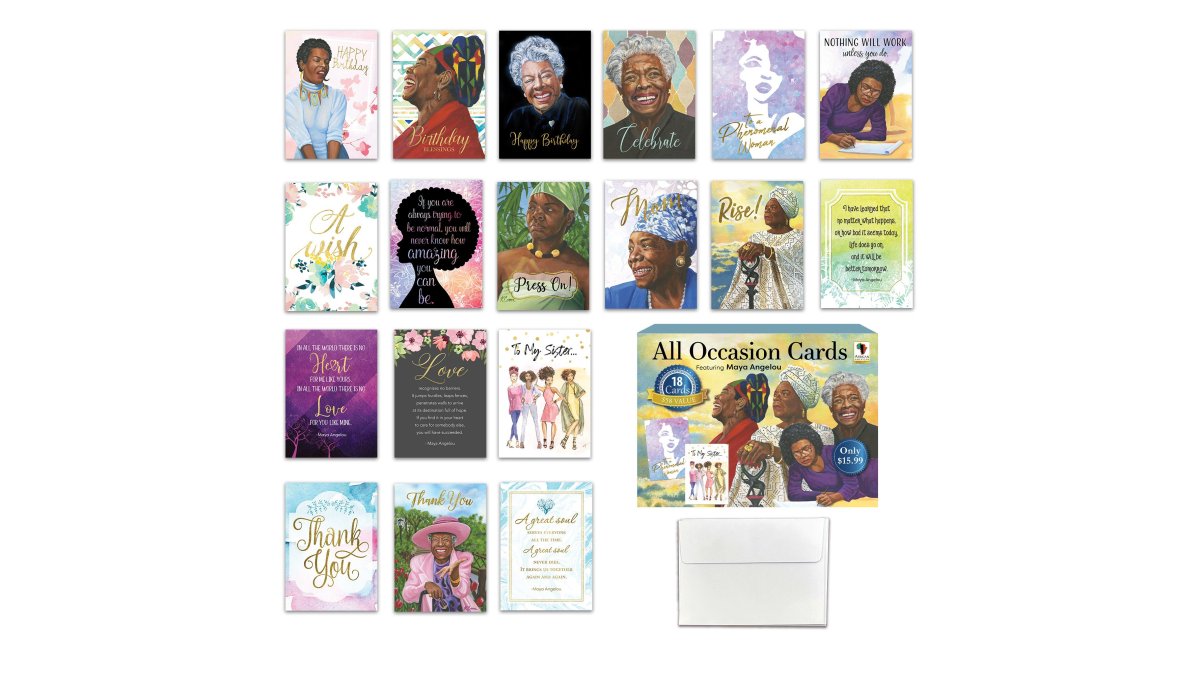
The Maya Angelou box is our middle-tier recommendation. It holds 18 cards spanning encouragement, birthday, romance, graduation, friendship, Mother's Day, thank-you, and sympathy occasions, printed on thick cardstock with 18 white envelopes, something donors will actually use.
Cultural Authenticity and Ethical Sourcing: What to Look For
Cultural authenticity is the difference between a product that reflects a community's heritage and one that borrows its imagery for a season. Research from Ohio State University's 2024 case study on donor motivations shows that internal culture shapes how donors respond to an organization's ask, which means the products you sell carry that culture whether you intend them to or not.
Most gift guides stop at "buy from diverse-owned businesses" and call it done. That advice is not wrong, but it is not a vetting process. Here is the framework we use, plus red flags that should stop an order cold.
The five-question supplier screen
Run every prospective supplier through these before you commit a single dollar:
- Who creates the work, and are they credited? A publisher that writes, illustrates, and credits its own artists differs from a reseller licensing stock art. Ask for the artist's name; if the answer is "our design team," ask who is on it.
- Is the cultural reference specific or generic? A card quoting Maya Angelou's actual words, or a scripture verse tied to a specific tradition, carries meaning. A vague "celebrate diversity" slogan is decoration, not heritage, and donors can tell the difference.
- Who owns the business, and does that ownership reach the creative decisions? Ownership matters most when it shapes what gets made, not just who signs the invoice, so ask how product decisions get made.
- Can the supplier trace the source of the artwork, text, or design? If nobody can tell you where the imagery came from or who licensed it, that is your answer. Untraceable sourcing is how appropriation ends up on your fundraising table.
- Does the supplier's own community benefit? A Black-owned publisher that employs Black illustrators and writers keeps the economic loop inside the community the product represents. A reseller licensing the same imagery does not.
Red flags that should end the conversation
- Seasonal-only representation. A supplier that stocks culturally specific products only during heritage months is selling you a trend, not a relationship.
- No named artists or writers. Anonymous creative work is the single most common sign of licensed stock imagery.
- "Inspired by" language with no attribution. If the product description leans on a culture without naming a creator from it, treat that as a warning.
The trade-off you will actually face
Authentic, community-rooted products usually cost more per unit than mass-produced alternatives, a box of cards from a Black-owned publisher may run a few dollars more than a generic big-box assortment at the same card count.
The math still works in your favor. If the authentic item sells through and the generic item sits, the higher-margin-per-unit calculation is irrelevant, you earned nothing on the unsold boxes.
Payment and access at the table
Digital wallets are reshaping how donors pay, with mobile giving crossing the 50% threshold in three major markets, according to Fundraise Up's Q1 2026 giving trends report. Make sure whatever you sell can be paid for from a phone at the table, a QR code linked to your donation page, a card reader, or both. An authentic product with no way to pay for it is a display, not a fundraiser.
ALL OCCASION ASSORTMENT BOX 13 - MAYA ANGELOU →
Logistics of Bulk Procurement: Planning Your Order
Bulk procurement fails on timing and minimums far more than on price. Order early, confirm the ship date in writing, and build a two-week buffer before your event date.
Work backward from the event date
Start with the day the boxes need to be on the table, then subtract:
- Two weeks for the buffer between delivery and event day
- The supplier's stated lead time for your order quantity (ask for it in writing)
- One week for payment processing and order confirmation
If your fundraiser lands on the first weekend of February for Black History Month, that math puts your order in December, not January. Groups that order in January pay for expedited shipping or run a table with half the inventory they planned.
Minimum order quantities and case packs
Most wholesale stationery and gift suppliers sell in case quantities, not single units. A case might hold 12, 24, or 48 units depending on the SKU. Before you calculate margin, confirm three numbers:
- The minimum order quantity (MOQ) for the SKU you want
- The case pack size, how many units ship per case
- The per-unit price at your order quantity, not the single-unit price
A common pattern is a price break at the case level: the per-unit cost drops once you cross a threshold. If your event needs 30 units but the price break starts at 48, decide whether you can sell the extra 18, a second table, a follow-up email sale, or a spring event. If not, pay the higher per-unit price rather than sit on dead inventory.
Split shipments and multi-table events
If your fundraiser runs across multiple tables, campuses, or service times, decide up front how inventory gets divided. Case packs rarely divide evenly, so plan for one location to hold the remainder, and label each box with its destination before the shipment arrives, re-sorting on event morning is how tables end up short.
Storage, shrinkage, and who owns the risk
Ask two questions before you sign anything:
- Who stores the inventory between delivery and the event? A church basement, a school office, and a volunteer's garage all carry different risks, damp, heat, and theft among them.
- What happens to unsold inventory? Some programs let you return unsold units; most do not. If you are buying outright, unsold boxes are your loss, not the supplier's. Programs that operate on consignment or with no upfront inventory cost shift that risk off your organization entirely, which matters most for first-time fundraisers.
Reorder windows mid-campaign
A sold-out table is a good problem, but only if you can restock. Before the event, ask your supplier the reorder lead time and whether a mid-campaign reorder ships at the same per-unit price as your original order. Some honor the original price; others reset to single-unit pricing on small reorders, knowing which changes how much you order the first time.
A simple planning worksheet
| Decision | What to confirm |
|---|---|
| Event date | Fixed |
| Order-by date | Event date minus lead time minus two-week buffer |
| Order quantity | MOQ, case pack, and price break all considered |
| Inventory split | Per-location counts, with remainder assigned |
| Storage | Named location and responsible person |
| Reorder plan | Lead time and price at reorder quantity |
| Unsold inventory | Return policy or write-off plan |
For a smaller congregation, start with one or two SKUs and a modest quantity. You can always reorder mid-campaign, and a sold-out table looks better than one with boxes left over.
Post-Event Impact Reporting: Closing the Loop with Donors
Post-event impact reporting is the step most organizers skip, and it determines whether donors come back next year.
Nonprofits using the Bloomerang platform see an average one-time gift of $201, which is 45% higher than the reported industry average of $139, according to Bloomerang's 2026 fundraising statistics.
Your recap does not need to be long. Three paragraphs and one photo of the event will do more than a formal annual report.
Running a fundraiser for a school or church means juggling volunteers, deadlines, and a community that expects the products you sell to reflect who they are. Browse our greeting card assortments and gift collections, then get started with African American Expressions and turn culturally inspired products into funding your community can count on.
Frequently Asked Questions
What makes a gift culturally inspired and why does it matter for fundraising?
A culturally inspired gift reflects the heritage, traditions, or identity of a specific community. For fundraisers, these items matter because they create an emotional connection with donors. When supporters see their own culture represented in greeting cards, artisan goods, or home decor, they are more likely to purchase and share the items. This authenticity builds trust and encourages repeat participation, which is essential for long-term donor retention.
How do culturally inspired gifts increase donor participation?
Donors engage more when they feel a personal connection to the cause and the products. Culturally inspired gifts, such as Maya Angelou greeting card assortments or Black women artwork stationery, resonate on a personal level. This connection turns a simple transaction into a meaningful gesture. When donors feel seen and celebrated, they are more likely to attend events, share on social media, and return for future campaigns, boosting overall participation.
What are the best fundraising products for community organizations?
High-margin, culturally relevant items work best. Greeting card assortments and accessories that celebrate Black heritage are strong sellers. These products have broad appeal for birthdays, holidays, and Black History Month. They also carry a meaningful message, which makes them easier to sell. Look for suppliers that offer bulk pricing and a generous commission structure, such as 40% on every sale.
How can nonprofits benefit from selling culturally inspired merchandise?
Nonprofits can tap into a loyal customer base that values authenticity. Selling culturally inspired merchandise raises funds and strengthens community ties. It also positions the organization as a supporter of cultural preservation. With recurring gift revenue now at 31% of online fundraising, according to Zeffy, adding merchandise can diversify income streams and improve donor retention. Monthly donors are 9x more likely to keep giving over three years.
How do you select high-margin products for a community fundraiser?
Start by calculating the profit per item after all costs. Look for suppliers that offer at least 40% commission or wholesale pricing. Choose products with broad appeal and cultural relevance, like greeting card boxes that cover multiple occasions. Consider the average one-time gift amount of $88, according to NPTechforGood, and price items so donors feel they are getting value while your organization earns a healthy margin.