

Table of Contents
- Why a Family Trivia Night Is the Perfect Way to Celebrate Black History Month 2026
- Black History Month Trivia Questions for Kids: How to Curate Age-Appropriate Content
- Your Trivia Night Planning Checklist: From Date to Decor
- Structuring Your Game: Rounds, Scoring, and Team Formation
- Black History Trivia Night Scripts: A Host's Guide to Keeping the Energy Up
- Black-Owned Business Gift Ideas for Prizes That Everyone Will Love
- Technical Setup for Hybrid or Virtual Trivia Nights
- Conclusion: Bringing Your Community Together Through Black History Trivia
- Frequently Asked Questions
Last Updated: October 2, 2026
Why a Family Trivia Night Is the Perfect Way to Celebrate Black History Month 2026
A family trivia night turns Black History Month into something everyone can share. Instead of reading facts alone, your whole household competes, laughs, and learns together. This guide from African American Expressions shows you how to plan Black History Month 2026 family trivia nights step by step.
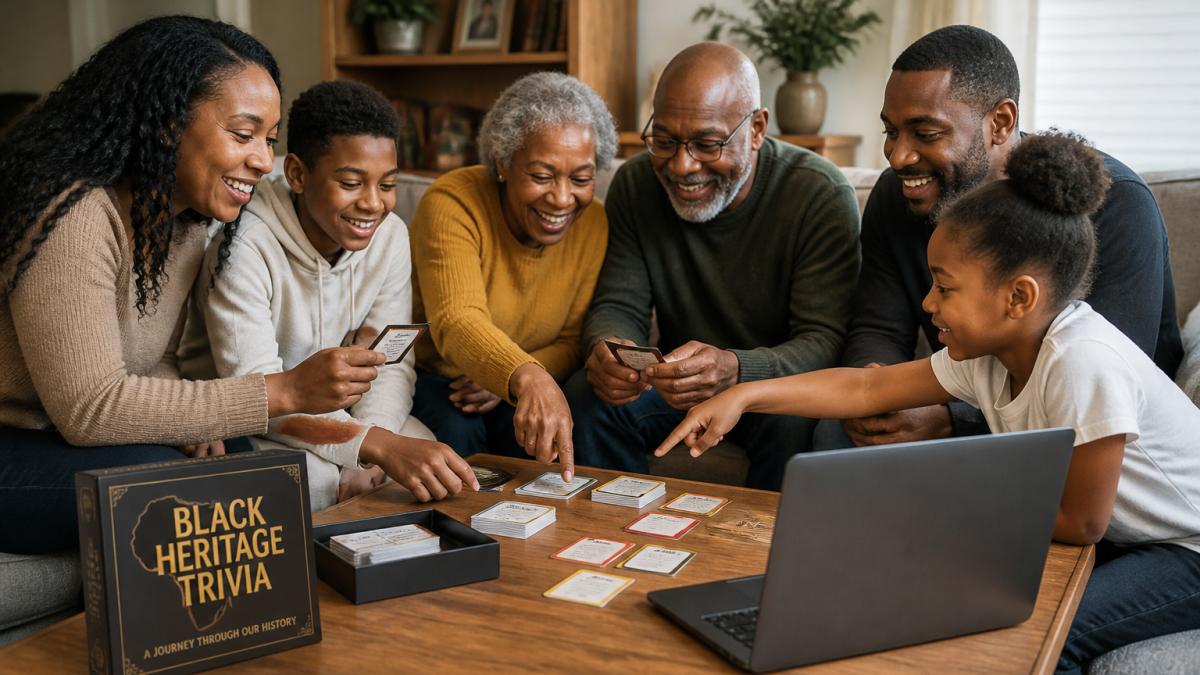
The timing has never been better.
Here is why this format works so well:
- It works for every age, from grandparents to grade-schoolers
- It sparks real conversations about African American history
- It costs little and takes one evening
- It builds pride through shared storytelling
Below, we walk through questions, scripts, prizes, and scoring. You will also see how to run the night in person or online.
Black History Month Trivia Questions for Kids: How to Curate Age-Appropriate Content
Black History Month trivia questions for kids should match each child's reading level and life experience. Easy wins keep young players engaged. Harder rounds give teens and adults something to chase.
A common mistake is using one question set for the whole room. Kids shut down fast when every answer goes over their heads. The fix is not to dumb down the whole game.
The Difficulty Ladder: A Framework for Mixed-Age Rooms
Most practitioners find that a workable family trivia night runs on a three-tier ladder inside every round:
- Tier 1 (warm-up): One question per round that a 6-year-old can answer from general knowledge. These exist to keep young players on the board.
- Tier 2 (core): Two to four questions per round pitched at a middle-school level. This is where most of the points live.
- Tier 3 (stretch): One or two questions per round that require real historical knowledge. These separate teams at the top of the scoreboard.
A round of eight questions might break down as 2 Tier 1, 4 Tier 2, and 2 Tier 3. That ratio keeps the game moving without leaving anyone behind.
Age Band Reference
- Ages 6-9: Simple who, what, and where questions. Stick to figures and events children may have encountered in school or in picture books.
- Ages 10-13: Dates, firsts, and famous quotes. This is the sweet spot for Tier 2 questions.
- Teens and adults: Deeper history, arts, and lesser-known figures. Reserve these for Tier 3.
- Mixed teams: Pair one older player with one younger player so the older player can coach rather than answer for the team.
Sample Questions by Age Group
Ages 6-9 (Tier 1)
- Who was the first Black president of the United States?
- What month do we celebrate Black History Month?
- Which civil rights leader gave a famous speech that starts with "I have a dream"?
Ages 10-13 (Tier 2)
- Who refused to give up her bus seat in Montgomery, Alabama?
- Which holiday honors the end of slavery in Texas?
- Who was the first Black woman to serve in the United States Congress?
Teens and adults (Tier 3)
- Who was the first Black woman to win the Nobel Prize in Literature?
- Which Black inventor created the three-position traffic signal?
- Which Black composer wrote the "Black National Anthem," and what is its title?
TriviaMaker's 2026 Black History question collection offers a ready-made bank you can sort by difficulty, which saves you from writing every tier yourself.
How to Test a Question Before You Use It
Read each question aloud to one adult and one child in your household before game night. If the child cannot understand the wording, rewrite it. If the adult answers instantly, move it up a tier. This two-person test catches most problems before they reach the room.
Your Trivia Night Planning Checklist: From Date to Decor
A trivia night planning checklist keeps you from scrambling the day of the event. Lock the basics first, then build the fun around them.
Use this checklist:
- Pick a date in February 2026 and a backup date
- Choose the location (living room, church hall, or community center)
- Set a start time and a two-hour run time
- Send invites two weeks ahead
- Assign a host and a scorekeeper
- Print or buy your trivia deck
- Buy small prizes
- Plan simple snacks and drinks
- Test your screen, speaker, and internet
- Prepare an answer key
Budget-Friendly DIY Hosting Tips
You do not need a big budget. A strong trivia night runs on planning, not spending.
- Print questions on index cards instead of buying a set
- Use a phone timer instead of a stopwatch
- Ask each family to bring one snack
- Award homemade certificates alongside small prizes
- Borrow a projector from a friend or your church
Structuring Your Game: Rounds, Scoring, and Team Formation
A clean structure keeps energy high and arguments low. Split the night into four or five themed rounds, with a short break in the middle.
CCA Educate's guide to kid-friendly Black History activities recommends grouping questions into themes, much like Trivial Pursuit. Themed rounds feel better than random questions.
Here is a simple round plan:
| Round | Theme | Questions | Points Each |
|---|---|---|---|
| 1 | Historical milestones | 8 | 1 |
| 2 | Music and arts | 8 | 1 |
| 3 | Sports and firsts | 8 | 1 |
| 4 | Black excellence today | 8 | 2 |
| Final | Rapid fire | 5 | 3 |
Team formation rules that work:
- Cap teams at four to six players
- Mix ages on every team
- Give each team a name tied to Black history
- Rotate seating between rounds so people mingle
Scoring system basics:
Black Heritage Trivia Game Cards →
- One point per correct answer in early rounds
- Bonus points for full-team answers
- No penalty for wrong answers, so nobody stops guessing
Black History Trivia Night Scripts: A Host's Guide to Keeping the Energy Up
Black history trivia night scripts give your host a clear path from welcome to wrap-up. You do not need to memorize lines. You need a rhythm.
A good host does four things: welcomes, explains, paces, and celebrates. Keep each round moving and never let a pause stretch past a few seconds.
Sample Opening and Closing Scripts
Opening script: "Welcome, everyone. Tonight we celebrate Black history together. We will play five rounds. Each team writes its answers on the sheet. No shouting out answers.
Closing script: "Thank you all for playing. Tonight we honored Black excellence across history, music, sports, and culture. Take a moment to share one fact you learned. Then we will hand out prizes."
Black-Owned Business Gift Ideas for Prizes That Everyone Will Love
Black-owned business gift ideas for prizes make the win feel meaningful. Skip generic dollar-store items and pick something players will actually keep.
At African American Expressions, we have spent 34 years creating culturally inspired gifts that celebrate Black heritage. Our Black Heritage Trivia Game Cards come with 114 questions and 131 cards, perfect as a prize or as your game itself.

Other prize ideas that land well:
- The Black Heritage Word Search Book for a quiet, screen-free win
- The Let's Talk About It conversation deck for family bonding
- The Church Flow Games Cards for church or youth groups
Prizes do not have to be big. A $17.99 activity book feels more personal than a gift card.


Technical Setup for Hybrid or Virtual Trivia Nights
Hybrid trivia lets faraway family join the fun. The setup is simpler than most people expect, but you must test it before game night.
The Tool Stack
You need four things working together:
- A video call platform for remote players. Zoom, Google Meet, and Microsoft Teams all support screen share and chat. Zoom's breakout rooms are the most flexible for splitting remote-only teams.
- A question display that remote players can read. Share your screen and use a large font (at least 28 point) so phone viewers can read it.
- An answer submission channel. Chat works for small groups. For larger groups, a shared Google Sheet or a free quiz tool like Kahoot or Blooket lets remote players submit answers directly.
- A shared scoreboard. A single Google Sheet that everyone can view keeps remote teams from feeling cheated. Update it after every round, not just at the end.
Room Setup for the In-Person Side
- Point one laptop or tablet at the in-person group and keep it on the call so remote players can see and hear the room.
- Put the host's microphone near the host, not near the crowd. Background noise from the room drowns out questions for remote players.
- Use a speaker connected to the call so remote players can hear the host without headphones.
The Day-Before Test
A common mistake is testing the setup five minutes before guests arrive. Test it the day before. Run through this checklist:
- Start the call and join from a second device as a remote player
- Share your screen and confirm the question text is readable on a phone
- Confirm chat works and that remote players can type answers
- Open the shared scoreboard and confirm everyone can edit or view it
- Test your microphone from the remote player's perspective
- Test your timer so remote players can hear or see it
- Confirm breakout rooms work if you plan to use them
Troubleshooting the Common Failures
- Remote players cannot hear the host. Move the microphone closer to the host's mouth and ask the room to quiet down during questions.
- Remote players cannot read the screen. Increase font size and switch to a plain background. Patterned backgrounds compress badly on video calls.
- Chat answers get lost. Assign one person to monitor chat and copy answers into the scoreboard in real time.
- The call drops. Keep a backup phone hotspot ready and share the meeting link in a group text so everyone can rejoin.
Scoring Across Two Rooms
Keep one shared sheet everyone can see. Remote teams trust the score more when it is visible. Announce the score after every round so both rooms hear the same number at the same time.
Washburn University's 2026 Black History Month Trivia Night used a Jeopardy-style format, which translates well to a shared screen because the board itself becomes the visual anchor for both rooms.
Conclusion: Bringing Your Community Together Through Black History Trivia
Gathering your family and community around Black history takes one evening and a little planning. The payoff lasts far longer than the game itself.
African American Expressions has helped families and organizations celebrate Black heritage for over 34 years. Our trivia cards, activity books, and conversation decks make hosting simple. Our fundraising program also lets schools and churches earn 40% on every sale.
Get started with African American Expressions and bring your community together through Black history.
Frequently Asked Questions
What are some good trivia categories for Black History Month?
Organize your Black history trivia into themes similar to Trivial Pursuit: civil rights milestones, African American inventors, music and film legends, HBCUs, sports pioneers, and contemporary Black excellence. Dividing them into four to six themed rounds keeps energy high. For family nights, mix easy pop-culture questions with deeper historical ones so every generation can contribute.
How do you make family trivia nights inclusive for all ages?
Divide questions into age brackets: simple multiple-choice for kids under 10, intermediate for teens, and challenging questions for adults. Use a multi-generational team format so younger players pair with grandparents or older relatives. The Black Heritage Trivia Game Cards from African American Expressions include 114 questions designed for all ages, making it easy to bridge generations. Physical flashcards with ABCD answer cards also help younger participants follow along without needing to write.
Where can I find printable Black History Month trivia questions?
The Black Heritage Word Search Book from African American Expressions ($17.99) includes 100 puzzles and trivia entries that work as ready-made game material. For a structured event, pair printable questions with a Jeopardy-style board.
How long should a family trivia night last?
Aim for 60 to 90 minutes total, including three to four rounds of 10 to 15 questions each. Build in a 10-minute break between rounds for snacks and conversation. If you include post-trivia discussion prompts, add 15 minutes at the end for reflection.