

Last Updated: October 22, 2026
Quick Summary
To identify high quality heritage furniture, inspect the frame, material, joints, then finish and drawers in that fixed order. A solid frame stays quiet in the wobble test, and tight dovetail or mortise-and-tenon joints beat screws and staples. Judge construction, not age or veneer labels, since good veneer over a stable core can outlast solid wood.
- Run five frame checks first: wobble, lift, leg, corner, and diagonal square measurements.
- On solid wood, grain runs continuously from face to edge; veneer shows a thin line.
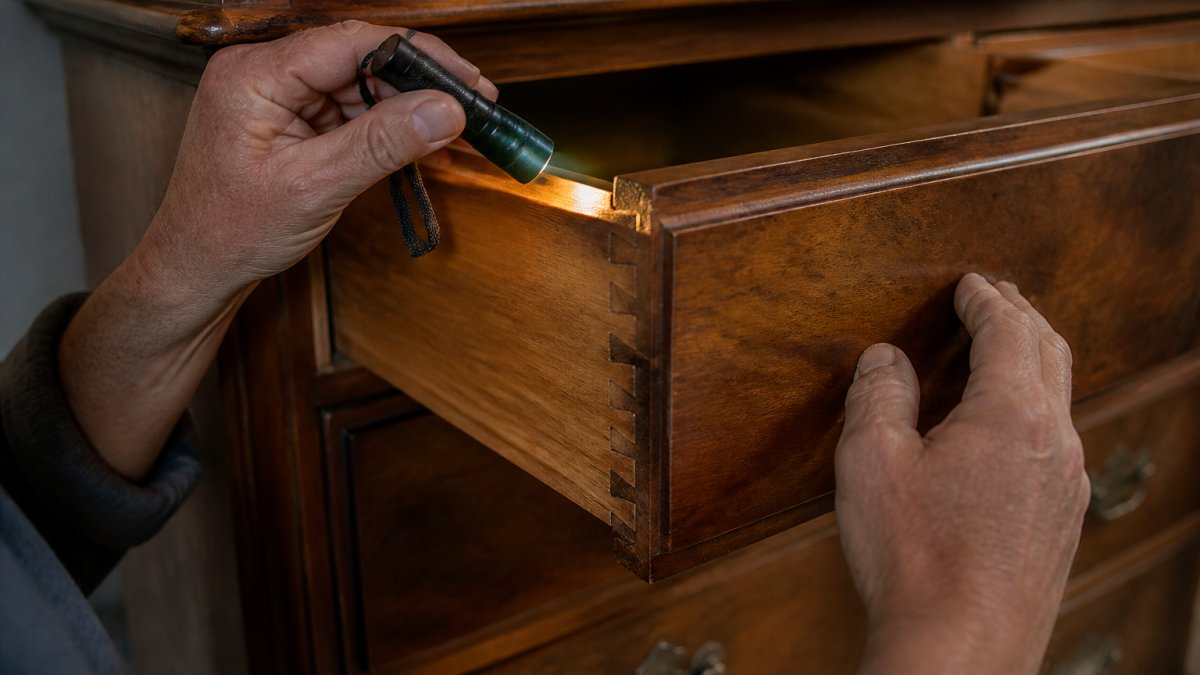
- Dovetail joints are the gold standard for drawers because they resist pulling apart.
- A small magnet sticks to plated hardware but not to solid brass.
- Genuine patina builds on drawer pulls, edges, and armrests, not evenly across a surface.
Table of Contents
- Start With a Component-by-Component Heritage Furniture Inspection
- How to Identify Solid Wood Furniture vs. Veneer and Impostors
- How to Identify Furniture Wood Types by Grain, Weight, and Color
- Furniture Joinery Types and Quality: What Strong Joints Look Like
- Finish, Weight, and Drawer Construction: The Details That Reveal Craftsmanship
- Antique Furniture Inspection Checklist: Separating Age From Quality
- Provenance, Reproductions, and Misleading Signals
- Conclusion
- Frequently Asked Questions
Start With a Component-by-Component Heritage Furniture Inspection
Heritage furniture is built to be handed down, not just used up.
You do not need an appraiser's license to spot quality, just a flashlight, a tape measure, and a routine.
Age and quality are different things: a 60-year-old table can be junk, and a well-made reproduction can outlast it by decades.
Inspect in a fixed order: frame, material, joints, then finish and drawers.
What to Check First: Frame, Legs, and Case
Start with the skeleton: structure is the hardest thing to fake and the costliest to fix.
- Wobble test: Set the piece on a hard floor. Press one top corner, then the opposite. A solid frame stays quiet. A loose one rocks or creaks.
- Lift test: Pick up one side. Heavy is a good sign. A case that feels light for its size may be particleboard under a thin skin.
- Leg check: Look at how legs meet the case. A leg joined into the frame with a visible bracket or block is sturdier than one screwed on from the outside.
Run these five checks before looking at anything decorative. A beautiful surface on a shaky frame is money misspent.
How to Identify Solid Wood Furniture vs. Veneer and Impostors
Solid wood furniture is made from boards of one species cut through and through. Veneer is a thin slice of real wood glued over a cheaper core, and many fine pieces use it well.
The trick is knowing what sits underneath:
- Look at the edges. On solid wood, the grain runs continuously from face to edge. On veneer, you may see a thin line where the top layer ends.
- Check matching surfaces. Grain on a solid top should repeat on the underside. If the bottom looks like plain particleboard, the top is a veneer.
- Find an unfinished spot. Pull a drawer or look under a seat. Solid wood shows the same grain there. Manufactured board shows chips or uniform fibers.
How to Identify Furniture Wood Types by Grain, Weight, and Color
Learning how to identify furniture wood types takes a few minutes per piece once you know the tells. Species affects weight, hardness, and grain. On a finished piece, identification is an educated guess, stain, age, and lighting all lie a little. Use the clues below, then confirm with an unfinished spot.
The Species Tells Worth Memorizing
- Oak: Open, coarse grain with strong rays and prominent pores you can feel with a fingernail. Heavy and hard. Common in sturdy period pieces. Red oak and white oak differ mainly in pore structure and ray height, not in heft.
- Cherry: Fine, tight grain that darkens with age from a light reddish tone toward deep brown. Moderate weight and prized for heirloom work.
- Maple: Closed, smooth grain with little figure. Very hard and dense. Look for a tight, almost poreless surface and a pale, uniform color under the finish.
How to Read Grain and Growth Rings
Natural grain and growth rings are your best evidence. Look for rings that arc and vary, since no two boards match. On solid wood, end grain shows rings through the thickness; on veneer, it is a thin slice over a flat core.
A practical trick: find an unfinished spot under a drawer, behind a back panel, or under a seat. That raw patch shows true color and pore structure without stain.
Weight, Hardness, and the Trade-Offs
Weight tells you a lot: dense hardwoods feel heavier than their size suggests, while light pieces often hide softwood or composite cores. But weight alone is not quality, a heavy piece can be thick low-grade stock, and a light one a well-engineered veneered case.
Hardness matters for wear surfaces. A pine tabletop shows every fork mark; maple or oak shrugs off decades of use. A softwood bookcase is fine; a softwood kitchen table is a maintenance commitment.
Finally, match the species to the claim. A "solid walnut" piece should show walnut on the underside, drawer sides, and back, not just the top. Mixed species are normal in fine furniture, but the maker should tell you which wood is where.
Furniture Joinery Types and Quality: What Strong Joints Look Like
Mortise-and-tenon joints connect legs to rails and frames to posts.
Dowels and biscuits are common in mid-range work and acceptable when paired with glue and a solid frame.
What to avoid: joints held only by screws, staples, or nails. Those loosen with seasons and humidity.
Run your thumb along a joint line. If you feel a lip or step, the pieces have shifted.
Finish, Weight, and Drawer Construction: The Details That Reveal Craftsmanship
Craftsmanship lives in the parts you almost never see. That is exactly why a careful buyer checks them.
How Finish Sits on the Wood
A penetrating finish, like oil or hand-rubbed wax, sinks into the grain and leaves wood feeling like wood. A surface film, like lacquer or polyurethane, sits on top and can chip or peel in sheets.
Become a part of our AAE family and start fundraising today! →
- Run your fingers across the surface. It should feel smooth, not plastic or tacky.
- Look at an edge at a low angle. Thick, cloudy buildup suggests a heavy sprayed coat hiding something.
- Check for drips and sags under the top and along the legs.
A good wood stain should be even, with grain still visible underneath. If the color looks painted on and flat, the wood may not be worth showing.
Drawers, Slides, and Hardware
Pull every drawer out and turn it over, quality shows up fast.
- Drawer construction: Dovetails or strong box joints at the corners. A solid wood bottom set into a groove, not stapled to the underside.
- Drawer slides: Wood-on-wood runners are traditional and fine when waxed. Metal slides should glide without grinding.
- Drawer pulls and brass hardware: Solid brass feels weighty and develops a warm patina. Plated metal flakes and pits. Wooden hardware should be smooth and firmly seated.
Antique Furniture Inspection Checklist: Separating Age From Quality
An antique furniture inspection checklist should grade condition, not guess at a date. Here is how we would score any piece.
Condition grading:
- Excellent: Tight joints, original finish in good shape, no structural repairs.
- Good: Minor wear and patina, small cosmetic repairs, solid structure.
- Fair: Loose joints, finish loss, or replaced hardware, but repairable.
Inspection checklist by component:
- Frame: square, steady, no wobble
- Legs: firmly joined, no cracks at the top block
- Joints: tight, no gaps or old glue lines
Age indicators like wear and patina matter, but wear can be faked. Genuine patina builds where hands actually touch: drawer pulls, edges, armrests.
Restoration is not automatically bad. A well-repaired heirloom beats a cracked original. Just price the repair work before you buy.
Provenance, Reproductions, and Misleading Signals
Provenance is the documented history of a piece and the strongest proof of authenticity you can get. A maker's mark, label, or original receipt adds real value. But provenance and quality are separate questions: documents prove origin, not craftsmanship, and reproductions and repairs can hide plenty.
What Provenance Can and Cannot Establish
Provenance answers "where did this come from and who owned it," not "is it well made." A documented piece can be a poor example of a maker's work, and an undocumented piece can be excellent.
Where to look for marks and labels:
- Underside of drawers and seats
- Back of the case
- Inside a drawer side
What each document can prove:
- Maker's mark or brand: Identifies the workshop or factory, not the individual craftsman. A stamped mark is harder to fake than a glued label.
- Paper label: Common on factory pieces from the late 1800s onward. Labels can be reproduced; check whether the paper, ink, and adhesive look period-appropriate.
- Original receipt or bill of sale: Strong evidence of date and retailer, weaker evidence of current condition.
A common pattern: sellers present a story as provenance. Ask for the document, not the anecdote. If the story is the only evidence, price the piece as if it does not exist.
How Reproductions and Repairs Create Misleading Signals
Reproduction furniture can be excellent, but it should not be sold as antique. These signals fool buyers most often.
- Artificial distressing: Genuine wear concentrates where hands and feet actually touch: drawer pulls, edges, armrests, and the front of legs. Fresh, even distressing across a whole surface, including the back and underside, is a warning sign.
- Replaced hardware: New pulls in old holes are a classic tell. Look for extra screw holes, elongated holes, or a shadow where an older pull sat. A magnet helps here: solid brass does not attract it, but many modern plated replacements do.
- Refinishing: A fresh, glossy finish on a piece claimed to be 150 years old is suspicious. Original finish on an old piece is usually thin, dull, and uneven. A strong chemical smell on an "antique" often means a recent refinish.
The Condition-and-Repair Assessment Buyers Skip
Before you pay for provenance, grade the condition. Acceptable wear includes surface scratches, minor dents, and patina on high-touch areas. Structural damage, loose joints, water staining, and insect damage are negotiation points, not charm.
- Loose joints: Repairable, but regluing a case piece can cost more than the piece is worth if the joints are complex.
- Woodworm or insect damage: Look for small exit holes and fine dust. Active infestation needs treatment; old, inactive holes are cosmetic but weaken the wood.
- Water damage: Staining and swelling on the underside or back usually means the piece sat in a damp space. Check for delamination in veneered areas.
Price the repair before you buy. A well-repaired heirloom beats a cracked original, but only if the repair cost is built into the price.
If you are shopping for decor that carries heritage meaning into a modern home, look for sellers who stand behind their materials and their mission. That is the standard we hold ourselves to at African American Expressions, where our canvas art and home decor celebrate Black heritage.
Conclusion
Spotting quality takes a routine, not an expert eye. Check the frame, test the wood, inspect the joints, and grade the condition. Then ask about provenance.
If you want decor and gifts that carry heritage and craftsmanship into your home or your organization's fundraiser, we can help. African American Expressions offers culturally inspired canvas art, calendars, and accessories, plus a fundraising program where schools and churches earn 40% on every sale.
Frequently Asked Questions
How can you tell whether furniture is solid wood or veneer?
Look at the same surface from multiple angles and check edges and undersides. Solid wood shows continuous grain that wraps around corners and matches on adjacent faces. Veneer often shows a repeating grain pattern, a perfectly flat surface with no seasonal movement, and a visible seam or edge banding where the thin layer meets the core. On solid wood, growth rings and natural grain run through the full thickness, and you may see slight checking or movement over time. A quick test is to examine an unfinished underside or the inside of a drawer, where veneer cores are usually exposed.
What types of joinery indicate well-made furniture?
Dovetail joints, mortise-and-tenon joints, and hand-cut joints signal durable construction. Dovetails interlock like puzzle pieces and resist pulling apart, so they are common on quality drawer boxes. Mortise-and-tenon joints lock rails into legs and are standard in sturdy chairs and tables. Machine-cut joints can also be strong when they fit tightly, so judge the fit rather than the method alone. Avoid furniture held together mainly by nails, staples, or glue with visible gaps. Check inside corners and undersides, where makers are less likely to hide weak construction.
Is high-quality heritage furniture always made from solid wood?
No. Solid wood is a strong indicator of quality, but well-made veneer furniture can also be durable and valuable, especially on antique pieces where veneer was used to showcase figured wood. What matters is the quality of the core material, the fit of the joinery, and how the finish has held up. A sturdy frame, tight joints, and smooth drawer operation matter more than the label alone. Judge each component: a solid wood top on a stapled particleboard case is not heritage quality, while a carefully veneered chest with dovetailed drawers can be.
What should you avoid doing to antique furniture during inspection?
Do not scrub, polish, or apply cleaners during an inspection, and never sand or refinish a piece before you know what it is. Harsh cleaners can strip a protective coating, and sanding can remove patina and original finish that support authenticity. Avoid dragging the piece, tipping it onto weak legs, or forcing stuck drawers, which can crack joints. Instead, use a flashlight, a soft cloth, and gentle pressure. Photograph labels, maker's marks, and wear patterns before moving anything, and ask before opening drawers or removing shelves.