

Table of Contents
- Step 1: Define Your Financial Goals and Campaign Purpose
- Step 2: Choose Fundraising Methods That Align With Your Mission
- Step 3: Build Community Relationships and Volunteer Coordination
- Step 4: Develop a Compelling Mission Message and Stewardship Strategy
- Step 5: Promote Your Campaign Across Multiple Channels
- Step 6: Implement Digital and Online Giving Solutions
- Church Fundraising Best Practices and Legal Compliance
- Conclusion
Last Updated: August 17, 2026
Step 1: Define Your Financial Goals and Campaign Purpose
The foundation of any successful church fundraiser starts with clarity. Before you launch anything, know exactly why you're raising money and how much you need. According to the Lake Institute on Faith & Giving (2026), over 60% of congregations in the United States engaged in fundraising in the past year, but many failed to articulate their purpose clearly enough to inspire giving.
Start by identifying your specific need. "We're raising $50,000 to renovate our youth center so we can serve 200 additional teens in our community" will move people far more than "We need money for the church."
Set a realistic fundraising goal backed by data about your donor base. Research from the Lake Institute shows that 74% of churches meet or exceed their fundraising goals with a well-executed capital campaign. Break your total goal into smaller milestones, if you need $50,000, aim for $10,000 by month one, $25,000 by month two, and the full amount by month three. Document your purpose in writing. This becomes the foundation for every conversation, email, and social media post you'll create.
Step 2: Choose Fundraising Methods That Align With Your Mission
Your fundraising approach should reflect your church's values and the preferences of your congregation. According to Church Mutual's 2026 survey, Baby Boomers and older Gen X prefer larger, less frequent gifts, while Millennials and Gen Z tend to give smaller amounts more frequently, often using text-to-give or QR code giving. Evaluate your operational capacity and choose methods your team can sustain.
Creative Fundraising Ideas
Pancake breakfasts and spaghetti dinners work because they're low-cost to execute. Your cost per meal is typically $2-4, and you can charge $8-12 per plate. With 100 attendees, you're looking at $400-800 in profit.
Bake sales and plant sales require minimal upfront investment. Recruit volunteers to donate items and sell them after Sunday service.
Auction nights work well if your congregation includes business owners or professionals who can donate items or services.
Car washes and yard work days appeal to younger volunteers and generate revenue while providing visible community service. Charge $15-25 per car wash or $50-100 for yard work.
However, events require significant volunteer coordination. According to Nonprofits Source (2025), campaigns that are shared fewer than 2 times have a 97% chance of failure. Your event promotion matters as much as the event itself.
How to Support Black-Owned Businesses Through Your Fundraiser
One of the most meaningful approaches is partnering with Black-owned businesses to source products for your fundraiser. This strategy generates revenue for your church, supports economic strength in the Black community, and provides your congregation with products they actually want.
African American Expressions has supported churches and organizations for over 34 years through their fundraising program. They offer a 40% commission on every sale, which is significantly higher than many traditional fundraising options. Your church can sell culturally inspired gifts, calendars, canvas art, and home decor items that resonate with your congregation and broader community.
Here's how this works: You partner with African American Expressions, receive their product catalog, and take orders from your congregation and community. Once orders are fulfilled and delivered, you keep 40% of the revenue. A $12 reusable bag generates $4.80 profit per unit. If you sell 100 bags, that's $480 in revenue with minimal operational overhead.

The beauty of this approach is that it aligns fundraising with stewardship. You're not just asking for donations; you're offering high-quality, meaningful products that celebrate Black heritage and culture. According to Church Mutual's 2026 survey, all four generations primarily donated to places of worship, accounting for 74% of charitable donations. When you offer products alongside your ask, you're meeting people where they are.
Products like the QUEENDOM REUSABLE BAG ($12) or the QUEEN BLACK/GOLD REUSABLE BAG ($12) are practical items people use regularly, keeping your church's mission visible in their daily lives. The SISTER FRIENDS REUSABLE BAG ($12) and SHE WHO KNEELS REUSABLE BAG ($12) celebrate community and faith in ways that resonate deeply.


African American Expressions has generated millions of dollars for Black schools, churches, and organizations since 1991. Your church becomes part of that legacy while building your own fundraising capacity.
Step 3: Build Community Relationships and Volunteer Coordination
No fundraiser succeeds without volunteers. Your team's energy and commitment directly influence your results. Start by identifying who in your congregation has the skills and availability to lead specific areas: event planning, social media promotion, donor outreach, and logistics.
Be specific about roles and time commitments. Don't ask someone to "help with the fundraiser." Instead, ask: "Would you lead our social media promotion for the next six weeks? This involves posting three times a week and responding to comments."
Create a volunteer appreciation plan before you launch. Small gestures matter: a thank-you email, a recognition moment during service, or a volunteer appreciation event. Research from Virtuous (2025) shows that those who feel appreciated are far more likely to volunteer again.

Build relationships with local businesses and community leaders. If you're partnering with African American Expressions, introduce your congregation to the company's story and values. Host a volunteer kickoff meeting where you share your financial goal, explain why it matters, and outline the timeline.
Step 4: Develop a Compelling Mission Message and Stewardship Strategy
Your message is everything. As Shauw Chin Capps, President at Cooperative Baptist Fellowship Foundation, states:
"Embrace fundraising as a ministry. It is not a 'necessary evil.' It is part of your spiritual calling. You have been called to ensure the church has the resources to live into its calling. Therefore, embrace that work."
This mindset transforms how you communicate. You're not begging for money. You're inviting people to participate in something meaningful. Craft a one-sentence mission statement for your campaign: "We're raising $50,000 to establish a youth center where we can mentor and serve 200 additional teens in our neighborhood." Use storytelling in your communications. Share a story about why this matters: "Last month, a teenager came to our church asking for help. She had nowhere safe to go after school. We had to turn her away because we didn't have the space. This campaign ensures we never have to say no again."
Crafting Church Donation Letter Examples
A well-crafted donation letter is one of your most powerful tools. It's personal, it's permanent, and it gives donors time to reflect before deciding.
Here's a template:
Dear [Donor Name],
I'm writing to invite you to be part of something extraordinary.
For the past six months, our youth ministry has been turning away teenagers who need safe space after school. We have the heart to serve them, but not the facility. This campaign will change that.
We're raising $50,000 to renovate our community center into a dedicated youth space. This will allow us to serve 200 additional teens annually with mentorship, tutoring, and spiritual guidance.
Become a part of our AAE family and start fundraising today! →
Your gift of $[amount] will directly fund [specific outcome: "new computers for our tutoring program," "renovated kitchen for community meals," etc.].
All donations are tax-deductible. We'll provide a receipt and quarterly impact reports showing how your generosity is changing lives.
Will you join us?
In gratitude, [Pastor/Leader Name]
Keep the letter to one page. Use specific numbers and outcomes. Include a response mechanism, a link to your giving page, a tear-off donation card, or a phone number to call.
Step 5: Promote Your Campaign Across Multiple Channels
Your fundraiser won't succeed if people don't know about it. According to Nonprofits Source (2025), crowdfunding campaigns get 126% more donations when owners update supporters. Consistent, multi-channel promotion is essential.
Start with email. Send a campaign launch email explaining your goal and how people can contribute. Follow up with weekly updates sharing progress toward your goal and stories of impact.
Use social media strategically. Post on Facebook, Instagram, and TikTok at least three times per week. Share behind-the-scenes content, volunteer stories, and progress updates. Use hashtags like #ChurchFundraiser, #CommunityServing, and #BlackOwnedBusiness to expand your reach.
Host an in-person launch event. Gather your congregation, explain the campaign, and give people immediate opportunities to contribute.
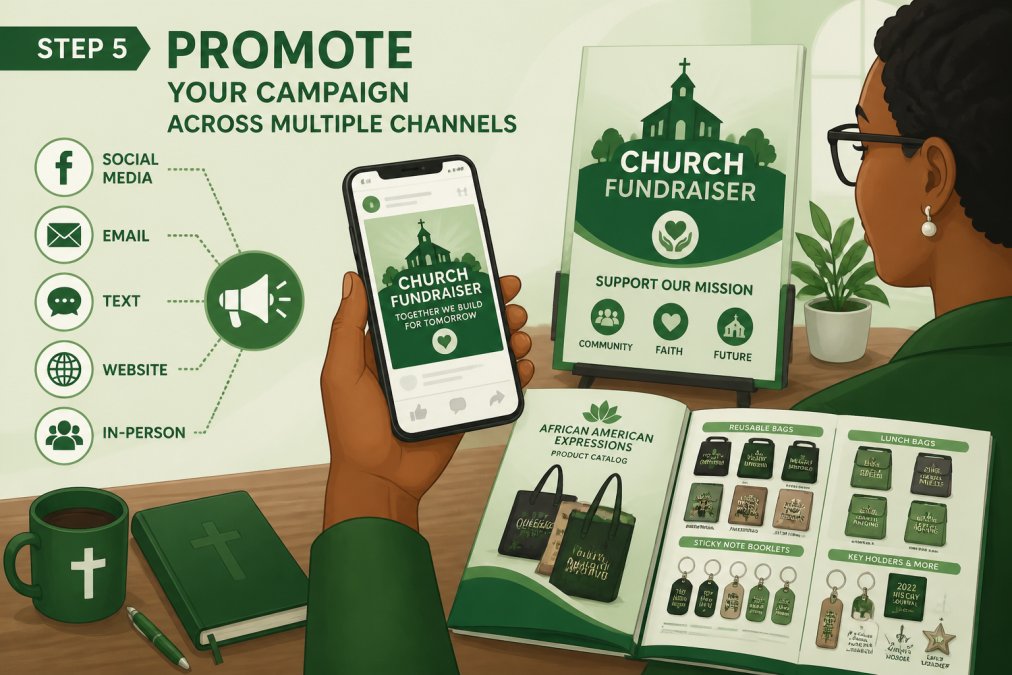
Create a simple one-page handout explaining your campaign. Include your goal, timeline, how to give, and the impact their gift will have. Distribute this at every church event. Partner with local media by sending a press release to local news outlets and community blogs.
Step 6: Implement Digital and Online Giving Solutions
Digital giving now accounts for more than half of all church donations, according to ChurchRaise Blog (2026). If your church doesn't offer online giving, you're leaving money on the table.
Set up a giving page on your church website. Include your campaign goal, timeline, and a progress bar showing how close you are to your target. Offer multiple giving methods: online giving through your website, text-to-give, QR code giving, and mobile app giving if your church has one. According to ChurchRaise Blog (2026), mobile devices account for nearly 65% of digital giving transactions. Your giving page must be mobile-optimized.
Promote recurring giving. Research from ChurchRaise Blog (2026) shows that recurring giving accounts for roughly 40% of total digital giving at churches that offer it. A donor who commits to $25 per month for six months gives $150. Track your giving data to see which channels are most effective and where you need to focus promotion efforts.
Church Fundraising Best Practices and Legal Compliance
Your fundraiser must operate within legal and ethical boundaries. This protects your church's reputation and ensures your efforts have lasting impact.
Tax-Deductible Giving and Non-Profit Compliance
Your church's tax-exempt status (typically 501(c)(3)) means donations are tax-deductible for donors. Always include language in your materials: "All donations are tax-deductible to the extent permitted by law."
Provide donors with written receipts for their gifts. Include the date, amount, and a statement that no goods or services were provided in exchange (unless they were, in which case you must disclose the fair market value of what they received). Keep detailed records of all donations to protect you in case of an audit and to honor donor intent.
Avoid fundraising methods that could jeopardize your tax-exempt status. According to Christ and Common Sense (2023), raffles are considered games of chance and are included in state penal codes. They should be avoided by churches to maintain a reputation "above reproach." Use auctions instead, where donors bid on items, this is legal and often more lucrative.
Be transparent about how funds will be used. If you're raising $50,000 for a specific project, spend it on that project. If circumstances change and you need to redirect funds, communicate this clearly to your donors.
Post-Fundraiser Donor Retention and Impact Reporting
Your fundraiser doesn't end when you reach your goal. The most critical period begins after you've raised the money. According to Virtuous (2025), faith-based nonprofits had the highest gross donor retention rate across all sectors at 59%, compared to an industry-wide average of 50%. But only 41% of first-time donors make a second gift.
The difference lies in stewardship. After your campaign concludes, send a thank-you letter to every donor. Be specific: "Your gift of $500 helped us purchase computers for our youth tutoring program."
Provide quarterly impact reports. Share stories of lives changed, programs expanded, and goals achieved. Use photos, quotes from beneficiaries, and concrete metrics. Invite donors to see the impact firsthand through tours, events, or videos. Create a donor database and track giving history. With proper stewardship, first-time donors become long-term supporters.
Starting a church fundraiser requires clarity about your purpose, strategic choices about your methods, strong volunteer leadership, and consistent promotion across multiple channels. When you combine these elements with digital giving solutions and rigorous stewardship practices, you create a sustainable fundraising engine that serves your mission.
The most successful campaigns treat fundraising as ministry, not as a necessary burden. When your congregation understands they're investing in something meaningful, they give generously. Partnerships with mission-aligned organizations like African American Expressions, which has supported churches for over 34 years, amplify your impact while supporting Black-owned business. Their fundraising program offers churches a 40% commission on culturally inspired gifts, meaning you're not just raising money, you're celebrating heritage and strengthening community simultaneously.
Become a part of our AAE family and start fundraising today!
Frequently Asked Questions
What are the most effective ways to promote a church fundraiser to the congregation?
Campaigns shared fewer than 2 times have a 97% chance of failure, so repetition is critical. Use multiple channels: announce the fundraiser during services, send emails to your donor database, post on social media, and create physical signage. Include a clear call-to-action with the campaign deadline and impact statement. Crowdfunding campaigns receive 126% more donations when organizers provide regular updates to supporters, so maintain momentum with weekly progress reports and testimonials from community members who benefit from the funds.
How can churches raise money online and accept digital donations?
Digital giving now accounts for more than half of all church donations. Offer multiple online channels: a giving page on your website, mobile giving apps, text-to-give (text a keyword to a number), and QR codes that link directly to donation forms. Mobile devices account for nearly 65% of digital giving transactions, so ensure your donation platform is fully optimized for smartphones. Recurring giving accounts for roughly 40% of digital giving at churches that offer it, so actively promote monthly giving options to donors. Designated giving also increases donations by 15-25%, so allow donors to choose where their money goes (building fund, mission support, youth ministry, etc.).
How do I support Black-owned businesses through my church fundraiser?
Partner with Black-owned fundraising programs that offer competitive margins and culturally meaningful products. African American Expressions has empowered churches and organizations for over 34 years, allowing you to earn 40% on every sale of culturally inspired gifts, stationery, and home decor. This approach generates funds for your ministry while supporting Black economic strength. The program has generated millions of dollars for Black schools and churches since 1991. Choose products that reflect your community's values and heritage, and communicate to donors that their purchases directly support both your mission and a Black-owned business.
What are the legal and tax considerations for running a church fundraiser?
Ensure your fundraiser complies with state regulations and your church's non-profit status. Donations to qualified religious organizations are tax-deductible, but you must provide donors with written acknowledgment of their gifts. Avoid fundraising methods like raffles, which are classified as games of chance in state penal codes and can damage your reputation. Maintain financial transparency by tracking all donations and expenses in a dedicated fund. Keep accurate records of who donated, how much, and for what purpose. Consult your church's leadership and consider working with a nonprofit accountant to ensure compliance with IRS regulations and state charitable solicitation laws.
This article was written using GrandRanker