

Table of Contents
- The Real Value of Personalized Cultural Gifts: What 2026 Data Shows
- The Psychology Behind Why Custom-Made Gifts Feel More Meaningful
- Black History Month Gift Ideas That Go Beyond Generic Merchandise
- The Cost-Benefit Analysis: Are Personalized Cultural Gifts Worth the Price?
- The Benefits of Supporting Black-Owned Businesses With Your Gift Budget
- The Anti-Consumption Counter-Argument: When Personalized Gifts Miss the Mark
- How to Choose High-Quality Personalized Cultural Gifts That Last
- Conclusion
- Frequently Asked Questions
Last Updated: September 24, 2026
The Real Value of Personalized Cultural Gifts: What 2026 Data Shows
Are personalized cultural gifts worth buying? The short answer is yes, if the item fits the recipient's life. According to Elle Cadeaux's 2026 gift-giving statistics, 76% of consumers say personalized gifts feel more meaningful than generic ones, and those same items see 48% lower return rates. At African American Expressions, we have watched that shift play out for more than three decades.
Emotional Impact vs. Retail Value
Emotional impact and retail value are two different scoreboards, and they rarely agree. A $12 mug can outlast a $200 gadget in the recipient's memory. Research from the University of Bath found that customized gifts increase recipient appreciation and self-esteem regardless of how much time or money the giver spent. That finding matters because it reframes the purchase. You are not buying an object.
The Psychology Behind Why Custom-Made Gifts Feel More Meaningful
Custom-made gifts feel more meaningful because they function as identity affirmation, not just objects. A ScienceDirect study of 2,072 participants found that culturally mixed gifts strengthen giver-recipient relationships more effectively than generic ones, largely because of their symbolic weight. Consumer psychology backs this up on the retail side: MyGifteee's 2026 data shows 80% of consumers are more likely to make a repeat purchase after a personalized experience.
Black History Month Gift Ideas That Go Beyond Generic Merchandise
Black History Month gift ideas work best when the item carries a story the recipient can use, display, or pass down. Generic merchandise with a slogan printed on it rarely survives past February. Culturally grounded pieces tend to stay in rotation all year.
Stationery and Journals That Carry Cultural Stories
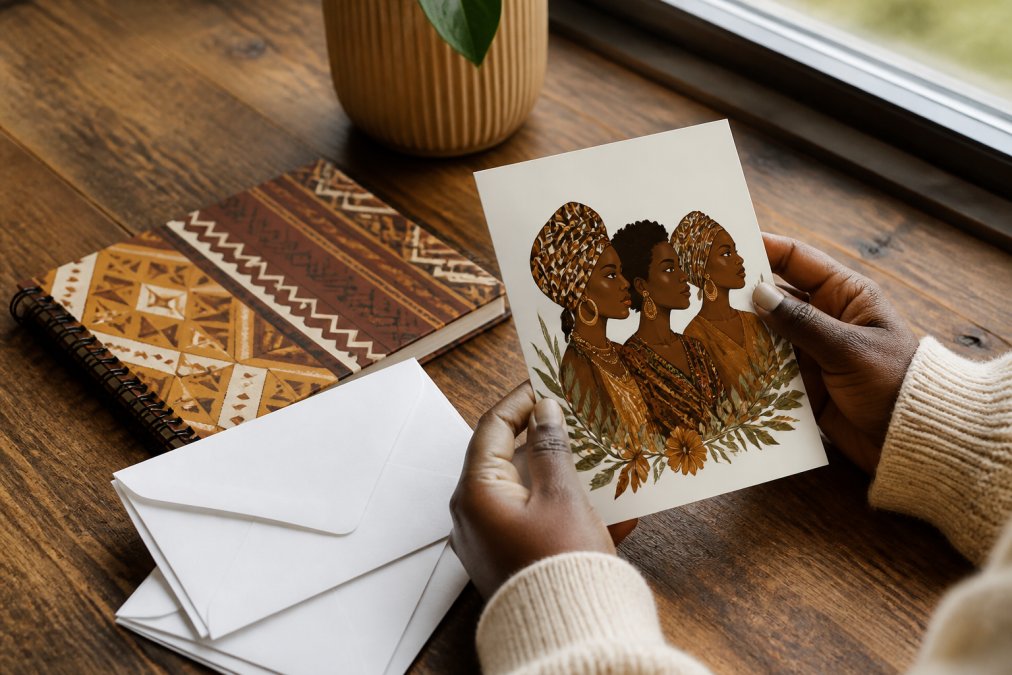
Stationery is the most underrated category in cultural gifting. It gets used, which means it gets seen, which means the sentiment repeats every time someone writes a note. The All Occasion Assortment ($20.00) pairs illustrations of Black women with sturdy cardstock and matching white envelopes, plus pre-written messages and blank space for your own words. The Black History Journal ($13.00) runs 128 lined pages with scripture at the top of each sheet and a spiral binding that holds up to daily carry.

Home Decor and Keepsakes for Year-Round Reflection
Home decor and keepsakes earn their place by staying visible. The Maya Angelou Drinking Glass Set ($26.00) includes four designs with her words, packed in a gift box that doubles as storage. For a desk or kitchen, the Michelle Obama Mug ($12.00) is microwave and dishwasher safe, which matters more than most buyers expect. The Black Heritage Trivia Game Cards ($24.00) carry 114 questions across 131 cards, built for family game nights and classrooms.
| Item | Price | Best For | Why It Lasts |
|---|---|---|---|
| All Occasion Assortment | $20.00 | Everyday correspondence | Thick cardstock, reusable sentiment |
| Black History Journal | $13.00 | Daily writing and reflection | 128 pages, spiral bound, thick paper |
| Maya Angelou Glass Set | $26.00 | Hosting and display | Four designs, gift box storage |
| Michelle Obama Mug | $12.00 | Daily routine | Dishwasher and microwave safe |
| Black Heritage Trivia Cards | $24.00 | Family and classroom | 114 questions, all-ages play |
The Cost-Benefit Analysis: Are Personalized Cultural Gifts Worth the Price?
Personalized cultural gifts are worth the price when the item gets used; they are a poor buy when it becomes clutter. That is the honest cost-benefit test, and it has nothing to do with the sticker price. The personalized gifts market sits at roughly USD 34.03 billion in 2026 according to Business Research Insights, and the personal gifts segment is projected to hold 57.50% of the gift retailing market per Fortune Business Insights. Buyers are voting with their budgets.
- A specific detail the recipient recognizes. A name, a date, a shared reference, or a cultural touchstone tied to that person. Generic "heritage" branding does not qualify.
- A material upgrade. Heavier cardstock, real ceramic, archival ink, or a binding that survives daily carry. If the personalization is the only difference and the base item is flimsy, you are paying for a label.
- A functional role in the recipient's routine. Something they would reach for anyway: a mug, a journal, a set of cards, a game.
- A story the recipient can retell. Cultural gifts carry extra weight when the item itself has a documented origin, a named figure, or a real quote rather than a vague motif.
When the Personalization Premium Is a Markup
There are clear cases where the customization is decoration for the giver, not value for the receiver:
- The base item is identical to a mass-market version and only the print changes.
- The personalization is a name or initial that the recipient will never see again after the occasion.
- The item requires special care the recipient will not perform (hand wash only, dust regularly, store flat).
- The cultural reference is broad enough to apply to anyone, which means it applies to no one in particular.
A Simple Break-Even Test
Before you buy, estimate how many times the recipient will realistically use or see the item in the first year. Divide the total price by that number. If the per-use cost is higher than what you would pay for a comparable everyday item, the personalization premium is not earning its keep. Most practitioners find that functional personalized gifts clear this test easily, while display-only pieces rarely do.
The Benefits of Supporting Black-Owned Businesses With Your Gift Budget
Supporting Black-owned businesses turns a single purchase into community infrastructure. That is not marketing language; it is how the money moves. The personalized gift sector is growing at a compound annual rate between 8.5% and 10.2% through 2030, per Stellar Market Research, and where that growth lands depends on where buyers spend.
The Anti-Consumption Counter-Argument: When Personalized Gifts Miss the Mark
Personalized gifts miss the mark when sentiment outruns utility. This is the strongest argument against the entire category, and it deserves a straight answer rather than a defense. Gift-giving research keeps surfacing the same tension: recipients value thoughtfulness, but they also value space. A Reddit r/Gifts discussion on the topic makes the point bluntly. If the recipient has nowhere to put a decorative item, the personalization does not rescue it.
The Resale and Donation Reality
Personalized items are hard to resell, and culturally specific items are harder still. A monogrammed item has a market of one. A culturally themed keepsake may carry meaning for a narrow audience, which shrinks the pool of buyers further. On the donation side, thrift stores and donation centers receive far more decorative personalized goods than they can move, and many end up in bulk liquidation or textile recycling rather than on a shelf.
Choosing Functional, Long-Lasting Personalized Items
The way to avoid the clutter trap is to buy personalized items that already had a job before they were personalized. Functional categories absorb personalization without becoming waste:
- Drinkware. Mugs, glasses, and tumblers get used daily and wear out, which means replacement is natural rather than wasteful.
- Stationery. Cards, journals, and notepads are consumed by design. A personalized card set is used up, not stored.
- Games and activities. Trivia cards, puzzles, and conversation decks create shared experiences and have a clear use case.
- Textiles. Blankets, aprons, and towels are functional first and sentimental second.
A Three-Question Filter
Before buying any personalized cultural gift, run it through three questions:
- Would the recipient have bought this for themselves? If yes, the gift fits their life. If no, you are guessing.
- Does it have a use beyond display? If the only function is to sit somewhere, the risk of clutter goes up sharply.
- Can it be passed on or repurposed? If the personalization locks it to one person forever, the item has no second life.
How to Choose High-Quality Personalized Cultural Gifts That Last
Quality in this category comes down to materials, construction, and whether the cultural content is specific or generic. Use this checklist before you buy:
- Check the material spec: thick cardstock, real ceramic, heavy paper, sturdy binding
- Confirm care instructions exist (dishwasher safe, microwave safe, ink-resistant pages)
- Look for named figures, real quotes, or documented history, not vague "heritage" branding
- Verify the seller's track record and years in operation
- Match the item to the recipient's available space and daily routine
- Buy from a seller whose mission connects to the community the gift represents
Conclusion
The hard part of cultural gifting is not finding something beautiful. It is finding something the recipient will actually keep, use, and feel seen by. African American Expressions has spent 34 years building a catalog around that problem, with culturally inspired stationery, home decor, and keepsakes, plus a fundraising program that pays organizations 40% on every sale. Start with a journal, a card set, or a trivia game, and give something that stays in the room long after the occasion ends.

Frequently Asked Questions
Are personalized gifts worth the extra cost?
Personalized gifts often justify their cost through higher recipient satisfaction. Research shows 76% of consumers find personalized gifts more meaningful than generic ones, and these items have 48% lower return rates. When you factor in that a customized item is less likely to be returned or regifted, the effective value increases. For cultural gifts specifically, the personalization adds a layer of identity affirmation that mass-produced items cannot replicate.
What makes a cultural gift meaningful?
A cultural gift becomes meaningful when it reflects the recipient's heritage, values, or personal story in a way that feels authentic. The University of Bath found that customized gifts increase recipient appreciation and self-esteem regardless of the giver's actual time or effort. Meaningful cultural gifts often include specific references to shared history, inside jokes, or family traditions. The key is specificity, not just slapping a name on a generic item.
How do I choose a high-quality personalized cultural gift?
Look for materials that hold up over time, like thick cardstock, ceramic, or hardcover binding. Check whether the personalization method (engraving, printing, embroidery) is durable. Read reviews about print longevity. For cultural gifts, verify that the designs reflect genuine heritage rather than generic patterns. Products like the Black History Journal ($13.00) or the Maya Angelou Drinking Glass Set ($26.00) show how quality materials and thoughtful design combine.
Do personalized gifts have higher sentimental value?
Yes, research supports this. A 2024 study found that culturally mixed gifts strengthen relationships more effectively than non-culturally mixed gifts because of their symbolic significance. Personalized items signal that the giver paid attention to the recipient's identity and preferences. This effort perception translates into stronger emotional connection, even when the actual time invested was minimal. The sentimental value comes from being seen, not from the price tag.
What are the benefits of supporting Black-owned businesses when buying gifts?
Supporting Black-owned businesses keeps money circulating within Black communities, supports job creation, and preserves cultural representation in the marketplace. When you buy from a brand like African American Expressions, you are also supporting a company that has generated millions for schools and churches through its fundraising program. The personalized gifts market is valued at $34.03 billion in 2026, and choosing Black-owned brands ensures that wealth and cultural influence grow within the community.