

Quick Summary
Professional development for inclusive history instruction is ongoing training that helps teachers teach the past through diverse voices, multiple sources, and classrooms where every student can take part. Effective programs are sustained, embedded in daily work, and paired with practice, feedback, and coaching in real lessons.
- Start by auditing your unit plans to list the people, events, and sources included and the gaps that remain.
- Match the training format to your staff's schedule and budget, since each option carries different time demands and trade-offs.
- Use a four-question routine to evaluate every source set for perspective, purpose, language barriers, and student tasks.
- Set norms and a structured talk routine before discussing sensitive or difficult historical topics with students.
- Measure impact by observing lessons, collecting student work before and after training, and scheduling regular follow-up coaching.
Table of Contents
- What Inclusive History Instruction Means for Teachers
- Step 1: Identify the Gaps in Your Current History Teaching
- Step 2: Choose Professional Development Formats That Fit Your District
- Step 3: Build Inclusive Teaching Strategies for History Classrooms
- Step 4: Adapt Materials for Accessibility and Differentiated Learners
- Step 5: Extend Learning to World History Teacher Professional Development
- Step 6: Measure the Impact of Your Training and Sustain Coaching
- Finding a Downloadable Professional Development Plan for Your Team
- Frequently Asked Questions
What Inclusive History Instruction Means for Teachers
Last Updated: November 16, 2026
Inclusive history instruction means teaching the past so that every student sees themselves and their communities in it. It asks teachers to include diverse perspectives, use multiple sources, and create classrooms where all learners can take part. Professional development for inclusive history instruction gives teachers the skills and support to do this well over time.
Inclusive history instruction is the practice of teaching history with varied voices, primary sources, and perspectives so students from all backgrounds can engage with the content. Teachers who practice it look beyond the standard textbook narrative and ask whose stories are missing.
U.S. Department of Education guidance on building and sustaining inclusive educational practices recommends professional development that is relevant, sustained, and embedded in daily work. Teachers rarely need one more lecture. They need practice, feedback, and time to try new methods in their own classrooms.
A critical review of a decade of teacher learning research for inclusive education describes how the research landscape has shifted toward ongoing learning. The review points to a clear need for programs that connect training to real classroom work.
Culturally responsive approaches are one place to start. Our guide to culturally responsive teaching strategies for elementary students shows practical ways to bring varied experiences into lessons.
Step 1: Identify the Gaps in Your Current History Teaching
Start with an honest look at what your current units include. Pull out your unit plans and list the people, events, and sources that appear. Then ask what is missing.
Look for these common gaps:
- Few voices from communities outside the dominant narrative
- Heavy reliance on a single textbook
- Events told only from one perspective
- Little use of primary sources
- Limited support for students who read below grade level
Share your findings with a colleague. A second set of eyes often spots gaps you missed.
Step 2: Choose Professional Development Formats That Fit Your District
Not every training format suits every district. Match the format to your staff's schedule, budget, and goals, and be honest about what each one demands in time and follow-up. The table below is a decision aid, not a ranking.
| Format | Typical time commitment | Best for | Main trade-off |
|---|---|---|---|
| In-person workshop | 1-2 days, plus follow-up | Hands-on practice, peer discussion, shared planning time | High energy, low durability without coaching afterward |
| Online, self-paced course | 6-20 hours spread over weeks | Flexible learning for teachers with tight schedules | Little peer interaction; completion does not guarantee classroom change |
| Facilitated online cohort | Weekly sessions over 6-10 weeks | Distributed teams, rural districts, cross-school collaboration | Requires reliable connectivity and a skilled facilitator |
| Action research group | One semester, meeting every 2-3 weeks | Teachers testing a strategy and reporting results | Needs a shared protocol and protected meeting time |
| Coaching cycle | 4-8 classroom visits per teacher | Changing practice in real lessons | Coach capacity is the limiting factor; plan ratios carefully |
| University course | A full term, often with credit | Deeper study, certification, salary-schedule advancement | Cost and calendar fit; content may be general rather than history-specific |
| School-based customized training | Designed per site, often 3-5 sessions | Aligning a whole department around one unit or source set | Depends on a strong facilitator and administrative buy-in |
The U.S. Department of Education guidance favors job-embedded learning and instructional coaching.
Budget realistically. District professional development is usually funded through Title II, Part A of the Elementary and Secondary Education Act, local professional development allocations, or school improvement funds. Ask your business office for the current substitute rate before you commit to a schedule. As you weigh substitute costs against other training needs, Babb Education can help connect careful budgeting with thoughtful assessment of what teachers learn.
For event ideas that build school-wide interest, see 8 creative Black History Month assembly ideas.
Step 3: Build Inclusive Teaching Strategies for History Classrooms
Good training gives teachers strategies they can use the next day. Focus on methods that invite student thinking, and give teachers a repeatable routine rather than a list of slogans.
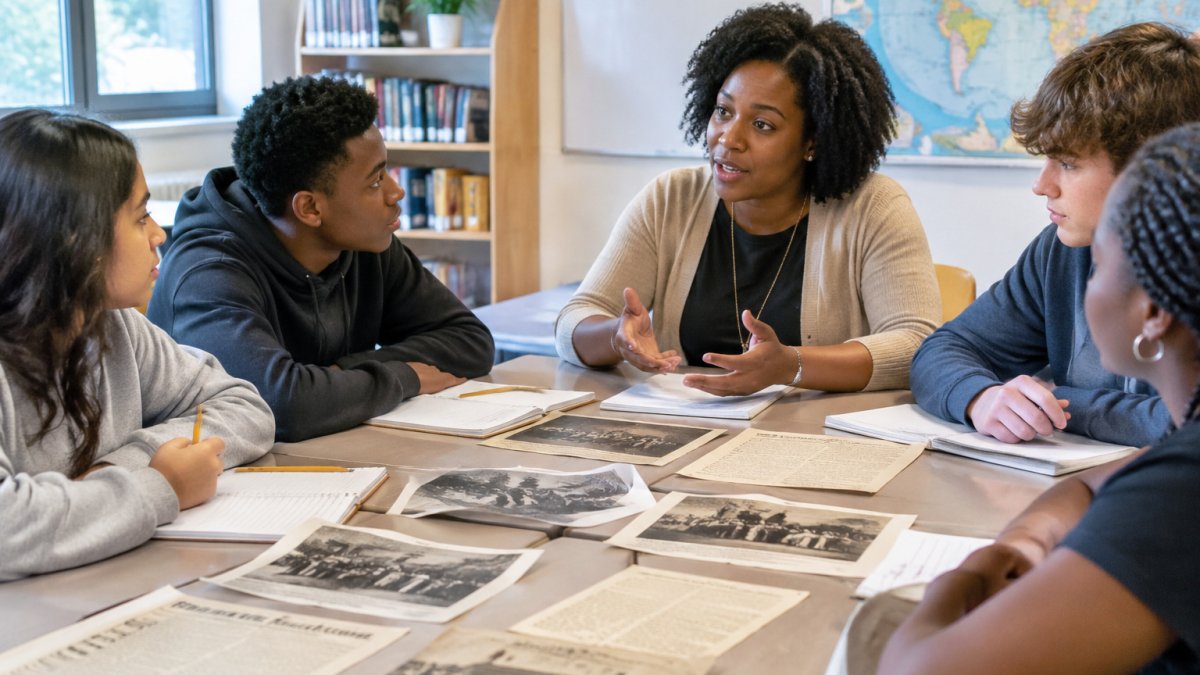
- Use inquiry questions such as "Who made this record, and why?" and "Whose voice is missing from this account?"
- Pair primary sources with secondary accounts so students see how historians build an argument
- Use structured discussion protocols for sensitive topics
- Let students compare two perspectives on the same event
- Connect historical events to students' own community histories
A review of professional development research for inclusive education notes that teachers benefit most when they can practice a strategy with peers and reflect on the results. The U.S. Department of Education guidance also emphasizes instructional coaching, where a coach observes a lesson and helps the teacher adjust the next one.
A Repeatable Source-Selection Routine
Before a unit goes to students, run every source set through four questions:
- Whose perspective does this source represent, and who is absent? Add at least one source from a missing group when the unit's story depends on it.
- What was this source made for? A newspaper article, a diary, a census record, and a photograph each carry a different purpose and audience.
- What language will trip students up? Flag archaic terms, racial or ethnic labels used in the period, and euphemisms, and decide in advance how you will explain them.
- What will students do with it? A source without a task is decoration; pair every document with a question students must answer using evidence.
Concrete Examples of Inclusive History Lessons
Example 1: Civil rights movement, two-source comparison. Start with a photograph from a local newspaper, then compare a mainstream news account with a firsthand letter. Give students a three-column organizer: what each source says, what each source leaves out, and what a historian would need next. Students write a short paragraph explaining what each source reveals and what it omits. For students reading below grade level, provide a glossary and a sentence-stem version of the paragraph frame.
Example 2: Family-history mini-project. Students interview a family member about a local event and compare that account with the textbook version. Build in an alternative for students who cannot access family interviews: a community archive, a local historical society's online collection, or a recorded oral history from a library database. The comparison task stays the same; only the source changes.
Example 3: Perspective-taking on a contested event. Assign small groups different roles from the same event, give each group two sources written from that role's vantage point, and have groups present a one-minute case. Then run a whole-class debrief: Which claims were supported across multiple roles? Where did sources conflict, and why might that be? This routine teaches that historical interpretation is built from evidence, not memorized.
Facilitating Sensitive or Difficult History Discussions
Emotionally charged topics need a protocol, not improvisation. A workable sequence:
- Set norms in advance. Agree on how the class will disagree, how students can pass, and how the class will handle a comment that stereotypes or excludes a group.
- Separate evidence from opinion. Ask students to tie claims to a source before responding to a peer.
- Use a structured talk routine. Think-pair-share, a silent chalk talk, or a written dialogue journal lowers the temperature before whole-class discussion.
- Respond to harmful comments calmly and specifically. Name the comment, restate the class norm, redirect to evidence, and follow up privately if needed. Do not debate a student's right to belong in the room.
- Close with reflection. Ask what students learned about the people in the sources, not only about the event.
For book recommendations that bring diverse history into lessons, see the best Black History Month books for children.
Step 4: Adapt Materials for Accessibility and Differentiated Learners
Inclusive instruction means making materials usable for every student. Adapt texts, tasks, and assessments so learners at different levels can participate.
- Provide primary sources with glossaries and visual supports
- Offer audio versions of long readings
- Give students a choice of how to show understanding, such as a poster, a short essay, or a presentation
- Chunk long documents into shorter sections with guiding questions
Review your resources with a checklist. Look for reading level, visual clarity, and whether each student can access the content.
To compare materials for your next unit, read a review of top Black History Month 2026 educational resources.
Step 5: Extend Learning to World History Teacher Professional Development
Inclusive history instruction does not stop at national borders. World history teachers can apply the same principles by including diverse regions, languages, and historical actors.
Plan training that addresses world history directly. Teachers can practice comparing sources from different regions and examining how global events were recorded by different communities.
Step 6: Measure the Impact of Your Training and Sustain Coaching
Training only matters if it changes teaching. Set clear measures before you begin.
- Observe classroom lessons and record which strategies teachers use
- Collect student work samples before and after training
- Survey teachers about their confidence and needs
- Schedule follow-up coaching visits every few weeks
Keep the cycle going. Meet monthly to share what worked, what did not, and what to try next.
Finding a Downloadable Professional Development Plan for Your Team
A written plan keeps training on track. Build one that lists goals, formats, timelines, and measures of success. Share it with administrators so they can support the work with time and resources.
You can adapt the steps in this guide into a plan for your own district. Start small with one unit, one strategy, and one coaching cycle, then expand as teachers gain confidence.
Frequently Asked Questions
What are some effective instructional strategies for teaching history?
Effective history instruction relies on inquiry-based learning, where students work with primary sources to build their own interpretations. Teachers can pair documents from different perspectives, ask students to evaluate who created a source and why, and structure discussions around evidence. Starting with a single source per lesson makes these strategies manageable for teachers new to the method.
How can professional development help history teachers create more inclusive lessons?
Sustained, job-embedded professional development gives history teachers time to examine their own curriculum for gaps in representation and to practice new approaches with feedback. The U.S. Department of Education's guidance on building and sustaining inclusive practices recommends relevant, sustained training and instructional coaching for general educators. Teachers who plan lessons with colleagues and revisit them after classroom trials tend to build more lasting changes than those who attend a single workshop.
What should professional development for history teachers include?
Effective programs typically include content knowledge in history, practical classroom strategies, and time to adapt materials for diverse learners. Look for training that offers inquiry-based primary source work, opportunities to plan and test lessons, and follow-up coaching.
How can teachers include diverse perspectives in history instruction?
Teachers can include diverse perspectives by selecting primary sources from varied authors, including those from marginalized communities, and asking students to compare accounts of the same event. Frame each source with questions about the author's position, audience, and purpose. Recognizing that a single narrative omits voices is a useful starting point,
