

Last Updated: October 29, 2026
Quick Summary
Antique-style home decor can resell, but resale value varies widely by piece. Designer interest is rising, yet the antique furniture market lost 45% of its value between 2004 and 2019, and resale often runs 30% to 50% below retail.
- Designer interest is rising: 63% of 2026 survey respondents used antiques made before the 1920s.
- The antique furniture market lost 45% of its total value between 2004 and 2019.
- Resale value can run 30% to 50% below retail value, so listing prices overstate payouts.
- Condition is often the largest factor in resale price, and original finish usually sells better than a refinished piece.
- Price from completed sales, not asking prices, and record the sale date, price, and condition of each comparable.
Table of Contents
- Why Antique-Style Decor Resale Values Vary So Much
- Identifying Vintage Home Decor and Its Materials
- Valuable Vintage Home Decor Items to Look For
- How to Value Antique Decor: A Practical Resale Workflow
- Where to Sell Vintage Home Decor and What You Keep
- Deciding Whether Your Piece Is Worth Selling
- Frequently Asked Questions
Why Antique-Style Decor Resale Values Vary So Much
Antique-style home decor is more popular with designers than it has been in years, but that doesn't mean every piece will resell well. A 2026 survey by 1stDibs 2026 Interior Design Trends survey found that 63% of respondents used antiques made before the 1920s, up from 56% in 2024. Demand from designers is rising.
Resale is a different question. Research summarized by Journal of Historical Research in Marketing article on antique furniture demand found that the antique furniture market lost 45% of its total value between 2004 and 2019. Rising design interest and falling resale values can exist at the same time.
Retail prices also overstate what sellers usually receive. One resale guide notes that resale value can run 30% to 50% below retail value, so a listing price is a starting point, not a payout.
Identifying Vintage Home Decor and Its Materials
Before you can value a piece, you need to know what it is. Check the materials, construction, and any marks on the underside. Solid hardwood, hand-painted porcelain, brass, and milk glass each carry different collector interest and different pricing ranges.
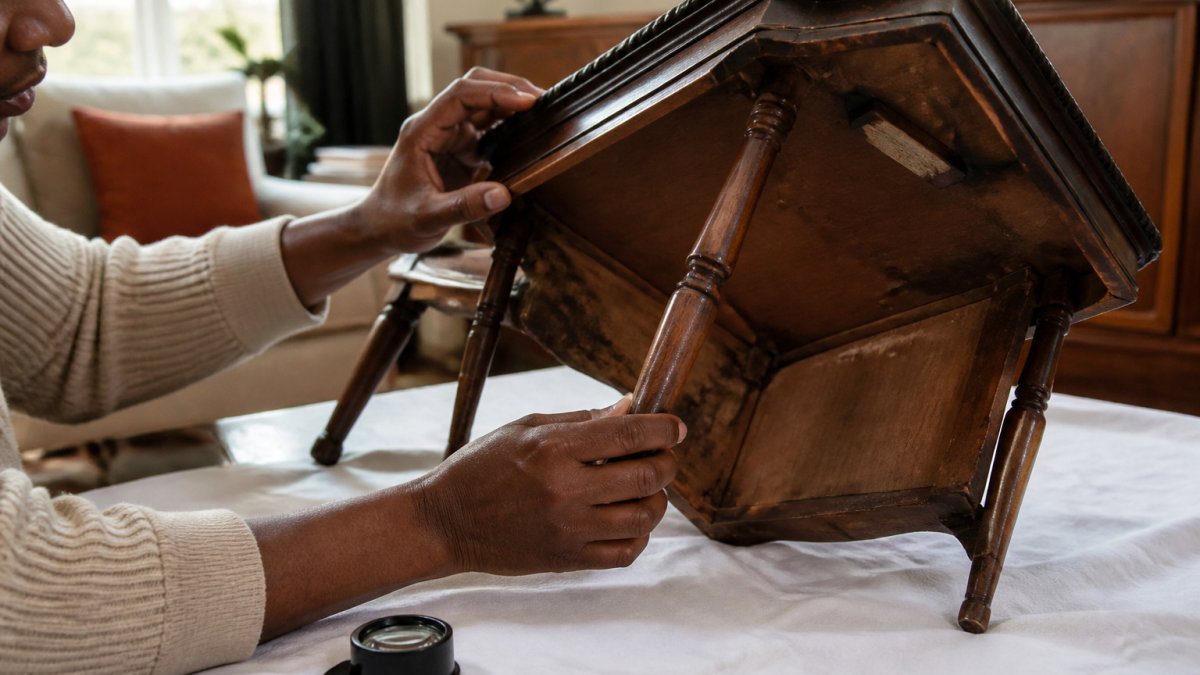
Look closely at how the piece was made. Hand-cut joinery, hand-painted details, and uneven wear that follows years of use all point toward older craftsmanship. Modern reproductions often use laminate, particleboard, or uniform machine finishes.
!Close-up of a person's hands examining the underside of a wooden side table in a sunlit living room, with a magnifying loupe resting nearby
Age, Maker's Marks, and Provenance
A maker's mark, stamp, or label can raise a piece's value considerably. Record every mark you find and photograph it under good light. If you can't find one, that doesn't rule out value, but it does make the piece harder to verify.
Provenance is the documented history of ownership. A receipt, an estate record, or a family story with dates adds credibility. Without it, buyers usually discount the price to account for the risk.
Condition, Wear, and Restoration Decisions
Condition is often the largest factor in resale price. Original finish with honest, even wear usually sells better than a piece that has been heavily refinished. Cracks, missing pieces, and water damage lower value, sometimes sharply.
Restoration is a judgment call. A professional repair can make a damaged piece sellable, but the cost may exceed the value gained. For most sellers, cleaning and stabilizing a piece beats a full restoration. Document any work you do, because buyers want to know exactly what was changed.
Valuable Vintage Home Decor Items to Look For
Some categories of decor tend to hold interest better than others. Solid wood furniture with original hardware, signed or marked ceramics and porcelain, and well-made brass pieces are common examples. Sculptural mid-century and early-twentieth-century objects also draw collectors.
Items that are mass-produced, heavily reproduced, or in poor condition rarely command premium prices. Focus your time on pieces where the materials, maker, and condition all point in the same direction.
How to Value Antique Decor: A Practical Resale Workflow
Most guides tell you to "check comparable sales" and stop there. What they skip is the actual sequence: how to move from an unidentified object to a defensible asking price without overpaying for appraisals or overpricing the listing.
Step 1, Identify before you value. Photograph the piece from six angles, including the underside, the back, and every joint. Record dimensions and weight. Note materials, construction method, and any marks. Identification errors are the single most common cause of bad valuations: a piece misattributed to a maker can be priced at several times its real market. If you cannot identify the maker, describe the piece by category, period style, and material instead of guessing at a name.
Step 3, Pull completed sales, not asking prices. Search sold and realized listings on marketplaces and auction result archives for the same category, maker, and period. Collect at least five to ten comparables. Record the sale date, the final price, the condition grade, and whether the piece was complete.
Step 4, Adjust for differences. A comparable in better condition, with original hardware, or with documented provenance is worth more than your piece; one that is refinished, incomplete, or unmarked is worth less. Apply a percentage adjustment for each meaningful difference and write down your reasoning.
Become a part of our AAE family and start fundraising today! →
Step 5, Set a realistic asking price. Anchor your asking price slightly above your adjusted comparable range to leave room for negotiation, but not so far above that the listing goes stale.
Step 6, Subtract selling costs to get net proceeds. Fees, shipping, packing materials, insurance, and your time all reduce what you keep. Estimate them before you list, not after.
Using Completed Sales Instead of Asking Prices
Asking prices show what sellers hope to get; completed sales show what buyers actually paid. The gap between the two is often large, especially for decorative objects where listings can sit for months. When you pull comparables, note whether each figure is an asking price, a best offer, or a realized sale, and weight realized sales most heavily. If a category has few completed sales, widen your search to adjacent categories and adjust downward for the uncertainty rather than treating an asking price as a sale.
A Worked Pricing Example
Suppose you have a marked brass table lamp in good condition with original shade. You find five completed sales for similar marked lamps: two at $180, two at $220, and one at $260, all in excellent condition. Because your lamp is in good rather than excellent condition and the shade is original but worn, you adjust the range down by roughly 15%, landing at about $155 to $220. You set an asking price near the top of that range to leave negotiation room, then subtract marketplace fees, packing, and shipping to estimate net proceeds before deciding whether the sale is worth the effort. The numbers will differ for every piece, but the sequence, identify, grade, compare, adjust, price, net, stays the same.
Where to Sell Vintage Home Decor and What You Keep
Two sellers can list the same lamp at the same price and walk away with very different amounts. The difference is the channel: each one takes a different cut, reaches a different buyer pool, and shifts shipping and risk in a different direction. Compare channels on net proceeds, not headline price.
Online marketplaces. The largest buyer pool and the easiest way to reach collectors outside your area, but fees, payment processing, promoted-listing costs, and shipping all come out of the sale. Bulky furniture is expensive to ship and prone to damage claims, so many sellers restrict online sales to smaller decor.
Local sales and in-person marketplaces. No shipping and no platform fee in many cases, and buyers can inspect the piece before paying, which reduces disputes. The trade-off is a smaller buyer pool and more time spent coordinating.
Consignment shops and dealers. They handle marketing, storage, and buyer traffic, but typically take a substantial share of the sale price and may set the price themselves. Consignment works best for pieces that need display space or a specialist buyer, and it shifts the time cost off you.
Auctions. Strong for rare, signed, or highly collectible pieces where competitive bidding can push the price above retail expectations. Auction houses charge seller's commissions and may charge buyer's premiums that affect final demand, and results are uncertain, a piece that draws no bids may sell below your comparable range.
Estate-sale companies. Useful when you are clearing a whole collection rather than selling one piece. They take a commission but handle pricing, staging, and buyer traffic, which can be worth it when volume is high and your time is limited.
Selling Costs That Quietly Reduce Your Return
The costs that surprise sellers most are the ones that do not appear in the listing fee: packing materials for fragile ceramics and glass, shipping insurance, return shipping if a buyer disputes condition, restoration or cleaning before listing, storage while the piece waits for a buyer, and the hours spent answering messages and coordinating pickup. For lower-value pieces, these costs can exceed the sale price, which is why a worksheet that estimates net proceeds before listing is worth more than any single pricing tip.
The channel you choose changes what you keep, so compare the main options on net proceeds rather than headline price.
| Channel | What it costs you | Best for |
|---|---|---|
| Online marketplaces | Fees, payment processing, promoted listings, shipping | Smaller decor and buyers outside your area |
| Local sales | Little or no fee, your time coordinating | Heavy furniture, where shipping would eat the margin |
| Consignment shops and dealers | A substantial share of the sale price | Pieces needing display space or a specialist buyer |
| Auctions | Seller's commission, possible buyer's premium, uncertain results | Rare, signed, or highly collectible pieces |
| Estate-sale companies | A commission | Clearing a whole collection with high volume |
Deciding Whether Your Piece Is Worth Selling
Sell when the estimated net proceeds justify the effort and the piece is unlikely to appreciate meaningfully on its own. Keep pieces with strong personal or family value, even if their resale price is modest. For everything else, a clear worksheet will tell you whether a sale makes sense.
If you're sorting through decor and want to find pieces that reflect Black heritage, our African American Expressions catalog offers culturally inspired home decor, art, and gifts. Browse our selection on African American Expressions to see what's available.
Frequently Asked Questions
How can you tell whether antique-style home decor is worth anything?
Start by checking whether the piece has a maker's mark, a date, or documented provenance, since these change value more than style alone. Then look at completed sales of similar items on marketplaces, not current listings, because asking prices run higher than what buyers actually pay. Condition matters a great deal: visible damage, replaced parts, or heavy restoration usually lower the price. If a piece has none of these markers and sells for little in completed sales, it is likely decorative rather than valuable. A written comparison of three or four recent sales gives a more reliable estimate than any single listing.
Where is the best place to sell vintage home decor?
The best channel depends on the item's value and your time. Online marketplaces, local consignment shops, estate sales, and auction houses are possible channels. Compare net proceeds after fees and shipping, not the gross sale price, before choosing a channel.
Does antique-style decor have resale value if it is not a genuine antique?
Antique-style reproductions usually resell for much less than genuine period pieces, and many reproduction items sell only at or below their original retail price. Buyers pay for authenticity, so a piece sold as vintage but later identified as a reproduction can damage your reputation and trigger refunds. Be accurate in your listing: describe it as antique-style or reproduction when that is what it is. Honest, accurate descriptions tend to sell more reliably than inflated claims about age.
How should you price antique-style decor for resale?
Price by reviewing sold listings for comparable items, adjusted for condition and completeness. Start slightly above the lowest recent sold price if the piece is in excellent condition, and be ready to negotiate. Factor in fees, packaging, and shipping before settling on a final price, so your net return stays acceptable. Keep notes on what sells and how quickly, and revise your pricing based on actual sales over several weeks.
