

Table of Contents
- The Economic Power of Black-Owned Brands
- Black History Month Gift Ideas That Support Community
- How to Find Black-Owned Businesses and Verify Authenticity
- Supporting Black Businesses Year-Round: Beyond Seasonal Spending
- Black-Owned Business Fundraising Programs for Schools and Churches
- Closing the Wealth Gap Through Consumer Activism
- Conclusion
Last Updated: August 28, 2026
The Economic Power of Black-Owned Brands
Black-owned brands are engines of wealth creation, employment, and economic resilience. According to The BBX's 2024 business data, there are over 3.7 million Black-owned businesses in the United States, making up 11.3% of all businesses. The number increased by 28% from 2021 to 2024, demonstrating accelerating entrepreneurial momentum.
Black-owned businesses generate approximately $183.3 billion in annual receipts and employ nearly 1.4 million people. Between 2017 and 2023, Black-owned employer businesses grew by 62%, outpacing overall U.S. employer business growth of just 3.3%, according to Brookings Institution's 2026 research on Black entrepreneurship. In 2023 alone, Black-owned employer firms generated $249 billion in revenue, supplied over 1.8 million jobs, and paid out $69.8 billion in salaries.
When you choose Black-owned brands, you participate in wealth creation and economic mobility. At African American Expressions, we've spent 34 years helping communities understand that supporting Black-owned businesses strengthens neighborhoods through job creation, reinvestment, and generational wealth building.

Black History Month Gift Ideas That Support Community
Black History Month provides a natural moment to celebrate and support Black-owned brands, though the impact extends year-round. When you purchase culturally meaningful gifts from Black-owned businesses, you invest in artisans and entrepreneurs who pour their heritage into their work.
The Fund for Social Equity's 2025 consumer research found that when Black-owned brands market themselves as certified Black-owned businesses, consumer likelihood to purchase rises as much as 30%. Nearly half (48%) of consumers are willing to pay a premium for products displaying authenticity and cultural integrity.
African American Expressions offers curated collections for this purpose. The Black History Wired Journal ($13.00) features Thomas Blackshear's intricate Black art depicting Barack Obama, Frederick Douglass, Mary McLeod Bethune, and Sojourner Truth, a daily reminder of legacy and excellence.

For deeper impact, consider the Harriet Tubman Relief Art ($240.00) by renowned Black artist D.D. Ike. This striking piece transforms living spaces while honoring courage and determination.
The Black History Puzzle ($18.00) offers family engagement with educational value, depicting the journey from slavery to the White House.
How to Find Black-Owned Businesses and Verify Authenticity
Finding authentic Black-owned businesses requires verification beyond simple searches. The premium consumers willingly pay only creates real impact when the business is genuinely Black-owned and operated.
Official Certifications and Verification Standards
Start with official certifications. The ByBlack: Certified Prosperity for the Next Generation seal verifies ownership and commitment to community reinvestment. Other recognized certifications include the National Minority Supplier Development Council (NMSDC) certification for B2B procurement and state-level minority business enterprise (MBE) certifications requiring documented proof of Black ownership and control.
Ask to see documentation. Legitimate Black-owned businesses can point to ownership registration documents, business licenses, and corporate filings clearly identifying Black ownership. Secretary of State filings are public records, you can verify ownership structure yourself without relying solely on company claims.
Supply Chain Transparency and Ethical Sourcing
Investigate where products originate and how they're made. Black-owned brands increasingly publish supply chain information detailing minority-owned supplier sourcing, manufacturing locations, and labor standards. Ask specific questions: Are raw materials sourced from other Black-owned suppliers? What percentage of the supply chain is minority-owned? Are workers paid living wages with documented benefits?
For fashion and apparel, look for domestic production or certified fair-trade manufacturers. For beauty products, verify ingredient sourcing and in-house formulation. For home goods and art, confirm whether items are handmade by credited artisans or mass-produced and resold. These distinctions determine whether your purchase funds individual creators or simply moves inventory through a Black-owned retail channel.
Ownership Structure and Profit Distribution
Black-owned means Black people control the business, make strategic decisions, and retain profits. Ask: Who holds majority ownership? Are decisions made by Black executives or outsourced to non-Black management? What percentage of profits stay within the business for reinvestment?
Businesses with outside venture capital or private equity backing may retain Black founders as figureheads while ceding control to non-Black investors, limiting wealth accumulation for the Black community. For family-owned businesses, verify that ownership and decision-making authority remain within the family. For cooperatives and employee-owned models, confirm that Black workers hold meaningful equity and voting power.
Community Reinvestment Verification
Look for businesses that sponsor local events and maintain visible community presence. Move beyond surface-level sponsorships to verify actual impact. Ask: What percentage of annual profits return to the community? Can they document measurable outcomes, students served, dollars invested in local nonprofits, jobs created in underserved neighborhoods?
Established brands with deep community roots are your safest bet. African American Expressions, operating for 34 years, maintains direct relationships with schools, churches, and community organizations, transparency built over decades of consistent service.
Supporting Black Businesses Year-Round: Beyond Seasonal Spending
The most powerful consumer activism happens when support extends beyond February. Seasonal purchasing creates temporary spikes but doesn't build sustainable economic momentum.
Black women are starting businesses at a higher rate than any other demographic group, accounting for 42% of all new women-founded businesses, according to The BBX's 2024 entrepreneurship data. This explosive growth creates year-round opportunities to support innovation and leadership across every sector.
Integrate Black-owned brands into your regular purchasing patterns. If you buy journals, choose from Black-owned stationers. If you purchase home decor, prioritize Black artists. If you need gifts, default to Black-owned options first.
Build relationships with specific businesses and creators. Follow their social media, sign up for newsletters, and understand their product development cycles. Recommend Black-owned brands to your network, word-of-mouth remains the most powerful marketing tool. minority-owned food businesses.
Black-Owned Business Fundraising Programs for Schools and Churches
Schools and churches serve as community anchors. Fundraising programs that partner with Black-owned businesses align financial goals with community values, creating win-win outcomes.
African American Expressions has structured its fundraising program specifically for these institutions. Organizations earn 40% on every sale, a margin reflecting genuine partnership. A school selling $1,000 in products earns $400 in direct revenue. Scale that across a year-long campaign, and you're talking about meaningful fundraising without requiring staff to work outside their core mission.
Become a part of our AAE family and start fundraising today! →
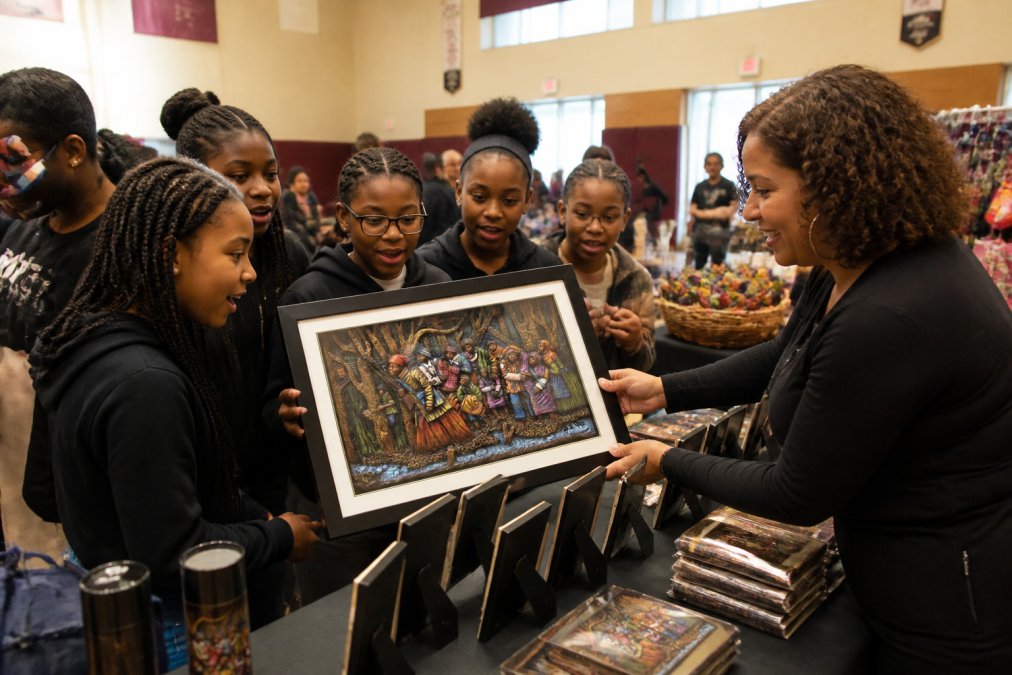
African American Expressions handles inventory management, fulfillment, and quality control. Your organization focuses on sales and community engagement. The program scales because it's built on direct relationships and flexible participation rather than rigid quotas, working with churches and schools of all sizes.
Closing the Wealth Gap Through Consumer Activism
Consumer activism represents a direct mechanism for narrowing the racial wealth gap by redirecting capital flows toward Black-owned businesses.
The Capital Access Disparity
According to the Federal Reserve Banks' Small Business Credit Survey, 41% of Black business owners applying for loans were denied, compared to just 18% of white business owners. Even with stronger financial profiles, only 20% of Black business owners were fully approved for funding versus 58% for white business owners. When approved, Black business owners receive smaller loan amounts and face higher interest rates, approximately 30% smaller than for white-owned businesses.
This funding gap limits capacity for inventory expansion, hiring, technology investment, and geographic scaling, the mechanisms through which businesses build equity and generational wealth.
How Consumer Spending Bypasses Systemic Barriers
Consumer purchasing decisions bypass these systemic barriers by providing direct revenue that doesn't require loan approval. When you choose a Black-owned brand, that revenue immediately enters the business as working capital.
A $50 purchase generating $20 in gross profit (at typical 40% retail margins) can be immediately reinvested: purchasing inventory, hiring staff, upgrading technology, or expanding locations. Each reinvestment cycle compounds, accelerating business growth without the debt burden constraining Black entrepreneurs accessing traditional financing. Over five years, consistent consumer support can transform a $500,000 annual revenue business into a $2 million operation, growth funded through customer loyalty rather than bank loans.
Quantifying Community Wealth Accumulation
Black consumers represent over $370 billion in spending across consumer packaged goods, general merchandise, and quick-service restaurants, accounting for nearly 12% of total spend. If even 10% of that spending ($37 billion annually) redirected to Black-owned businesses, the economic impact would be transformative.
That profit would fund hiring, each $50,000 salary creates a job. At that wage level, $14.8 billion in gross profit supports approximately 296,000 new jobs. Those employees spend 70% of their income locally, generating secondary economic activity. Their families build home equity and their children attend better-resourced schools.
The Federal Reserve's Survey of Consumer Finances shows the median white family held approximately $188,000 in net worth while the median Black family held approximately $24,000 in 2023, a ratio of 7.8:1. Consumer activism targeting Black-owned businesses directly addresses this disparity by funding the business ownership pathway.
Long-Term Reinvestment and Community Development
Locally-owned Black businesses typically reinvest 60-70% of profits back into operations, hiring, and community initiatives, according to research from the American Independent Business Alliance. A Black-owned business generating $1 million in annual profit and reinvesting $700,000 builds business equity while funding community development. Over ten years, that business accumulates $7 million in reinvested capital, capital that stays within the community and creates ownership opportunities for the next generation.
Black women starting businesses at 42% of all new women-founded businesses create year-round opportunities to support innovation and leadership. When these emerging businesses receive consistent consumer support, they scale faster and accumulate wealth more quickly than businesses dependent on traditional financing.
The Compounding Effect of Consistent Consumer Activism
Consumer activism isn't a one-time purchase, it's sustained redirection of spending patterns that compounds over years and decades. When you integrate Black-owned brands into regular purchasing patterns, you fund an ecosystem of entrepreneurship, employment, and wealth creation.
The wealth gap isn't inevitable. It's a product of specific policy choices and market dynamics that can be shifted through deliberate action. Consumer activism, choosing Black-owned brands consistently, represents one of the most accessible forms of economic intervention available to individuals, funding hiring, business expansion, and generational wealth transfer.
=== FAQ ANSWERS (audit these too, same rules) ===
[1] Q: Why does it matter if I buy from Black-owned brands? A: When you choose Black-owned brands, your spending directly supports economic empowerment and wealth creation in Black communities. Black-owned businesses employ nearly 1.4 million people and generate approximately $183.3 billion in annual receipts. Consumer awareness of minority ownership increases purchasing intent by up to 30%, and nearly half of consumers are willing to pay a premium for certified Black-owned products. Your choices help close systemic wealth gaps and foster long-term economic resilience.
[2] Q: How can I verify that a business is actually Black-owned? A: Look for third-party certifications like the 'ByBlack: Certified Prosperity for the Next Generation' seal or check if businesses are registered with the U.S. Black Chambers. Request documentation of ownership and leadership. Established Black-owned brands often display their heritage prominently on their websites and packaging. Research the founder's background through company history sections and press releases. Authentic Black-owned businesses are transparent about their ownership structure and mission to support the community.
[3] Q: What is the impact of supporting Black-owned businesses on the economy? A: Black-owned employer businesses generated $249 billion in revenue in 2023, supplied over 1.8 million jobs, and paid out $69.8 billion in salaries. Between 2017 and 2023, Black-owned employer businesses grew by 62%, far outpacing overall U.S. employer business growth of 3.3%. This growth drives community reinvestment, creates local jobs, and builds wealth that stays within communities. Supporting these businesses strengthens the inclusive economy and demonstrates that market inclusivity generates measurable economic development.
[4] Q: How can I find Black-owned brands to support year-round? A: Start with certified directories like the U.S. Black Chambers business finder and the 'ByBlack' marketplace. Follow Black-owned businesses on social media to discover new brands and stay informed about their products. Research company websites for founder stories and ownership information. Join community groups and local business networks that highlight Black entrepreneurs. Brands like African American Expressions offer curated collections of culturally inspired gifts and home decor, making it easy to shop intentionally while supporting established Black-owned businesses with decades of community impact.
Frequently Asked Questions
Why does it matter if I buy from Black-owned brands?
When you choose Black-owned brands, your spending directly supports economic empowerment and wealth creation in Black communities. Black-owned businesses employ nearly 1.4 million people and generate approximately $183.3 billion in annual receipts. Consumer awareness of minority ownership increases purchasing intent by up to 30%, and nearly half of consumers are willing to pay a premium for certified Black-owned products. Your choices help close systemic wealth gaps and foster long-term economic resilience.
How can I verify that a business is actually Black-owned?
Look for third-party certifications like the 'ByBlack: Certified Prosperity for the Next Generation' seal or check if businesses are registered with the U.S. Black Chambers. Request documentation of ownership and leadership. Established Black-owned brands often display their heritage prominently on their websites and packaging. Research the founder's background through company history sections and press releases. Authentic Black-owned businesses are transparent about their ownership structure and mission to support the community.
What is the impact of supporting Black-owned businesses on the economy?
Black-owned employer businesses generated $249 billion in revenue in 2023, supplied over 1.8 million jobs, and paid out $69.8 billion in salaries. Between 2017 and 2023, Black-owned employer businesses grew by 62%, far outpacing overall U.S. employer business growth of 3.3%. This growth drives community reinvestment, creates local jobs, and builds wealth that stays within communities. Supporting these businesses strengthens the inclusive economy and demonstrates that market inclusivity generates measurable economic development.
How can I find Black-owned brands to support year-round?
Start with certified directories like the U.S. Black Chambers business finder and the 'ByBlack' marketplace. Follow Black-owned businesses on social media to discover new brands and stay informed about their products. Research company websites for founder stories and ownership information. Join community groups and local business networks that highlight Black entrepreneurs. Brands like African American Expressions offer curated collections of culturally inspired gifts and home decor, making it easy to shop intentionally while supporting established Black-owned businesses with decades of community impact.
This article was written using GrandRanker